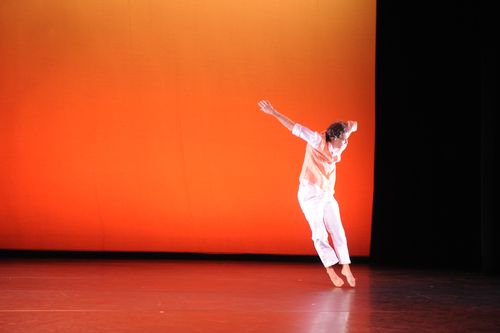
Hometown: Sacramento,
CA
Current city: Los
Angeles, CA
Age: 42
College and degree: California
State University, Fullerton, BA 1994
Graduate school and degree: University of Utah, MFA in
Modern Dance 1996 (age 24-26)
How you pay the bills: Professor and Chair of Dance at Loyola Marymount University
All of the dance hats you wear: Dance
Administrator, Professor, Dancer, Choreographer, Producer, Mentor
Non-dance hats you wear: Husband, Brother, Uncle, Son, Friend
————————————————-
Describe your dance life in your….
20s: I was a
college student until I was 24. I
paid for college myself by working and taking out loans. For most of my 6 years I was working 30
hours a week evenings and weekends, and so there were several semesters when I
worked and danced more and enrolled in fewer classes.
I married in August 1994 and moved to Salt Lake City to accept a full
scholarship at the University of Utah.
For the first time ever, I was a full time student and had the luxury of
focusing exclusively on school.
This would not have been possible if not for my wife agreeing to work
full time and support us.
After I graduated in 1996, I joined the Ririe-Woodbury Dance Company
and toured the US for two years. As
a married person and confirmed home-body, touring did not agree with me, so I
left the company in 1998 to move back home to California.
I took a position as a part time teacher at Orange Coast College (2
classes), got a job at Chili’s Restaurant as a server, and joined the dance
company Tongue. Also, at this time
Ann and I moved in with her mother, who was recently divorced. We lived there for two and a half years
while Ann went back to school full time to get her teaching credential.
Over the next 2 years I held positions of varying levels of commitment
at five different 2 and 4 year colleges teaching modern dance, choreography,
improvisation, and dance conditioning, as well as choreographing for various
productions and directing dance concerts.
At one time, I literally worked for 5 colleges, rehearsed 25 hours a
week at a 6th campus and was driving over 600 miles a week. At this point I was working 6-7 days a
week and spending up to 20 a day away from home.
30s: At 31 I
became a full time Professor at Loyola Marymount University, a position I still
hold.
I continued in Tongue for 2 more years.
At 32, I left Tongue to freelance as a performer and to start my own
Company, Palindrome Performance Group. As a freelance performer, I received a Horton Award for
performance for Joe Goode’s Native Son, as
well as an ensemble award for Leaving
Evidence by Loretta Livingston.
As the director and dancer
in Palindrome, I received two more Horton Awards. For Choreography for 4 Inches to the left (2003) and
Performance of Manifold (2007).
At 37 I was granted Tenure and Promotion in rank to Associate Professor
at LMU.
40s: At 41, I
was elected Chair of the Dance Department, Loyola Marymount University. At 42 I applied for promotion in Rank to Full Professor (results pending).
On training and care of the body…..
Try to enjoy it. Do not
let living a healthy lifestyle, proper diet, regular exercise, attending a
variety of classes, seem like work.
It should feel good to take care of your body.
I turn 43 this year and I have a goal of being in better shape at 43
than I was when I was 30. I work
out 60 minutes 4 days a week (cardio, weights, and core work), jog once or
twice a week (40 minutes/4 miles), take 1-2 yoga classes (generally flow for
flexibility purposes) and play basketball for 90 minutes each week………..Oh yeah,
I dance, too!
Non-dance movement practices important to you include…..
Weight training, jogging, yoga, basketball
The role of teaching in your dance career:
It’s my full time job!
Teaching Modern Dance at the collegiate level is all I’ve ever wanted to
do.
Advice to young dancers on teaching, the role of teaching in
their dance lives ahead, and becoming a well-prepared teacher:
Pay attention to how your teachers approach crafting a class, a week of
classes, a semester of classes. Structure and scaffolding are important. LISTEN to how they offer feedback,
LISTEN to the feedback they receive.
Don’t be afraid to ask for what you need.
Mostly, though, I feel you’ll learn to be a teacher by teaching! No amount of prep can prepare you for
your first class. It’s scary and
fun.
On commuting:
IT SUCKS!!!! Thank God for
podcasts!
I still drive 500 miles a week, as I have chosen for 13 years to live near
family rather than near school. I
get up at 4:45 and leave the house at 5:45 and get to school by 7. I can usually leave school by 3 and get
home by 4:30. I eat an early
dinner and read or watch TV until about 8:45 and I am in bed by 9 (on non
rehearsal/performance nights).
Perks at your job:
-Full medical/dental and a great retirement plan
-Time to have coffee with students and friends
-A beautiful campus
-I LOVED college, and have never left it!
An idea from your college or grad school years that you
still think about/apply:
Be more dedicated, enthusiastic, motivated and passionate about this
project than you were on the last.
Leave any situation better than you found it.
College course or grad course that made the most impact on
your career path:
Sally Fitt’s Dance Kinesiology class. This was the class that made me want to be a teacher.
Working for Abby Fiat in her dance INCLINATIONS in 1994. This experience turned me into a
professional. Abby’s expectations,
clarity, artistry and humanity taught me about professionalism, dedication and
respect for the artform.
Working with Jude Clark-Warnisher in a variety of dance projects as an
undergrad. She is a visionary
artist who valued her students and peers in a way that was inspirational and
motivational. I wanted to work
hard to become even half the choreographer she was!
Your growth as a dancer or choreographer over time:
Trusting my process has become key to my success. It took me a long time to identify
the specifics of my process. Once
I gained clarity in this area, the work started to flow.
At about age 37, I realized I choreographed differently than I lived,
and I needed to engage in a process that reflected who I was, rather than a
process that imitated that of artists I’d admired and worked with.
In the beginning I’d walk into the studio and try to make choreography
appear from nowhere. In time, and
after many less than stellar works, I came to realize the folly of “making a
dance,” by that I mean jumping straight into the craft of choreography before
taking time to develop the raw material of movement phrases. There was little organization,
structure, or planning. I hoped
that inspirational material would spring fourth and flow freely from me to the
dance. This lack of a cohesive
plan was totally counter to my personality and lifestyle (I have been told that
I have a touch of OCD and that I tend to over-organize, compartmentalize, and
attempt to maintain order.) I have
no problem with any of these traits and actually find my compulsive need for
organization to be traits worth celebrating.
SO, I needed to develop a process for making art that celebrated these
traits.
I began to identify a creative process in which movement is developed,
more movement is developed, and even more movement is developed. Once I have a rich palette of varied
material, I then can begin to craft it according to the voice and vision of the
work. I am not precious about the
material at this time and regularly modify or delete large chunks of
material. It is during this phase
that choreography begins to emerge and can be analyzed and reflected upon for
revision, re-vision, and ultimately, completion.
Interestingly, the process is clean and neat, though the work rarely
is. My work continues to have the
edge, humor, and physicality it always did; it’s just easier to make now.
Future career goals:
14 more years as Chair of dance at LMU, retire at 56. Yoga, golf, playing the piano, and
making my wife laugh for the rest of my days!
Books, websites, blogs, shows that serve as inspiration:
Art and Fear by David Bayles
and Ted Orland, an amazing book for all artists that reminds us the normal
people make great art.
The Power of One by Bryce
Courtney, a great novel about one man’s journey from childhood to young
adulthood. I am inspired by all he
had to overcome. While my journey
was nowhere near as epic as his, I’ve overcome a lot of obstacles to get to
where I am.
Groundhog Day starring Bill Murray and Andie MacDowell, just an
amazingly funny film that is about one man’s ability to change.
Advice to young dancers:
Don’t worry so much. I
live a relatively stress free existence, not because I do not have problems to
deal with, but because I CHOOSE to live a relatively stress free existence.
Here is how it works. Each day you have a list of things to do,
figuratively and/or literally. You
can wake up and check the list for the day and say,
“Holy Crap, that’s a TON of stuff to do!”
Then you get all balled up over it, generate anxiety, break out in a
cold sweat, get a stress headache and a bladder infection, and then get to
work.
OR you can look at the list and say,
“Holy Crap, that’s a TON of stuff to do!”
Then you take a deep calming breath, look at the first thing on the
list and get to work.
Either way, the list has to be tackled. You can decide to put yourself in a mindset that allows for
you to work at your best, or you can put yourself in a mindset that has you
working at far below your best.
It’s up to you.

 Life as a Modern Dancer
Leave a comment