
Photo Credit: Jo Kreiter/Flyaway Productions
Hometown: I grew up in Marlboro, NJ
Current city: I live in New York City, and work in New Brunswick
and Princeton, NJ
Age: 37
College and degree: Princeton University, Bachelors in Sociology
with minors in Women’s Studies and Theater and Dance
Graduate school and degree: MFA in Dance from The Ohio State University – I attended right out of
college, so I was 21; I went back to get my MBA at the Graduate School of
Management, University of California, Davis when I was 32.
Website: www.arballet.org
How you pay the bills: Managing Director of American Repertory Ballet
All of the dance hats you wear: I just wear one hat these days, but it’s a pretty big
hat. As Managing Director, I
oversee all aspects of the $3.3 million organization. Our operations include a professional company of 16 dancers
who perform approximately 30-35 public performances per year under the Artistic
Direction of Douglas Martin; the affiliated Princeton Ballet School, which runs
about 70 classes per week and has around 50 faculty members, 15 accompanists
and 1200 students in 3 locations throughout Central New Jersey; and our Access
and Enrichment programs which offer residencies, assembly programs, master classes
and lecture/demonstrations to the community. I set the strategic plan, in collaboration with my Board of
Trustees, then I oversee the team that executes all the goals that will move
that plan along – all while maintaining a balanced budget. I am also the de facto Marketing
Director for the organization, which means I’m also responsible for overseeing all of our traditional and new media campaigns, which involves a lot of graphic
design, media buys, web maintenance, etc. I’m also deeply involved in the fundraising for the
organization, and am responsible for contracting, legal matters, and the many other
operational issues that may arise.
Occasionally, I jump into “active dance” roles like
substitute teaching, making a cameo in our productions (I’m a regular Mother
Ginger in The Nutcracker each year). I worked with Rider University, with
whom Princeton Ballet School has a partnership, and conducted master classes in
Contact Improvisation, and I was commissioned to choreograph a piece for their
students last year.
———–
Describe your dance
life in your 20s and 30s. Can you talk about performing, getting 2 different
masters degrees, and heading into arts administration? In terms of your
performing work, how did you land your various gigs? Was it auditions, being
seen in class, taking a workshop, etc?
While I was earning my MFA at Ohio State, I took a class
with Jo Kreiter, who was there as a Guest Artist. Her work physically and philosophically clicked with
me. Like me, Jo is a former gymnast
and feminist, and she, through her company Flyaway Productions, makes
apparatus-based and aerial work that often contain themes of female
empowerment. She choreographed a
solo for me, and afterwards she asked me to be in her project, “Copra Dock
Dances” out in San Francisco. I said yes, and soon found myself in San
Francisco mid-semester (at that point, I was doing a lot of “independent
study,” so I had the freedom to jump at this opportunity). In the piece, we harnessed ourselves to
the side of an industrial crane and performed 20, 30, 40 feet above the
ground. We had to row (or
tightrope walk, but I usually chose the row boat) out over the Islais Creek in
order to rehearse each day on the crane.
I’d never done anything like it before. I stayed with a friend who had a loft in West Oakland and
took class every day at ODC (Oberlin Dance Collective) before rehearsal. That was my first San Francisco gig.
Once I was finished with my MFA at Ohio State, I moved out
to Oakland and started working with Jo and Flyaway Productions. We began work on
“Maybe Grief is a Good Bird Flying Low” which was first created in residence at
SomArts, then premiered at the Forum space in Yerba Buena Center for the Arts,
both in San Francisco. Jo also
hired me to do administrative work for her. I helped out with database management and some grant writing. This helped “pay the bills,” but also
gave me a good introduction to arts administration. It was great to move out west with some tangible work already
lined up, so I was really lucky in that way.
During these first couple of years in the Bay Area, I lived
right near Shawl-Anderson Dance Center and Berkeley Ballet, so in addition to
taking class at ODC, I also started taking class regularly at these studios.
Through those classes (notably modern with Randee Paufve, Nina Haft, and Sima
Belmar and ballet with Charles Anderson and Sally Streets), I met a world of
people who brought me into “the scene.” Nicole Richter brought me into AXIS
Dance, which then led me to work with Eric Kupers and Dandelion Dancetheater,
which in turn led me to Kristin Heavey and Element Dance Theater. Randee Paufve and Sima Belmar also cast
me in their work.
The modern dance scene in the Bay Area was, for me, very
welcoming and easy to “break into,” but it was also very piecemeal and
project-to-project. So, I
supplemented my income in a variety of ways. Mostly, I taught a
lot. I worked as an
Artist-in-Residence in public schools through Performing Arts Workshop and the
Museum of Children’s Art, and as a freelance artist at many other private and
Montessori schools teaching creative movement, gymnastics and rock climbing
through in-class and afterschool programs. I wrote for an online publication and occasionally for the
Oakland weekly publication. In
addition to the administrative work I did with Flyaway Productions, I began
doing similar work for AXIS Dance Company. I also taught dance each summer in Alaska at the Sitka Fine
Arts Camp with an incredibly talented group of widely regarded artists in many
fields. It was always an intense,
inspiring and incomparable experience.
So generally, during these years, I kept busy doing a lot of different
things.
A few years later, I was “home for the holidays” back in New
Jersey, and I saw that STREB was having an audition. I didn’t have any plans that day, and I figured it would be
an interesting master class. I had
seen STREB perform at The Joyce (NYC) in the mid-90s and liked it well enough,
but at the time didn’t feel incredibly drawn to the company. I was still very close to my gymnastics
career, and aspired to do movement that was more “dance-y,” where I could move
lushly through my spine, and partner sinuously with others. STREB was not that, so it fell off my
radar until I saw the audition post.
I took the train over to Williamsburg and entered Elizabeth’s brand new
warehouse. It was cold. And dirty.
We started the audition by learning PopAction technique – a cerebral and highly
physical series of actions; then we learned some sequences from the company’s
repertory – all involving partnering, split-second timing, trust, acrobatic
skills, and an ineffable performative quality; and then we were catapulting
ourselves up walls, hanging and swinging off trusses, and diving off of
platforms – landing on every different surface imaginable – flat on our
stomachs, our backs, our shins, hamstrings – and, most incredibly, doing it
without getting hurt. It was very
satisfying!
The audition was to be 3-days, but after the first day, I
was so sore I couldn’t lift my arms. Since I had no intention of actually joining
the company, I didn’t return to the second or third day. To my surprise, Elizabeth called me that
afternoon to ask why I hadn’t returned.
I explained that I lived in San Francisco and was just home for the
holidays. I was deeply committed
to the companies I was working with, and had a lot of exciting productions
coming up (including Flyaway’s “Mission Mural Project” and a season with AXIS
where I would get to perform works by Bill T. Jones, Stephen Petronio, Sonya
Delwaide, and other amazing choreographers). I thanked her for the wonderful
experience, and expressed my genuine admiration for her and the company’s work
(I didn’t mention how sore I was!).
When I returned to the Bay Area after the holidays, I kept
thinking a lot about the STREB audition.
I was smitten with the whole experience – the movement, the impact, the
required skill set that just happened to perfectly match mine, the sense of
accomplishment that emerged from every action, the adrenaline rush I felt when
I knew my timing and focus had to be absolutely exact. I knew it was something I needed to do. So, I started wrapping up
projects and not signing up for new ones.
Once I was finished with the projects I had committed to, I picked up
and moved – a stereotypical “follow your dreams, leap before you look” move.
Luckily, I had a safety net in my family, whom I leaned on heavily
during this transition. I initially
stayed with my aunt on the Upper West Side and started furiously taking classes
at STREB. Hedging my bets, I also
took class at all the other places you were suppose to go to in order to “be
seen” – Dance Space (now Dance New Amsterdam), Mark Morris, Movement Research,
etc. I took workshops, and even
flew out to Paris to audition for DV8 (another company whose physicality and
daring I was drawn to at the time).
Again, I picked up work teaching in public schools, and did some website
work for the Princeton Club of New York to pay the bills. However, once I saw STREB’s SLAM show
(her home season), I became even more obsessed with getting in the company.
In retrospect, I feel so honored to have taken classes with
Elizabeth during this period (though those few months felt like an eternity
when I was in limbo). She has not
regularly taught technique classes since, so essentially I was in the last
generation of dancers to have trained with Elizabeth, herself, in PopAction
technique. Years later, when I was
teaching these classes myself, Elizabeth would sometimes take my class. As if that weren’t intimidating enough,
she would ask me philosophical questions about her technique in class. I always
felt ridiculous trying to answer (didn’t you invent it?), but came to realize she was actually posing these questions
in an absolutely genuine and inquisitive way. She’ll always be searching for
answers, nuances and explanations about the body, physics and impossible action.

Photo Credit: STREB
Long story short, there was soon an opening in STREB, I
auditioned, got in, and enjoyed 4 years in an inspiring company – traveling the
world with a wonderful set of people, performing with high art and pop culture
icons. To help pay the bills, I
taught a lot of kids classes and began taking on more and more administrative
work with STREB, eventually becoming the Programs Manager
for the many programs STREB had begun offering in her SLAM (Streb Lab for
Action Mechanics) space.
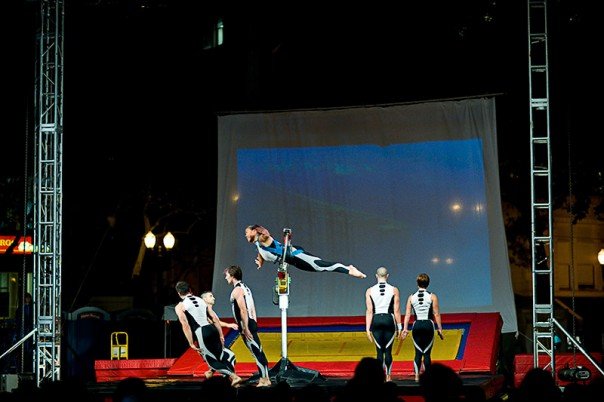
Photo Credit: STREB
What inspired you to
get your MBA?
I came to a point when I felt I might be starting to be ready
to retire from performing, and I started to think about what I might do next. I
felt I had some transferable skills, but didn’t have much work experience,
other than part time gigs pieced together around my dance career. Famously, I was traveling in Costa
Rica with my best friend in the off-season, when I woke up one morning and
said, “I’m going to go to business school.” Incredulous, but supportive, she asked me to explain. As I started to articulate my gut
reaction, my subconscious rationale began to make sense: I felt like I needed
to gain some tangible skills before running out and getting a job that might
not have any upward mobility. I thought it might help to have some kind of
outward, understandable stamp of approval for the management skills I thought I
might have. I also thought that going
through an MBA training couldn’t hurt, regardless of my ultimate path because
the training would help me organize the world through a different lens and
perspective.
What do you enjoy most
about arts administration? What are your strengths?
I like that my work keeps me busy, and I enjoy doing the
great variety of things I get to do each day. I think one of my strengths is my ability to stay positive
and improvise on a problem, while then having the discipline to codify a
process once I figure it out so I won’t have to figure it out again. I also think that my ability to understand
and empathize with artists, management and the board is helpful in bridging
communications gaps that sometimes plague other organizations.
Do you still perform,
choreograph, and take dance classes?
At first I did.
While working on my MBA, I taught in the dance department at UC Davis,
performed with the late, great Della Davidson, and even dabbled in musical
theater for the production of Oklahoma!
at the Mondavi Center. During my
first year at American Repertory Ballet, I took ballet and trapeze classes
regularly. But I don’t as much
anymore. At some point, the high I
got from performing was replaced by the high I now get when I am able to meet
or exceed organizational goals. At
first I kept dancing to get that high, but now that I’m fully consumed with
something that is wholly satisfying, I just stay physically active by running
and riding my bike to work every day.
Advice to young
dancers interested in getting into arts administration:
Approach a company that interests you, and see if they have
any internship opportunities. If
you’re not sure what you want to do, try out different roles – marketing,
development, finance, event planning, education. Once you immerse yourself in a given function, you’ll see if
it clicks or not. Don’t waste your
time trying to do something you think you should do, or that you think you should
be good at if, once you try it, you feel like it’s constantly an uphill
battle. Notice what you enjoy
doing, and what you’re good at.
Once you find the intersection of your skills and passions, that’s what
you should be doing. Also, make
sure that you actually want to work in arts administration and it’s not just a
fallback for other artistic dreams – your artistic skills might be better
matched in a different field that needs a creative being to balance out a more
business-like culture. Make sure
you’re ready to work hard. The
field is a difficult one – it’s far from lucrative, and we have to consistently
advocate not only for our own organizations, but for the field as a whole.
There’s incredible competition for funding, and everyone is trying to do so
much with fewer and fewer resources.
It’s very rewarding, but you really have to love it and believe in what
you’re doing, because it’s hard work.
Advice to young dancers in general:
My path and story seem very clear now that I look back and
see the road I’ve taken, but it was far from deliberate at the time. I had no idea I’d end up in arts
administration, even when I went to get my MBA. I just kept listening to what felt right and working hard at
what I was doing. So say yes to
every opportunity. Take risks and try new things. Commit to every experience
and make the most of everything you do at every moment, even if you think it’s
just “paying the bills." You may
realize when you’re waiting tables that you love engaging with people, and that
people like you, and getting good tips comes easily for you. In which case,
maybe fundraising/development is for you. Or, if you’re planning an evening out
with friends, and you’re the incredibly detail oriented one who enjoys putting
together e-vites and communicating with everyone, perhaps PR/communications
might be a right post-dance career path.
Above all, start thinking about the future before you have
to. I’ve known too many performers whose careers have been cut short due to
injury, lack of work or other circumstances. They’ve felt particularly lost afterwards. You need to have the stomach to
acknowledge that you’re going to have to do something else at some point. When I retired, I had as clear of a
plan as almost anyone I know, and my transition was still very difficult.
Changing what you do every day when you’re a dancer is really, really hard. In
addition to the “job” and the physicality of it all, you also change your
community, your identity and your lifestyle. When all that changes at the same time, it’s a lot to deal
with, emotionally. When asked what
I do, I sometimes still can’t help but say, “well, I used to be a dancer, but now…” It’ll be a part of every dancer’s
identity long after it’s what we actually do every day.
Also, be nice, be grateful, be humble, follow through, and
always send a thank you note.

 Life as a Modern Dancer
Leave a comment