
Hometown: New York. Born in Hong Kong.
Current city: New York
Age: 47
College and degree: Royal Ballet School, London. Fordham University, New York
(unfinished)
Website: www.newyorklivearts.org
How you pay the bills: Bill T. Jones/Arnie
Zane Dance Co (New York Live Arts)
All of the dance hats you wear: choreographer, teacher, repetiteur, director
Non-dance work you do: I do some projection design and video
editing.
——————————-
Describe your dance life in your….
20s: Graduated from the Royal Ballet School, London. Joined the Berlin Ballet and stayed
there for 8 years. During that
time, I met Bill T. Jones, who choreographed a piece on the company. The Berlin
Wall came down. Moved to New York
at age 27 to go back to school and learn about modern dance. Performed with the Bill T.
Jones/Arnie Zane Dance Co at the Joyce as a guest artist the same year and enrolled
in Fordham University. Became
rehearsal director of the company in 1996.
30s: Rehearsal director of BTJ/AZ. Worked closely with Bill on new work
and old repertory. Toured around
the world. Every project was a
learning process. Started doing
projection design.
40s: Became Associate Artistic Director. Took on more responsibilities with the company. Still not bored with my job.
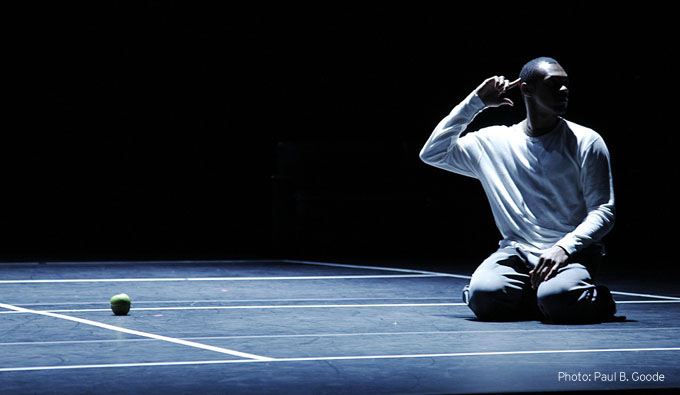
Photo: Bill T. Jones/Arnie Zane Dance Company
A turning point:
Deciding to leave Berlin and move to New
York.
Major influences:
My mother, Bill T. Jones, New York.
Right now, what does a typical “work day” or “work week”
look like?
A typical rehearsal day may begin with teaching
company class 10 – 12, and rehearsing
from 12 -6pm. I usually have work
to do at night – preparing material for rehearsal if we are working on a new
piece or reconstructing an old work, planning casting, touring, communicating with various
departments, etc.
If we are on tour, I usually go to the theater early to check that everything
is going well and it usually is. We have a great crew. Depending on the show I may have to work on projection. I will then teach company class, followed by a 3 hour tech
rehearsal. Dinner break is followed
by last minute technical corrections before the house opens. After the performance there may be a
Q&A with all of us.
On performing…..do you still perform?
No. Very early on I performed a duet with
Bill a couple of times based on material we were setting in Lyon, France.
How do you juggle wearing multiple hats?
I am quite organized. I use my time well.

Photo: Bill T. Jones/Arnie Zane Dance Company
How did you get into doing projection work? Is any of this work being used in any of the current BTJ/AZ pieces? What excites you about this form of artistic expression, and how does it interact with live movement?
A friend gave me a bootleg version of Final Cut Pro in 2004. I have since acquired the legitimate version. I started playing with it in my hotel room on tour. I didn't have a video camera so I used photos at the time. Like many people I learned as I went along, reading the manual when I had to. But mostly it was about solving problems, i.e. I want to do this with the footage or create this effect, and how can I do it? I have been very fortunate to be able to do projection design for the company. My first was in 2006 for Chapel/Chapter, and since then I have done projection design for every new work that has a multimedia component. We stayed away from heavy multimedia in the last couple of years; we wanted to clear the slate. But you can see a tiny bit in two new works, one of them is A Rite (2013) our latest full length work in collaboration with the SITI company. It appears in the last 3 minutes of the piece. The 2nd piece is Ravel: Landscape or Portrait (2012), again very minimal and brief but it kind of covers the whole stage and beyond. I enjoy technology as much as the next person but am not overly fond of it. I am rather old fashioned and am relieved when I go to a performance with no mutlmedia. However I love the idea of using projection to extend and alter the literal space and time on stage, and to add to the vocabulary of expression in the work. Nowadays I tend to think, do we really need projection in this piece, as opposed to what kind of projection.
Setbacks:
Not many, but when I was in my twenties I was very
worried about not having other skills. How would I survive when I stopped dancing since I didn’t even graduate
from high school? Fear, I guess.
Advice to young dancers:
Don’t forget your passion. The world does not want or need another
dancer. You have to want it badly.

 Life as a Modern Dancer
Leave a comment