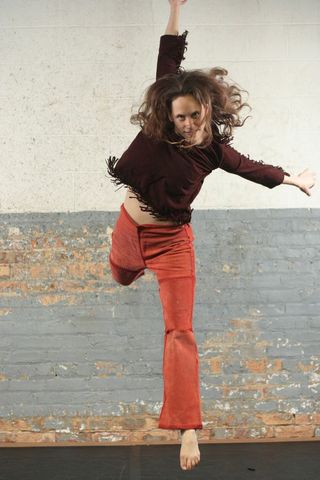
Hometown: Grew up in Houston, moved to Atlanta for last 1.5
years of high school – definitely consider Houston my hometown.
Current city: Chicago – been here since 1993.
Age: 38
Attended an arts high school? No, but both of my high schools
had excellent theater programs – and the one in Houston had an extra curricular
dance program that opened up my eyes to “the world beyond ballet.”
College and degree: Northwestern University, BA Dance and
Comparative Literary Studies
Graduate school and degree:
Ohio State University, MFA in Dance (Choreography Emphasis). I was 30 when I
went to grad school.
Website: www.stridinglion.org
https://vimeo.com/channels/573684
https://www.facebook.com/stridinglion
https://www.facebook.com/NorthwesternUniversityDance
How you pay the bills: I am a Lecturer in
Northwestern University’s Dance Program, where I teach modern and ballet
technique, Composition, Movement for Actors and History/Theory Courses.
All of the dance hats you wear: Dancer, Choreographer, Teacher, Scholar,
Curator, Grant Writer, Administrator, Fundraiser
Non-dance work you do: I’m a mom
to a 5 year old and 3 year old!
————————-
Describe your dance life 5 years after college:
I knew I wanted to stay in Chicago for a while after college.
Northwestern started their dance program while I was there, which meant that I
had unbelievable access to my professors both on and off campus. I danced with
two of them professionally (Billy Siegenfeld http://www.youtube.com/watch?v=WxgmcHjbHUw
and Brian Jeffery http://www.uaa.alaska.edu/theatreanddance/faculty/brianjeffery.cfm)
before I graduated and was anxious to continue that work on a more substantial
scale once I got out of school. Billy was holding auditions for his company
Jump Rhythm Jazz Project (www.jrjp.org), so I auditioned that summer and moved into
an apartment in the city with some dancer/actor friends.
Jump Rhythm was a part time company, which is how most of the
Chicago companies operate. We rehearsed three nights a week for 4 hours, so we
were able to pay bills with day jobs. I had a disastrous three week stint as a
waitress after my junior year in college, at which point I decided to do
whatever it took to make a living in my field. Instead of working in
restaurants or retail, I joined AmeriCorps, the domestic version of the Peace
Corps, and worked in Chicago Public Schools in the West Town area, teaching
school curriculum through dance and theater in a program called “Integrated
Arts, Integrating Education.”
The education work hooked me right away. After my AmeriCorps service
ended, I stayed on at the Settlement House where the program was based as an
Artist in Residence, teaching creative drama to their Head Start and School Age
After Care programs. I also worked with their Adult ESL programs, designing
project based learning scenarios like a cooking club, where we shared recipes,
shopped and cooked together, sharpening our language skills along the way. At
this point, I was also teaching children’s modern and ballet classes at a dance
studio in Evanston (www.dancecenterevanston.com), where I had done an
internship during the last quarter of my senior year at NU.
Through Jump Rhythm, I began performing and teaching
nationally. Billy was often hired as a guest artist at universities and
colleges around the country. I would go as his assistant, demonstrating for him
in more advanced classes, teaching other classes, and helping to teach company
repertory that the university dancers would later perform in their own
concerts. When Billy took his sabbatical from Northwestern, NU Dance (https://www.facebook.com/NorthwesternUniversityDance)
brought me in to teach Jump Rhythm Jazz Technique. Learning how to teach at a
university level through the lens of Jump Rhythm Technique (which is a codified
technique along the lines of Graham or Horton, but with rhythm rather than
shape as its defining principle) was an invaluable pedagogical experience for
me. The structure of a good class is built right into the bones of the
technique – as is a deep anatomical awareness, a strong sense of
community, and a fluid exchange
between improvisation and structured movement material. These tenants of JR are
now deeply ingrained in my own approach to teaching and making.
During this time, I was struggling to keep up my own
choreographic efforts. I was being hired to choreograph for Chicago theater and
being given opportunities to produce my own work for small festivals, but my JR
schedule was growing to the point that I knew I had to make a choice between
these two worlds. With Billy’s loving support, I left JR in 2000 to found an
interdisciplinary collaborative with a cohort of dance, theater and music
artists from my AmeriCorps days. We were complete newbies at arts administration,
but we had a strong group of artists and teachers that were dedicated to the
idea. Those early days were more like a commune than a company – dedication,
dreams and drama. I think of those years as my professional adolescence. I
learned more about non-profit law and fundraising and bookkeeping and budgeting
and grant writing and IRS reporting than I ever knew I could. We pulled a solid
little 501c3 together by the skin of our teeth, but I very rarely recommend the
same path to any of my students.

10 years after college:
When I was 30, I went to graduate school. At that point as a
choreographer, I knew the kind of work I wanted to do (and the kind of work I
didn’t want to do). I loved the interdisciplinarity of our collaborative
(Striding Lion InterArts Workshop), but it had become a defacto theater
company, with actors and scripts. I needed trained dancers to realize the work
I really wanted to do – and I needed more creative control. I also was teaching
dance more consistently at the university level, and I was hungry for a more
advanced interaction with history and theory than I had as an undergrad. The
final nudge towards grad school was a practical one. I was married to a
musician, and I wanted to have kids. I realized that if we were ever going to
have any kind of financial security, I was going to be the one to provide it. I
absolutely loved teaching at the university level, and I knew that
an MFA was necessary for the kind of position I wanted.
Grad school was heavenly for me — technique and Yoga in the
morning, creative or history/theory classes in the afternoon. My nerd self and
my artist self were in harmony. Plus… for the first time ever, as a Fellow and
then a Teaching Assistant, I had a salary and benefits. Up to that point, it
was my best paying dance gig. During those three years, I refined the dance
theater composition and performance approach that I use today, danced through
the pregnancy of my first child, and made friendships and collaborative
connections that will last forever. It was here that I became close with Ashley
Thorndike-Youssef, founder and director of Now & Next Dance Mentoring
Project (http://nownextdance.org),
which I am now involved in every summer as a faculty member.
As luck would have it, soon after my return to Chicago, my
co-founder and longtime friend, who had served as Striding Lion’s sole Artistic
Director since my departure, learned she would be moving to Boulder, CO,
leaving Striding Lion in flux. She and the Executive Director asked if I would
be interested in returning as Artistic Director. With permission to change the
name to Striding Lion Performance Group (www.stridinglion.org) and reorganize Striding
Lion into a dance theater company
– which meant auditions for new company members, regular company class
and rehearsal, and a rebranding campaign – I accepted.
In the past three years, Striding Lion has “emerged as a new
center of gravity for indie dance in Chicago” (http://www.timeoutchicago.com/arts-culture/dance/15052687/dance-2011-in-review),
gaining critical recognition (http://www.suntimes.com/entertainment/20284947-421/dada-gert-captures-the-essence-of-world-war-i-artist-valeska-gert.html
and http://www.timeoutchicago.com/arts-culture/dance/14805849/live-review-striding-lion-performance-group-remember-the-alamo)
and the respect of the very tightly knit Chicago dance community. Meanwhile,
our extensive education programming in Chicago area schools – we served over
2000 kids K-12 last year – keeps us deeply rooted in the real world through
daily exchanges with young artists and parents navigating one of the toughest
educational environments in the country. Professionally, I feel incredibly
lucky to have the now solid infrastructure (administrative support, educational
programming, incredibly talented company members and collaborators) of Striding
Lion behind me during this very fertile time in my dance making career.
My work in Northwestern University’s Dance Program is deeply
connected to my work in Striding Lion (which serves as the creative research
side of my responsibilities at NU). I workshop material for Striding Lion
productions at NU and vice versa, often producing full scale versions of
smaller pieces that I develop at NU in Striding Lion’s season a few months or a
year later. My advanced technique classes at NU are very similar to my company
classes, providing NU dancers an insight into my aesthetic values and creative
approach that sometimes leads to my welcoming them into the company after
graduation.
How you have paid the
bills over the years (dance and non-dance work):
While I’ve been lucky enough to garner a small income from
performing and choreographing since just before graduating from college, those
fees tend to just barely balance out the cost of getting to rehearsals and
paying subs for the other work you’re missing. Teaching in one form or another
has been my most consistent source of income. I’ve taught in public and private
K-12 schools through AmeriCorps, through Striding Lion, and as an independent
artist in residence; at a dance studio where I still teach and where Striding
Lion is now in residence two days a week; at summer dance/theater camps for
little ones and summer arts programs for high schoolers; and then, of course, I
taught my way through grad school. I’m also a certified massage therapist,
which provided income after college and through grad school, but I am no longer
practicing. I’ve actually done very little that wasn’t somehow related to my
dance career to make a living. The freelance nature of most of my work meant
that I was always living month to month – and always a little nervous about how
much I was going to bring in at various points throughout the year – but I made
it through. Having a consistent base of support from Dance Center Evanston (the
studio where I started as an Intern and was Program Director, teaching 20
weekly classes by the time I left for grad school) helped immensely.
Can you talk a little
about the many hats you wear – artistic director, choreographer, performer,
college professor, arts education specialist? Why do you wear multiple hats?
How do you balance the work, switch gears from one to the next, and have one
aspect support/feed another aspect of your dance life?
Ah… this is a good one. The truth is that at this point, it
doesn’t feel like I’m wearing multiple hats – although, at first, it certainly
did. Now it’s very clear to me that while the where and the with whom change,
I’m actually doing the same work in each setting. The “work” is making
something out of our primary creative tools: the body, the voice and the imagination.
These tools are the very first concept we introduce to students in a Striding
Lion workshop. In my work as choreographer, performer and classroom arts
education specialist, I’m engaging these tools simultaneously, moving through a
process of improvisation, critical reflection, collaborative composition and
finally performance. I’m using a variation on this same process when I write.
The medium is the written word, rather than the moving body. Improvising
becomes brainstorming, and the composition is the essay/article/lesson plan;
but otherwise, the process is the same. Ultimately, we are either making,
sharing, or reflecting on pieces of art – and my particular brand of art
usually involves dance and theater. My training in improvisation has greatly influenced
my understanding of the connection between what once felt like disparate acts.
Whether spontaneous or planned, everything I do is a composition of some sort –
every lesson plan, every student interaction, every grant, every technique
class, every press interview. In each instance, we are simply creating moments
with our bodies, voices and imaginations.
The role of teaching in
your dance career:
Teaching is central to my understanding of myself as a creative
artist. I’m teaching and learning in every creative process – so I really don’t
see my teacher self as distinct from my choreographer/performer self.

Advice to young dancers
on teaching, the role of teaching in their dance lives ahead, and becoming a
well-prepared teacher:
If you want to have a life as a dancer, you will teach.
Recognize teaching as a craft that takes the same level of attention, skill and
practice that your physical practice has taken. Become a member of NDEO
(www.ndeo.org), get on the list serves that appeal to you, and eavesdrop on the
conversations that teachers are having with one another. Start paying attention
to how rather than what your favorite teachers are teaching. Take Dance in
Education courses/workshops/intensives. Go and observe teachers you or others
know and respect in action. Sit in on classes and take notes about the
structure of their classes, the language they use, and the way they engage
their students (i.e. do they model/participate/play?). Then… and this is the
best piece of advice I have… assist, demonstrate or co-teach with great
teachers. Offer to do this for free – and you won’t believe the amount of
willing mentors you will have.
What do you look for in
a dancer?
I want to work with dancers who are brave, open and willing. I
want them to be connected in a Bartenieff understanding of that word –
core/distal; head/tail; upper/lower; body half; contralateral. I also want them
to be connected in a more spiritual sense of the word – sure enough of
themselves and who they are to take risks, put themselves out there, be willing
to fail. Technically I need dancers who can get in and out of the floor
quickly, who don’t mind getting a little animalistic and rough, who aren’t afraid
of making noise and breathing hard and getting a few bruises every now and
then. I want dancers who can teach – teach me, teach each other, teach students of all ages. And beyond
all of this, I want dancers who take ownership of our collaborative work – who
are willing to take direction, but feel a deep sense of collective ownership
over the work we build together. Striding Lion dancers have been known to
supply props from their own homes/backpacks, bike an extra mile out of their
way to pick up chocolates for the show, lug hoola hoops around in their trunks
for weeks on end, and hang and strike a set in less than thirty minutes. The
people who can do all of that and still return the next day hungry for more…
those are the lovely dancers I have the privilege of working with right now and
can’t wait to work with in the future.
As a choreographer, who
gives you feedback?
On a day to day basis I get feedback from company dancers and
collaborators. Our process is collaborative, so there’s lots of immediate
exchange between us about what’s working and what’s not. I am still deeply
connected with my college mentors – some of whom are now my colleagues at
Northwestern. One of the lovely things about working at a university is that
there are many opportunities for showing work at various stages throughout the
process. I also get feedback from my students. Whenever possible, I assign live
performance reviews as part of my technique classes and direct them to one of
our performances as an option. The students then turn in short 1-2 page essays
about the piece, which inform me immensely. I also hold our Chicago critics in
very high esteem. While each critic has his/her own aesthetic preferences and
tastes, the Chicago dance critics are incredibly well versed in the field and
give what I believe to be very valuable feedback in the context of their
reviews.
Can you talk a little
about choreographing for theater? How did you get into this? What interests you
about this kind of work?
I got into choreographing for theater in college. NU had a much more developed student
theater scene than a student dance scene – and while I loved my time in the
student dance company, I found much more freedom to experiment and take risks when
I choreographed for theater. While I’m a dancer first and foremost, I am
certainly a “theater artist” in the bigger sense of the word. I’ve always been
drawn to character and story – and what the body, in particular, can
contribute/say/affect.
When we graduated, a writer/director and a puppetry artist
friend and I continued to collaborate on a few shows that we developed together
in NY and Chicago. The textures of those pieces were what I was most drawn to.
The writer, Liza Steinberg-Demby, wrote the pieces with Sam Lieb (the visual
artist/puppeteer) and I in mind – so it was a dreamy situation. In Chicago, the
work sort of feeds on itself. There
are lots of companies who want to use movement in their work. They hear that
you “do that” and they call you up. One of my favorite companies to work with
here in town is Piven Theatre Workshop (www.piventheatre.org), which has its
roots in story theatre and opens itself up to more abstract physical
representations of character and narrative than your typical realistic play.
Ultimately, I think what I love most about working in theater
is the chance to engage unapologetically with narrative and language.
Resources and
resourcefulness for choreographers. How do you stretch dollars and prioritize
when juggling rehearsal space fees, theater rentals, lighting designers,
costumes, postcards, dancer stipends, and maybe paying yourself?
Beg. Steal. Borrow. OK… try not to steal – barter instead.
Relationships are key here. Relationships and professionalism. Dance Center
Evanston, once again, has played a key role for me here. Béa Rashid, the
Director of DCE, is a maker and performer herself. If you teach for her, you
can have access to the studios anytime they are free. There are quite a few
other places in town that have this same policy. So at first, I was borrowing
space from DCE and asking dancers to work with me for free. In our early 20s
that worked out fine, but now that my contemporaries and I have families and
babysitters, that hour of dancing for someone for free can cost you as much as
$40 when all is said and done. Now that Striding Lion and I are both more
established, we are an official company in residence at DCE. We rehearse there two days a week, and
in return we open our company class to DCE faculty for free and they include
the class as part of their adult programming. We also advertise for them on our
e-blasts and website and any printed materials. I send my company members Béa’s
way as teachers – so the relationship continues to deepen and expand. We pay for rehearsal space in
the city one day a week at a theater where we also produce much of our season –
being one of their consistent renters has made them very invested in our work
from a marketing and development perspective and led to a new choreography
series that we are co-producing this season. So… in short what I would say is
know that you are going to have to spend some money and be smart about where
that money is spent. You don’t need a big fancy theater. You need community,
and you need partners. Live in a community where there are existing networks
for artists and dancers (www.seechicagodance.org and www.chicagoartistsresource.org)
and take advantage of them.
% of time each week you spend on your company/choreographing:
I’m a 40-hour a week girl, when Northwestern is in session. As
I mentioned, Striding Lion is considered part of my creative research – so it actually falls within my job responsibilities at NU, even though it is a
separate 501c3. I spend 12 hours a week in the studio with Striding Lion and
another 6-20 hours a week in the studio for Northwestern, depending on the
quarter and my class schedule. All that increases dramatically when I’m in
production for either NU or SLPG. In the remaining hours, I am doing more desk
oriented research, planning, grading, grant writing and overseeing of SLPG
artists who are out in the field on teaching gigs.
What are you exploring
these days in your work?
I’m interested in making work that
engages audiences in an active way in the performance experience. I want an
audience to feel what we feel on the stage as much as possible. I don’t believe in the 4th wall or
weightlessness or masking the physical difficulty of dancing. I like performing
in intimate spaces/non-traditional spaces/promenade performance/performance
installations where the audience can be seen and heard as well as the dancers,
where we as dancers can flirt/confront/challenge/invite through direct eye
contact or a whisper.
I work from the body first – I am 100%
dancer, 100% choreographer – but I will use any and all theatrical devices
(dancing, speaking, singing, video, audio, costumes, set, props) at my disposal
to help get my point across to an audience. I consider myself a postmodern
expressionist – meaning that my work is fundamentally about exposing the gritty
underbelly of the human experience, but that I am not averse to digressions of
form and function or moments of aesthetic indulgence.
My process is extremely collaborative
(and here I am incredibly aware of the incessant use of the first person
singular throughout this response). My choreographic concepts are often tied to
a real place and time (North Carolina Farm in the Depression, The Alamo in the
1860s, Weimar Berlin, 1950/60/70/80/90s America). I do a lot of research and
journaling and thinking on my own.
I improvise on the ideas and generate dance phrases that I then teach to
the company. I bring in related texts/studies/newspaper
accounts/documents/letters/whatever I can find in my research on the topic that
inspires me. Then, together, the company and I workshop the material. Sometimes
it’s a linear process, where I’m sketching out something in the space that I’ve
dreamed up on my own and written down to try out in the studio. Sometimes, I am
just slamming different snippets of
material together in various relationships until I find something that
“works.” And when it “works” for me, that means it makes me feel something –
that it makes me catch my breath, or tense my muscles, or lean into the
movement with the dancers.
Also —- I’m very, very interested in
making work that is accessible, rather than alienating to audiences. That doesn’t mean that it is “easy”
work to digest. The Chicago Reader recommended Dada Gert, but described its jerks, twists and snorts as sometimes
hard to watch. That’s perfectly OK with me. I’m interested in rich, rather than
“pretty,” and I’m interested in offering audiences choices rather than
dictating their experience to them. But… I am very, very aware of my
responsibility to teach my audiences how to read each piece I make in the
process of the piece itself.
How would you describe
the modern dance scene in Chicago right now? Can you talk about it in terms of
performances, training, community meetings, etc.?
This is an incredible time to be a choreographer in Chicago.
There is a genuine sense of community and support of one another’s work. We’ve
finally figured out that to survive we have to find interesting ways to come
together – through festivals (www.hccdf.com), through shared office space (www.athenaeumtheatre.org),
through shared concerts (www.flyspacechicago.com), etc. Places like
Links Hall (www.linkshall.org)
and The Chicago Moving Company (www.chicagomovingcompany.org) space at the
Hamlin Park Fieldhouse offer affordable space for class and performance. The
Department of Cultural Affairs and Special Events (www.cityofchicago.org/city/en/depts/dca/supp_info/chicago_culturalcenterpresents.html)
hosts dance performances and occasionally grants the use of their downtown
studio space to emerging choreographers. Marketing and business support from
organizations like the Arts and Business Council of Chicago (www.artsbiz-chicago.org) help you negotiate the administrative angle,
while Audience Architects (www.seechicagodance.org) helps keep the
community talking through regular community meetings, salons, grant
opportunities and online communication. Almost every established company offers
open company class for professionals to take (takechicagodance.org) and the
Dance Center of Columbia College (www.colum.edu/Dance_Center/) and the Museum of
Contemporary Art (www.mcachicago.org)
bring in artists from around the world for performances and master classes.
What skills do you think
a modern dancer, in 2013, needs?
I’m moderating an hour long panel on this exact topic at the
National Dance Educators Organization Conference in Miami in October. So.. in a
few words? Flexibility and humility. They’ve got to recognize that there is no
“one right way” to dance or make dance. They’ve got to figure out who they are
and what they are uniquely passionate about and go deeply into that.
Final advice to young
dancers:
Erase any image of the “good dancer” that you are trying to
become. Work from the inside out instead. Get to know your body – its
strengths, its weaknesses. Get to know your creative self – your passions, your
aversions. Do that again and again, day after day. You will never “get there.”
You will never “finish.” You will never “complete” the process of becoming.
Start to recognize yourself as an artist and find a community of makers and
doers that you can collaborate with. The dance field is defined only by its
diversity. Don’t limit it or yourself.

 Life as a Modern Dancer
Leave a comment