
Photo: Aram Jibilian
Hometown: Bellefonte, PA
Current city: Brooklyn, NY
Age: 33
College and degree: B.A., Sarah Lawrence College
Website: www.aaronmattocks.com
How you pay the bills: full-time freelance performer
All of the dance hats you wear: dancer, writer, editor, curator, grant writer, panelist, lecturer
———————————

Photo: Aram Jibilian
How have you landed your performance gigs over the years with groups and choreographers like Big Dance Theater, Doug Elkins, Faye Driscoll (auditions, workshops, seen in classes, friends)?
I met Ursula Eagly while dancing with Kathy Westwater, whom I met as an undergraduate (Kathy was finishing her MFA) at Sarah Lawrence College. Ursula was instrumental in many ways. She was commissioned by Dance New Amsterdam to make a piece, which she asked me to be in, and named Aaron Mattocks. A repertory company started by Sonja Kostich and Brandi Norton, called OtherShore, was looking for a male dancer for a new dance/theater work by Annie-B Parson and Paul Lazar. They asked John Heginbotham, who was dancing for Mark Morris (where I was general manager) but he was unable, so he suggested me, as I had danced in some of his work on the side. Brandi and Annie-B attended Ursula’s show and offered me a job. From there, I was asked to join Big Dance Theater for their next production, Supernatural Wife, and I’ve been involved with them ever since.
After working on the piece with Annie-B and Paul, OtherShore invited me to join the company as a full time member, and commissioned both Jodi Melnick and Stephen Petronio to create new works on the ensemble. I would probably never have gotten to work with these two amazing people otherwise, based on my particular skill set, and I will be forever indebted to OtherShore for giving me such an amazing opportunity.
Ursula also continued recommending me for work after we danced together, and because of her I was introduced to and danced for both Yoshiko Chuma and Steven Reker.
I met John Kelly and David Parker when we were all in the same show, Christopher Williams’ The Golden Legend at Dance Theater Workshop. Christopher and I both went to Sarah Lawrence together for a year (he was a senior when I was a freshman). Through working with David Parker, I was recommended by Jeffrey Kazin for a job with Doug Elkins.
I met David Gordon through an audition from Dance/NYC for his show Dancing Henry V. I was cast in John Kelly’s production of Find My Way Home shortly thereafter and ended up not being able to be considered for Gordon’s show, but when he was bringing his production of Pirandello’s Six Characters in Search of an Author back to the stage at Joyce SoHo, he could only add one person to the cast, and he remembered me from that audition and asked me to join the cast.
Faye Driscoll had a tour of her 90 minute duet show, You’re Me, and with two and half weeks of prep time, her only other performer suffered an injury and was unable to do the show. She emailed several people in the community, including Annie-B Parson and Chris Giarmo (a fellow BDT artist), and Cassie Mey, whom I had danced with in Dean Moss’s work, and they all recommended me. She messaged me on Facebook, and I was in the studio with her the next day trying out material, and got offered the job. I was in tech and performing at New York Live Arts with Steven Reker/People Get Ready, every night from 5-10pm, and rehearsing with Faye 10-4pm almost every day. I had watched the video a ton, and had written down every moment of Jesse Zaritt’s role, and I would read and memorize his choreography in my own shorthand from my notebook on the subway ride each morning. People must have thought I was insane. We literally had rehearsal on the day of Hurricane Sandy, because we couldn’t afford to lose any time together in the studio. We watched from a carpeted children’s art studio (the only place in the city that would let us rehearse), which I had to walk to because the subways were shut down, as the weather turned from bad to worse. We left for the Boston ICA the very first day they reopened the bridges out of the city, and were able to perform the show, basically without a hitch. Unbelievable and completely surreal.
I got a job with Third Rail Projects’ Then She Fell because of my friend Carlton Ward. He had also been in Christopher Williams’ show, so I knew him from that, but Christopher got me a job in a stilt-walking marionette puppet show, created by a beautiful company named Phantom Limb. Carlton was one of the other puppeteers, and we became great friends on tour together. Carlton had been performing with Third Rail for a while, and when they decided to have a small closed casting session for replacements in Then She Fell, Carlton recommended me and I was able to get seen for the job.
It’s really clear to me, almost every opportunity has a direct connection to a person in my life, to a recommendation from a friend, and almost every one of those connections can be traced back to my first two professional dance jobs with Kathy Westwater and Christopher Williams, and Sarah Lawrence College.

Photo: Ayumi Sakamoto
What is on your plate for the 12 months – performing, choreographing, residencies, etc?
I am working with Big Dance Theater on their newest project, Alan Smithee Directed This Play, which will premiere in Lyon in March 2014, and come to New York for the BAM Next Wave Festival in October 2014. I’m also touring their recent piece with Mikhail Baryshnikov, Man in a Case, to Berkeley Rep, D.C., Boston, L.A. and Chicago. Courtney Krantz, a friend of mine from Sarah Lawrence, who is currently a Movement Research Artist-in-Residence, is creating a new evening-length duet for the two of us, to premiere in the fall of 2014. I am hoping to get to work with Faye Driscoll on something new in 2014 or 2015; we’ve talked about really wanting to work together again. I will continue to work on and tour with Doug Elkins’ Hapless Bizarre, to Jacob’s Pillow, ODC in San Francisco, and the Joyce Theater here in New York. I have also been a regular performer in Then She Fell for the last six months and, though I have to take a leave of absence for other work this fall, I am probably going to show up again there as well. The show I performed with Steven Reker and his band People Get Ready last year at New York Live Arts is touring to Duke University this fall, so I’ll get to do that one more time as well.
How did you first get involved in dance?
I began studying dance with Viola Farber at Sarah Lawrence, as an eighteen year old who wanted to study movement in order to be on Broadway as a triple threat in the work of Bob Fosse. Flash forward 15 years, and I have never once performed in a work by Bob Fosse. Viola died near the end of my first semester, and Sara Rudner took over. The faculty at Sarah Lawrence was forever patient and kind, helping me to develop and catch up on years of missed training. After many years of doing various kinds of classes and conditioning practices (Klein, Cunningham, yoga), my preference now is to study ballet. I mostly take class from Janet Panetta, who teaches an amazing ballet class for contemporary dancers, at the Gibney Dance Center in Manhattan.
What do you consider your best attribute as a performer of other choreographers’ work?
That I still consider every day working in the studio with each of them both an honor and a privilege.
That I am in love with this field, with performance, with the work that we all do, with each choreographer and his/her craft.
My dedication, passion, generosity, and open-heartedness.
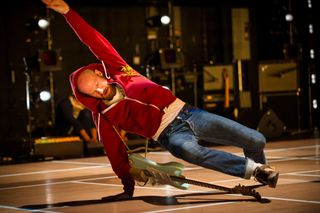
Photo: Ian Douglas, courtesy of New York Live Arts
Do you have any pre-performance rituals?
I was in an acting class at the William Esper studio, and was told an anecdote about, I believe, Pavarotti, meant to be an example of the inherent unknown and beautifully unpredictable and immediate nature of live performance. Pavarotti reportedly stood in the wings before each performance, and asked himself: “What’s it going to be? What’s it going to be?” I do this before every single performance, repeated as a mantra meant to open myself up to seeing each moment, each dance partner, each step, as completely new, approached as if in the moment of discovery. This is my ritual of openness to the ever-changing joy ride of each performance experience, each audience, each exchange of energy between myself and the world in the theater. It is a magical place with magical people, with such transformative powers, and this is the simplest method I’ve found to stay entirely in awe of that power. And, green tea. I *always* have a green tea with honey before a performance. It’s my thing.
What non-dance practices are important to you?
I think one of the most important things I’ve learned over the years, as a freelance performer, is setting boundaries. Knowing how and when to talk about compensation, how to say no, how to make sure I’m leaving personal time for myself. My new rule (and every rule is made to be broken): when possible, I don’t like to rehearse more than 6 hours a day anymore. I just feel like I don’t have much to offer after that, and the possibility of being resentful or getting injured or not being a thoughtful, caring person to a choreographer’s process just increases exponentially after the 6 hour mark. I also strive to make sure I am giving myself one day completely off a week (though I am notorious for breaking this rule as well). But those are my starting places with scheduling: 6 hours a day, 6 days a week. It’s taken a long time to get there, and of course at the beginning of my career my rule was “SAY YES TO EVERYTHING,” and I completely understand why I chose that, but you have to evolve as you grow older, and you have to make sure that self-care is at the top of your list. As a freelancer, no one else is responsible for you, no one else is making sure your schedule is not too full. I think the best approach is to think of yourself as a small business owner, where the business is you. You want to make sure you know what the money flow is like, and that you have an "open" and "closed" sign. No one but you knows how busy the rest of your life is…and the last thing you want is to agree to show up and then not want to be there because you’re tired, overworked, didn’t leave yourself enough time to rest and eat between jobs. Think about yourself as a sustainable being, and question your decisions with criteria such as longevity.
Pose 2 questions you would love young dancers to consider.
Is this the thing you care about more than anything else in the whole world? What will you give up, sacrifice, go without, to make it happen? Because this is not an easy path, and it certainly doesn’t pay. Be prepared to be emotionally wealthy, but financially challenged. We do this because we refuse to do anything else. If you can’t give up everything for it, and you’re not willing to fight for it over the long haul, you should reconsider your goals and expectations. The longer you stay the course, the more likely you will be to succeed. You have to be prepared to be around for 5 or 6 years in New York before you might get a break. Know what you’re going to do to stick around.
What are the skills that a modern dancer, in 2013, needs?
Be flexible in terms of your skill set. Take acting classes, voice classes…more and more work utilizes the voice, not just singing, but speaking, and the performer as a whole being, not just as a technical dancer. Know things outside of dance…be an interesting human being. Read books, watch films, go to museums and look at movements in the visual arts that correspond to the year of your favorite dances. Listen to music that isn’t current. Use technology thoughtfully. Always be respectful to your peers: I have been surprised again and again by the people that have come back into my life and had major influence on my career. Most of my job opportunities can be traced back to two people I met and danced for in college. Literally, I could make a diagram, and every job I’ve ever had could probably be traced back in some way to either Kathy Westwater or Christopher Williams. So look around you…the people you see every day are going to be the people who will shape your future. Treat them that way–they could change your life.
Final Advice:
There is no map for this kind of life. Even if you try to emulate someone else’s path, it’s not going to lead you to the same place. You might get a grant, you might never get one. You might get a full-time company job, with a big touring choreographer, but that choreographer will age and pass away, and the company you thought you always wanted to join might just shut down next year. The world is changing so constantly–be adaptable even while knowing where you THINK you want to end up. If you would have asked me 5 years ago if I thought any of the things I’m doing now were possible, performing full time, touring with Baryshnikov, nominated for a Bessie, I would have told you you were crazy, because I was sitting at a desk full time as an administrator for Mark Morris (I did that for 8 years!). But things have drastically changed in ways I never could have imagined, because I knew deep down where I wanted to end up, I kept my compass on those goals, and everything I did drew me nearer to the place I wanted to be. I think the best advice I got was from choreographer RoseAnne Spradlin, who said, “Draw your own map, the way you want it to look, and make it lead you where you want to go.” I couldn’t agree more.


 Life as a Modern Dancer
Leave a comment