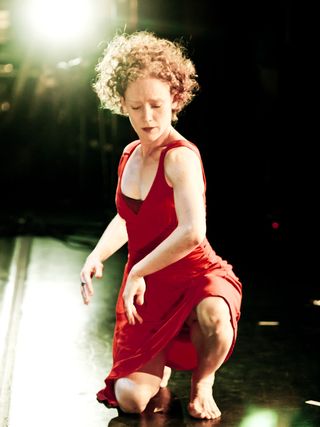
Photo: Peter Gannushkin
Hometown:
Pittsburgh, PA
Current
city: New Haven, CT
Age: 39
Attended
an arts high school? Throughout high school, I divided my schedule between
academic classes and pre-professional ballet training. At sixteen, I moved to
NYC to attend the School of American Ballet and completed high school at the
Professional Children's School.
College
and degree: BA in English, Yale University, 2006 (completed at age 32)
Graduate
school and degree: MA in American Studies,
Yale University, 2011 (completed at age 37)
Website: http://pantheon.yale.edu/~ecc34/file/Emily_Coates.html
How you
pay the bills: Currently, I'm a full-time faculty member at
Yale, where I direct the dance studies curriculum housed in Theater Studies.
All of
the dance hats you wear: Dancer, writer, choreographer/multi-media artist, curriculum devisor and professor.
Non-dance work you do: Some of the work that I
do now may seem like "not-dancing"–such as producing student work,
maintaining budgets, grading papers, designing syllabi, administrative work for
the curriculum, etc. But in the end, all of these activities relate to being an
artist in the world.
———————–
Describe
your dance life in your….
Teens…..
When I
was a teenager, I wanted to write fiction. Actually, biomechanical engineering
and brain surgery were in the mix then too, mainly because they sounded impressive
and far beyond my reality. But it was dancing that most forcefully tapped me on
the shoulder. I took my first dance class at age four in Brussels, Belgium,
where my family lived for two years. When we returned to the States, I kept
dancing, danced a lot, and continually advanced. Moving to New York at sixteen and
eventually accepting the offer to join New York City Ballet sealed my fate, for
reasons I had not anticipated: the daily ritual of dancing had become part of
me and me of it. I knew and craved the feeling of dancing, and in this way it sneaked
in and became my existence. That I became a dancer is as surprising to me as
the many vivid experiences that the art form has brought me.
20s…
My
career in my 20s began one way and ended up in another. The spring that I
graduated from high school, Peter Martins offered me a job with New York City
Ballet. I spent six years at NYCB, performing in a wide array of ballets by
Balanchine, Robbins, some Martins, and others. Working with Jerry Robbins was a
highpoint. I realized early on that I was mostly interested in the people who
are dancing than in the dance they are doing, and I believe he was, too. He
used to shout at us, "Know who you are, god damn it!"
My dancing
peers during these years went on to locate their careers entirely in the ballet
world. My career went in another direction, largely instigated by an encounter
with Angelin Preljocaj during City Ballet's 1997 Diamond Project. We wore
slippers, not pointe shoes, and bare legs, and performed a contemporary
movement vocabulary.
At the
end of his piece, La Stravaganza, I danced
in a duet that culminated in a surreal kidnapping: I was shuttled away from the
classical ensemble, and absorbed into the modern dance half of the ranks. Art
sparked reality; by the end of that season, the pointe shoes, classical lines,
taut buns, architectural makeup, tutus, and inherent hierarchies of the ballet
repertoire felt alien to me. I was no longer the same dancer. In 1998, I decided
to leave the company to explore "modern dance," which unexpectedly led
me to Mikhail Baryshnikov.
Several
months after I left NYCB, I got in touch with Misha through a friend at NYCB.
He is, after all, the king of this crossover from ballet to modern dance, and I
hoped he might be willing to offer me advice. I had been wandering around lower
Manhattan, investigating different types of modern dance classes, and fallen
into a rhythm taking class at the Cunningham Studio. I survived on
unemployment, and went to see as many different performances as I could.
The next
day, he told her to have me call him; he had a job to offer me. Two weeks
later, I began rehearsing with his company White Oak Dance Project, and a
number of months after that began to dance with him. I was twenty-four years
old.
During
the four years that I danced with Misha and White Oak, we performed new works
by then-emerging choreographers Sarah Michelson, Lucy Guerin, and John
Jasperse; older revivals such as the Erick Hawkins piece Early Floating and Trisha Brown's Glacial Decoy; the newly commissioned After Many A Summer Dies A Swan by Yvonne Rainer; and PastForward, a major retrospective of
postmodern dance featuring works by Brown, Steve Paxton, Deborah Hay, David
Gordon, Lucinda Childs, Simone Forti, and Rainer, among other things.
My new
repertory had several notable features: I was now working with quite a few
women choreographers–at City Ballet, they had been almost exclusively men. And
I was learning the meaning of "postmodern dance," from the original
artists themselves.
I was also
dancing frequently with Misha. Over four years, I performed three duets with
him, in works by Mark Morris, Karole Armitage, and Erick Hawkins. Outside of
the technical feats of NYCB's repertoire (the 110th reason I left ballet was
because I hated pirouettes!), I had more space to think about presence in
performance. I had to amp up and grow up, especially in relation to Misha's
formidable stage persona. Like playing tennis with a pro, dancing with Misha
made me a stronger performer.
When
White Oak ended in 2002, I began working with Twyla Tharp's touring company.
Whereas White Oak's repertory had allowed me to think about presence, Twyla's
shot me back into a fascination with movement itself. I loved dancing her choreography
and the challenge she poses to individuals within it. If I have any "if
only…" wish with regard to dance history, it is to have been part of her
late 60s group, with Sara Rudner, Twyla, and Rose Marie Wright… I feel an
affinity for those "three broads, doing god's work," as Twyla has
described it.
By then,
I had been dancing professionally for eleven years and performed a wide range
of repertory in three different companies. Each new company necessitated
reinventing my skills and identity as a dancer. I loved it, and yet I was ready
to take a hiatus from dancing in order to return to the dream that I had put on
hold, to complete my degree at an Ivy League university. Bundling up ten years
worth of credits that I had accumulated part-time at Fordham University, I
applied and was accepted as a transfer student to Yale. I wasn't ready to stop
dancing; I saw the degree as a way to expand my professional options and branch
out as an artist.
The
decision wasn't easy. I'm deeply grateful to certain advisers, for keeping me
artistically moored. That year, I stood in a storage closet at City Center with
Twyla, stumbling to explain my reasons for wanting to be a full-time student. Six
months earlier, I had had a similar conversation with Misha in a dressing room
while on tour in Italy. Both advised me not to stop dancing. Sara Rudner
attended one of the last performances I did with Twyla's company in NYC, held
my hand afterward backstage, and said with characteristic empathy: "It's a
big change. But this will all be here for you when you're ready to return to
it." While I was a student, Twyla wrote to me in an email: "Remember,
you're a dancer."
I spent
the first year of my full-time undergraduate existence at Yale desperately wanting
to run back to my old life, and the second year realizing that I had made a
solid decision and would survive. I became an English major in order to focus
on writing. I took more pre-1800 literature classes than anyone rightly needs,
as well as courses in linguistic and cultural anthropology, Chinese poetry,
political science, performance studies, creative writing, and astronomy.
In my
last semester, I began working with Joseph Roach, a scholar of performance
studies. We spent hours discussing why Yale had no curricular representation of
dance. He was the only professor I had met who encouraged me to find
connections between dance practice and scholarly work. During one of our final
meetings, he told me that he had received a large award from the Andrew W.
Mellon Foundation and offered me a position at Yale. Thus began my teaching
career.
30s….
I've
spent my thirties fostering a career that my late-twenty-something decisions enabled.
I've been engaged in multi-faceted activities, including teaching and developing
the dance curriculum at Yale, pursuing writing and other artistic projects, and
continuing to perform.
Designing
an arts curriculum where none had existed before is a unique experience. At
Yale, we now have seven dance studies courses, a host of ancillary activities,
and a co-curricular studio-based research initiative called Yale Dance Theater,
which I also direct. The curriculum reaches outward in interdisciplinary
dialogue with a variety of other arts, humanities, and social science
disciplines. My own courses address postmodern dance in practice and theory,
cross-disciplinary performance, the history of dance, dance on film and–in a
co-taught venture with particle physicist Sarah Demers– physics and dance.
Performing
continues to feed me, as well. I've worked steadily with Yvonne Rainer since
2006. During this time she has created five new works for a small group of
inestimably experienced dancers that has come to be known as the Raindears. Other
performing experiences have folded into the mix, too. Over the past four years,
I have worked on the piece Heartbeat,
by Christopher Janney, for which Sara Rudner serves as the choreographic
consultant. I have learned a tremendous amount from these projects.
When I
turned thirty, I knew I needed to begin to develop my own work, and write for
publication–any publication, I didn't know what or where. Both have unfolded. I've
collaborated with Lacina Coulibaly on a duet and a group piece for Ballet
Memphis. Co-creating and performing with him has been enriching and revelatory.
For Performa 09, I worked with sculptor Ettun to create a performance
installation. Bronwen MacArthur has been another important collaborator.
Writing is important to me, too. I swore to myself that I would publish my first
essay by thirty-five, which I have done, and more has followed. My collaboration
with Sarah Demers has spawned workshops, public presentations, and a
science-art video that is soon to be released. All quite surprising, as life
tends to be.
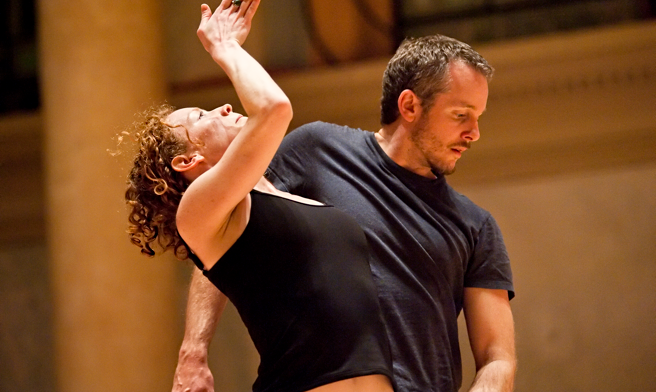
Emily Carson Coates with Alex Ketley; photo by Ian Douglas
40s…
I'm
not yet forty, so this is decade is uncharted territory, though it does raise
the subject of aging.
This
past Friday night, I saw Lisa Nelson and Steve Paxton–artists of long-standing
and astonishing investigation–perform in NYC. Yvonne Rainer is a force at
seventy-nine. At sixty-nine, Sara Rudner lifts her pinky finger and you feel
you understand dance anew. Ralph Lemon continually morphs and deepens. Just
when he seemed to have reached an apex, Misha's dancing got even richer. These
artists establish models of longevity that I believe we can all aspire toward.
I hope to cultivate as devoted, curious, expansive, playful, profound and
multi-faceted a practice as these artists whom I admire most. Above all, I aim
for their integrity of purpose.
Can you
talk about your teaching and artistic work right now?
My
current teaching and artistic work synthesizes movement practice with writing, and
operates across a range of disciplines. In my studio-based courses, I tend to
teach postmodern dance repertoire and composition, as opposed to ballet technique.
A friend once remarked that I "took the express train downtown" when
I left City Ballet, and in a very humorous way he was right, insofar as
"postmodern dance" takes shape downtown in NYC. I love the Balanchine
style, but feel more home teaching the conceptual choreography that marks the
second half of my career.
One of
the main things I'm working on right now is my collaboration with particle
physicist Sarah Demers. We co-teach a course called The Physics of Dance, and
have a contract with Yale University Press to co-write an interdisciplinary
textbook (I definitely never could have imagined that this would be my first
book publication!) We're also just completing a project called
"Discovering the Higgs," funded by the Arts Council of Greater New Haven.
Out of this, we're in the final stages of editing a video called "Three
Views of the Higgs and Dance," which we'll launch soon online. I hate
literal translations of science into choreography, and this video is not that.
We try to push both of our disciplines to be as complex as possible in
dialogue.
You have
performed with or performed in the work of several icons in modern and
postmodern dance – Lucinda Childs, Yvonne Rainier, Twyla Tharp, etc. Can you
share a few stories with college students who might just be learning about
these artists? Can you share a little window into the process, the work, etc?
I gravitate toward performing the work of Lucinda Childs, Twyla Tharp, Yvonne Rainer, and Sara Rudner, because their choreography is strongly conceptual while also physically rigorous. These women are philosophers who think through movement, albeit in very different ways. Stepping into their work feels like pulling on, for an instant, their worldview. When I performed "Carnation," Lucinda Childs's 1964 solo, for instance, I learned a feminist exactitude of a variety that was not my own (granting that she denies any feminist intent in the work!.) Sara's work is so completely her, too: I love and respect the way she lives in her movement over time. Twyla's work is different again, at once ferocious and loving. Yvonne is the quintessential artist-theorist; her body of work has guided me these many years.
One of the most important things I have learned from working with these artists is knowing who you are and being true to it. Their work comes out of a depth of self-knowledge. They can only be who they are, and their work uncompromisingly reflects that.
While I know I'm not going to produce exactly the same kind of work that they have, I carry their influence inside me. To remember what they have done and how they did it, and teach and transmit the ideas in whatever form that may assume–this is an honor.
Why and
how did you select your areas of study in college and graduate school, versus
degrees in dance?
I had
been a professional dancer for eleven years when I arrived at Yale. I knew I
didn't need to study dance; in fact what I most wanted to do was look at
everything but dance. The English
major made sense for me because it allowed me to focus on writing. I went on to
complete my master's degree in American Studies at Yale because, among other
reasons, I wanted to deepen my thinking and writing with regard to artistic production,
and American Studies is one home for cultural studies. I believe when you're an
artist, everything you do has the potential to inform your sensibility. I did
not see these degrees (or any higher degree) as incompatible with my artistic
work, but rather complementary.
Do you
still perform?
Absolutely!
One of the reasons I wanted to finish my degree was not to stop dancing, as
I've noted, but to gain a greater measure of control over my own artistic
projects. I feel fortunate to have been able to support myself in my 20's
dancing full-time. However, I had reached a point at which I didn't want to have to pay my rent through dancing,
because that meant I had to perform in anything that was given to me. Usually,
I believed in the work, but not always. The work that I perform in now–my own,
Yvonne Rainer's and other projects–I'm able to do because I'm interested and
believe in the ideas. The physics and dance workshops that I co-present with
Sarah Demers are also a kind of performance, as is teaching. So what
constitutes performing has gotten broader for me, as well.
What are
you exploring in your artistic work over the next year?
So many
things, including writing an interdisciplinary physics and dance book, for one!
Do you
still take classes? How do you train and care for your body?
My dance
practice has shifted over the years. As a ballet dancer in origin, I can say
with certainty that it's helpful to step away from ballet class for extended
periods of time in order to explore other forms of techniques, warm ups, and
movement systems. It will make you a more versatile dancer. Ballet dancers tend
not to value time not dancing–I have
come to see the value of this, too. When I step into the studio now, I feel
like a person first, and my actions feel more like me, as opposed to the
brainchild of a specific training. In a way, going to school and taking a
hiatus from dancing in my late twenties was part of some grand plan to produce
this aesthetic effect… to ground me as a dancer. This is how art and life
intertwine.
Advice
to young dancers about teaching, learning how to teach, and the role teaching
will play in their dance careers:
Teaching
is one of the greatest gifts of being an artist, if you recognize it is a part
of your practice. It can deepen your artistic work, as you can in class probe pressing
questions that you are grappling with yourself. Most important, teaching forces
you to think about the well being of others. It diminishes solipsism. I love
teaching and I love working with students. I learn from them everyday.
Current
passions and curiosities:
The
history of science and its correlations to the history of aesthetic movements
fascinates me right now….
Books,
websites, blogs that interest you right now:
The
students of Yale Dance Theater write a blog throughout the semester, based on
their experience engaging with seminal works of choreography. Their work is a
great example of having multi-faceted outcomes as an artist. For those out
there interested in the intersection of movement and writing practice: http://ydt.commons.yale.edu.
Last
performance you saw that really inspired you:
Lisa
Nelson and Steve Paxton in NYC. Longevity, humility, and commitment to the
practice–whatever that practice may be–gets me every time. Who wants to see
anything less?
Final
advice to young dancers:
Be
adventurous! Remain open! There is no one right way; there is only your way. Finding your way requires
remaining curious and open to new ideas, without judgment.
——————————-

 Life as a Modern Dancer
Leave a comment