
Hometown: Crystal Springs, Mississippi
Current city: New York, New York
Age: 31
Attended an arts high school? Idyllwild Arts Academy, 1996-2000
College and degree: BFA Dance, NYU/Tisch School of the Arts, ‘03
Website: www.trishabrowncompany.org
How you pay the bills: full-time dancer for Trisha Brown Dance Company
All of the dance hats you wear: I’ve shown small-scale pieces, mostly solos, around NYC over the past 3 years. I’ve taught intermittently, both for the company and in open classes in the city. But mostly I only wear the “dancer” hat.
————————

Photo: Trisha Brown Dance Company
Can you talk about your time at a boarding performing arts high school?
My time in Idyllwild was incredibly special and deeply formative.
It’s a rare privilege to spend 4 years of high school surrounded by like-minded individuals, particularly when coming from a part of the country where there’s very little reference point for a boy who wants to be a dancer. Going to Idyllwild legitimized my ambitions, and allowed me to rigorously train with similarly passionate young people from all over the world, working in a variety of artistic disciplines—all in an idyllic mountain landscape.
The school was small, and we worked really hard. Mornings were filled with college prep academic coursework (which we also had on Saturday mornings!), followed by 5 hours of technique and dance-related courses in the afternoon and 2 hours of rehearsals in the evening. In many ways, it was more challenging than college, especially in the sheer amount of work. In that kind of environment, you learn really quickly how to pace yourself, how to focus, and how to work efficiently. My teachers were really incredible, truly acting as mentors and parental figures in a dance department of only 30-something kids. There was a lot of individual attention, a lot of support for our own projects and interests, and really effusive encouragement. If we were worn down and lagging, they would chase us across the floor, helping us call upon deep reserves of energy and drive that helped us clear the hurdles of fatigue. My time there taught me how to direct my passion, and to believe that dedication produces enormous payoffs. It helped me build a rock-solid foundation for college and professional life in dance.
Describe your dance life 5 years after college….10 years after college…
5 years after college saw me making some pretty drastic changes. I had been dancing with Trisha Brown since finishing my BFA at NYU, working very closely with her on numerous projects, notably assisting her during the creation of a piece for the Paris Opera Ballet in 2004. We had a very close working relationship—she really respected and valued my choice making, contributions to creative process, and the way that I thought. Near the end of my time there, she and I were working alone in the studio with her choreographic assistant Carolyn Lucas. I really felt a deep privilege to be so closely connected to this seminal mind and figure in dance, and to have her express such deep faith in me.
That said, I was only 23, and I began to feel that I had reached the ceiling of what that experience could be. I began to wonder what other experiences might be out there for me, and decided—with somewhat naïve optimism—to leave the company. And the pendulum really swung in the opposite direction. I felt the need to rediscover dance as a practice of pleasure, to kick and turn and sweat, to put on music and really have fun. I started taking jazz and contemporary classes at Steps on Broadway, and began working with a couple of commercial and theatrical agencies, going out and auditioning for musical theater, commercials, and film. I had little odd jobs to pay the bills, which presented its own challenges in matching a schedule flexible enough to allow me to attend auditions and still make ends meet.
After a few months, I landed a job working on a short, independent film about the life of Louis Armstrong with choreographer Hinton Battle. It really felt like the dream job from my childhood—over 60 dancers, Beyonce’s “Get Me Bodied” blasting on repeat, cranking out choreography that fused swing and hip hop elements. It was a funny mix of people: big hip hop guys, tall blonde girls with legs for days, video vixens from LA, chiseled musical theater chorus boys… and me. I was literally a foot shorter than everyone in the room, but I was there because Hinton really loved my dancing. I still think about that job every time I hear that particular Beyonce song.
While there I ran into a friend who was dancing for Ballet Preljocaj in France, a company I had wanted to work with since discovering his work at Jacob’s Pillow the summer before moving to New York. She told me they were having auditions for men the week after we wrapped shooting. So, after lots of anxious deliberation, I took the money I had made on the film, bought a ticket the day before I left, flew to France and auditioned. Two days later, after returning to New York, I found out I had gotten the job, so I packed my life into two suitcases and started work there 5 days later. It was quite a whirlwind, and a real adventure. I hold it as a testament to the importance of taking risks and being willing to put oneself out there in this field. It was something I had wanted to do, and circumstances gave me an opportunity. And I took it.
Ironically, 10 years after college saw me back with Trisha Brown. I had returned from France after a couple of years, homesick and somewhat unsatisfied by the quality of work we were doing at Ballet Preljocaj. After doing smaller projects, notably with choreographer John Jasperse, I learned that a longtime member of Trisha’s company was leaving. Jokingly, I said to one of the company’s dancers, “Wouldn’t it be funny if I auditioned?” To which the reply came, “Don’t tease.” This little conversation made it up to the powers that be in the company, and they called, saying that if I were serious, the job was mine for the taking. I missed the work, which had always felt so much like home to my body, and I missed being able to dance full-time. So, after sitting down with Trisha and explaining my desire to return, I came back. It’s interesting to be something of a prodigal in the company, and to have such a storied relationship to the work as the company continues beyond Trisha’s retirement last year. It’s given me a real opportunity to grow with the organization, to find new ways to express a deep-seated love both for dance and for her work. And so the adventure continues!
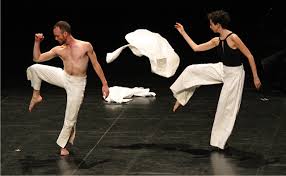
Photo: Trisha Brown Dance Company
In your work these days as a performer, what are you curious about? What are you exploring?
The field of contemporary dance evolves so quickly. It’s so hard to stay abreast of all the thinking, working, writing, etc. that informs my perspective and interests. But that’s part of what I love about the field—its volatility, its transitory nature, and the requirement of active participation.
Personally, I am intrigued by what feels like a “resurgence”—and I use that word cautiously, in acknowledgement of the limitations of my frame of reference—of highly physical, unambiguously kinetic work that I see among a handful of choreographers working in New York right now. In my little corner of the dance world, the deeply assimilated values of post-modernism have been (and understandably continue to be) ubiquitous. When coupled with a romanticized view of European dance economies, and the conceptual, more theoretical work that seems to animate those markets, it feels like recent years have been marked by a certain kind of exhaustion among performance-makers of a certain generation. As we struggle to find a voice that feels vital and authentic to our times, competing with the weight of our histories, I have felt—and again, this is just my limited opinion—that dancing has been relegated to the benches. Why invent movement, when movement feels so arbitrary, or too storied and loaded to be a sight of real innovation?
These questions feel particularly pertinent to me, being someone who has always so deeply identified, first and foremost, as a mover. The poetics of dancing, watching a body make real-time decisions in a way that will never be perfectly recreated, bridging the mysterious energetic divide between viewer and mover, are what I return to again and again. They are the things that dancing does in a way that no other art form can do. So I am particularly struck by what feels like an answer to those questions that I am seeing in the work of artists like Joanna Kotze, Beth Gill, and Juliana May, to name but a few. I am emboldened and inspired by the foregrounding of movement, as opposed to concept—and that this is being done in a way that somehow, in ways I still don’t full know how to articulate, manages to not ignore the history of 20th century art. It feels like dancing is being made new again. And that is exciting to me.
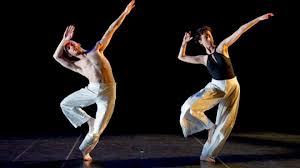
Photo: Trisha Brown Dance Company
How do you train? What non-dance practices are important to you?
In recent years, as injury and the aging process have become more and more pronounced in my body, it has become increasingly important to cross train. Dancing, as I’m sure many of us know, is not a healing practice. So going to the gym, reinvesting in the idea of “strength” after years of demonizing muscular effort, has produced a more resilient body that can cope with the continued demands of a performing career. Also, diversifying physical practices—whether with yoga, pilates, or the like—keeps the body agile and responsive.
And then, for fun, I still love to go take a good old-fashioned dance class. It’s really important to stay connected to the joy of dancing, because anything you do all day everyday becomes a j-o-b. So reminding myself of the breadth of experience available to me under the umbrella of “dance” keeps me happy and healthy. While I may have surrendered the idea of “getting better” a long time ago, I do think it’s important to have experiences inside of other value systems, and to connect with one’s interests and pleasures in order to keep a certain faith in the form.
——————

 Life as a Modern Dancer
Leave a comment