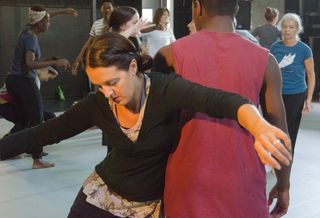
Hometown: Boise, Idaho
Current city: Eagle, Idaho
Age: 45
College and degree: Boise State University – BS Physical Education
Graduate school and degree: MA Dance, Cal State Long Beach (age 34); MFA Choreography and Performance, University of Wisconsin, Milwaukee (age 38)
Website: www.offcenterdance.org
How you pay the bills: Teach at an arts charter school
All of the dance hats you wear: Dancer, student, teacher, choreographer, artistic director (and all that goes with a very small company)
——————-
I was always interested in moving. As a child, I was a gymnast, swimmer and competitive free-style skier. It wasn’t until I was a senior in high school that I knew I wanted to dance. I consider myself a late bloomer in dance. Many young dancers begin training in conservatory schools. A number of others go into dance through competitive dance teams at studios or in their public schools. I was one of these kids. It seemed an extension of my "sports" competitive nature. I continued on this route competing in college dance teams for all five years of my college experience. Again, my scholastic interest was on the athleticism of the movement, hence my interest in obtaining a Bachelor of Science in Physical Education. My university provided full scholarships for dance team members, but did not have a dance degree.
What I found however, was that after a while the competitive nature that had driven me as a younger dancer, no longer served me as an adult dancer. I became interested in modern dance through a local dance company. I began training in classical ballet for the first time in my life. I was 29 at the time. My first pointe class was at 30. While dancing with this company, I became interested in the choreographic process, how one goes from idea to successful fruition of a dance work. I began my graduate school dance experience as an extension of this interest and enjoyed it so much, I attended and completed two dance programs.
In the thesis phase of my final degree, I was able to work with some local dancers to create a full evening concert. What I found was a need for a company with mature dancers; most of my company members are 25-35 (one is 63!). This is our sixth year as a company and we produce two concerts a year and have received numerous grants including a national Robert Rauschenberg Foundation SEED grant for new and upcoming non-profit arts organizations.
What are you exploring in your artistic work over the next year?
My process always begins with research. I start with an article I read or hear in the news and it sparks an interest in me. This is true of our newest production, a evening of dance based on the works of Edward Gorey. Both illustrations and text help define how it was created. Collaboration with musical and visual artists is also central to my work. This continues with a project in November based on the visual art of Gail Grinnell at BAM (Boise Art Museum). I am creating a work and lecture on the mind of the artist and process of creating art.
What is the role of teaching in your dance career? How did you learn how to teach?
I began teaching dance at the age of 18 at my local dance school. I consider teaching dance another way of exploring dance, analyzing how our bodies move and solidifying my own ideas about what dance can mean. I also learn from my students; they are insightful and see dance in their own way. My career has included working with students ages 3-80 in private schools, public schools and at the university level.
Last performance you saw that really inspired you:
Alvin Ailey this past summer. The dancers are amazingly strong and engaged performers.
Do you still take classes? How do you train and care for your body?
Yes I do still take class! I have to be careful to listen to what my body is telling me, however. This means less intensity and varying my training forms. I will take ballet and yoga one week and jog or train on my own the next. Additionally, I am continually attending conferences such as ACDFA, Bates Dance Festival and Velocity’s summer workshop. I have to travel to dance with my peers. Idaho is a state with a small but growing number of adult dancers and even fewer opportunities for adult dancers to train. My recent exploration in dance has been centered around flamenco dance and Spanish culture.

Bates Dance Festival…..When did you attend? Did you apply for the fellowship? What did you love about being there? Can you talk about the value of attending an iconic dance festival (Bates, Jacob’s Pillow, ADF)?
As a public school teacher, I am eligible for a number of grants for teachers. I have been the recipient of a SURDNA Teacher Fellowship, two Bates Teacher Fellowships (2011, 2013) and numerous Idaho Commission on the Arts Educator grants. In addition to working with international choreographers, seeing innovations in dance and increasing/maintaining my own technical skills, I always bring material and new teaching methodologies back with me. I am able to network with other educators and discuss dance education issues.
What is your relationship with technology as a dancer, choreographer, promoter of your work, teacher, etc?
In the last six years, I have created over 7 dance "shorts." After a workshop with Bridgman and Packer last summer at Bates, I created a work with recorded images, live shadow dance and live video projection during the same work. Another work, “In your Face,” used live projection of a Facebook page while audience members voted in a chance-dance inspired work. They were encouraged to take video and pictures while the work was performed and post comments, pictures and videos of the work in real time. In my classroom, I have seven iPads for student use, computer projection, multiple laptop carts available and even a computer lab of Mac computers with Final cut and sound editing software. Our public school is plugged in!
On the flip side, I see an even greater need for body experiences in this time of increased technology. My students need opportunities for movement and safe physical interaction with others. We NEED dance!
Can you talk a little about the modern dance scene in Idaho?
For a state with a small population, Idaho has an increasing amount of dance. In Boise alone, there is a professional ballet company, two modern pick-up companies and was the home base for Trey McIntyre Dance Company for six years. For the past three years, the Boise Dance Co-op has hosted a multi company festival style performance, encouraging up and coming artists to explore choreography. There are pick-up companies in Twin Falls and Pocatello, other small towns in Southern Idaho. Two Idaho universities have bachelor degrees in dance and a third has a dance minor. Despite these groups and university programs, the opportunities for adult dancers to train consistently is minimal. Few classes are available for pre, current and post professionals.
Final advice to young dancers:
Listen to your body…it will tell you what it needs. Don’t ignore the re-occurring injury or pain you might be feeling. Taking care of yourself now will mean a lifetime of moving.
———————-

 Life as a Modern Dancer
Leave a comment