
Hometown: I was born in Pettisville, Ohio. I grew up back and forth between Nigeria (West Africa) and the Midwest (Tri-state area).
Current city: Chicago, Illinois
Age: 43
College and degree: Florida State University, BA English Literature/Economics
Graduate school and degree: Florida State University, MFA Dance (I was 23-25)
How you pay the bills: Chairperson, Department of Dance at Columbia College Chicago
All of the dance hats you wear: Dancer, choreographer, teacher, administrator
Non-dance work you have done in the past: Food service industry, holistic health industry, after school programs
—————-
Describe your dance life in your….
20s: In my 20s I was only a few years into serious dance training as I started in college. So I was focusing a lot of my energy on that, taking class. I studied Jazz, Modern and Ballet as a non-major at Florida State University’s dance department. I was also introduced by a class offered by one of the program’s graduate students (Nia Love) to a West African dance class. Another of my FSU instructors (Kevin Vega) brought me to Florida A&M University where there was a repertory club/company (Orchesis Contemporary Dance Company). I was exposed there to more jazz and modern (particularly of the black dance lineage) as well as traditional West African dance and a broad range of guest artist choreographers. I progressed in many directions during this period. I completed undergraduate degrees in English Literature and Economics, and a Graduate Degree in Dance. I was married for a few years and had my first child at 23. I participated in a thriving community dance practice in West African dance and developed community dance programming for children. I began to develop my choreographic voice. I preferred working with large casts and exploring the landscape between contemporary African dance practice, science fiction, mythology, science and religion. I began to evolve an aesthetic that many saw as surreal. I matriculated through Orchesis Contemporary Dance Theatre to eventually lead as its interim artistic director. I left there and worked for two years as the Dance Director at Edison Park Elementary School for the Performing Arts in Fort Myers, FL.
30s: As I turned 30, I began a tenure-track position at the University of Colorado at Boulder. I worked there throughout my 30s and had two more children, one at 30 and the other at 38. I developed a distinctive contemporary dance technique, directed and administered a dance company, taught classes in the community, pursued research to support ongoing creative endeavors, taught at Naropa University in its BFA and MFA in Contemporary Performance programs, and studied with master West African dance and drumming teachers as well as Hatha Yoga teachers. I was also fortunate to have an opportunity to work in a project with the legendary Barbara Dilley, with whom I became aware of improvisation as a unifying thread through my diverse dance pedigree. During this period my work continued to be aesthetically contemporary African and also evolved significantly in formal articulation, research, and interdisciplinary collaboration. In the last couple of years of my 30s and time in Boulder I developed a group performance improvisation process called the “Technology of the Circle." During this period I also became very involved in curricular reform, and before leaving the University of Colorado served 2 years as the director of the Dance Program there.
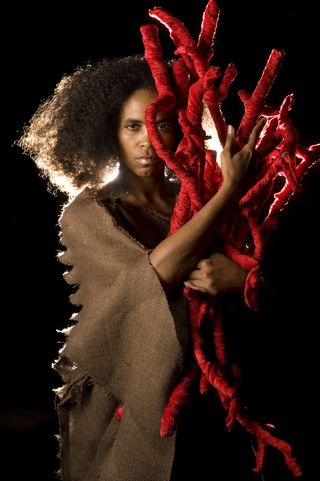
40s: I turned 40 in the last year of my tenure in Colorado. I was asked to, and I applied for the position of Chair of the Dance Program at Columbia College Chicago. During my transition here I was invited to teach at Earthdance (improvisation) and Bates Dance Festival. In the last few years I have been focusing on transitioning to a much bigger city, learning the “ropes," and beginning to participate more and more in national gatherings/academic conferences on dance. I have begun focusing a bit more energy on applying for larger grants and pursuing opportunities for presenting my work in my new city. So far I have self-presented here, and been invited to choreograph for the Nexus Project produced by The Cambrians here in Chicago. I have worked with Red Clay Dance and Ayodele Drum and Dance Theatre. I am continuing my work in curricular reform and am working to integrate serious West African and Hip Hop training and cultural concepts and frameworks into the curriculum in the Dance Department. I am also an invited member of the Chicago Dance Makers Forum Consortium, an organization that gives grants for the development of innovative work by choreographers ready to take their work to the “next level."
Major influences:
Teachers: My father (tennis coach), Nia Love, Beverly Barber, Lynda Davis, Jackie Villamil, Sensei Cliff Williams, and W. T. Lhamon and his book “Raising Cain”
Other influences:
Roots Reggae, post Black Power/Afro Centric cultural formations (a deeply cross-cultural/racial family experience), dances of the Sene-Gambian region of West Africa, Critical Literary Theory, science fiction writing of Frank Herbert and Octavia Butler, Hatha Yoga, Aikido, club dancing (free-style, house 80s & 90s, and salsa 90s), market women in Nigeria whom I watched in my childhood have babies and tie them to their backs and go right back to work. (This was probably the single most powerful influence over my continued productivity and development as a dancer and choreographer during my 20s and 30s. I did not skip a beat; my children were just raised in the studio.) I have had several deep and sustaining friendships with a number of profound artists with whom I have developed as a thinker/maker/creative being: Rennie Harris, Fara Tolno, Michelle Ellsworth, Salim Ajanku, David Capps, Darrell Jones, d.Sabela Grimes, Nzinga Metzger, and Ron K. Brown.
What are the key skills a modern dancer needs in 2015?
Be diverse AND be focused. Study specifically; know what you know and where it comes from, and where it is going and how it relates to other types of “knowing” around it. Diversify your training strategically. Think of various styles as “collaborators” in the making of you as a dancing instrument. How and why might tai chi and aerial dance and Senegalese Sabar and release technique all speak to one another, both within your body and within the communities of people/practitioners that you would traverse in the process of seeking the training? Be visionary, entrepreneurial: How can your skills add value in the world you see around you? Think outside the box. Develop the ability to articulate (talk, describe) how your dance abilities can work in many ways in many contexts.
What is on your plate/on your calendar for the next year’s time?
I will continue to work full-time as the Chair of the dance department at Columbia College. I have two choreographic projects. I will be adjudicating ACDFA in Baja in March. I am scheduled to host “The Gathering," a national convening of black female choreographers during APAP (Association for Performing Arts Presenters). I am planning to return to a regular practice of studying Bikram Yoga and a personal improvisational practice. I am engaged now in a grant-writing project to support a group improvisational project, that if successful will entail a 9 month process.
What do you look for in a dancer?
I look for a sense of grounded-ness, the ability to initiate movement from multiple places in the core, a sense of integrated and useful alignment, facility going into and coming out of the floor, a sense of ease, a clear articulation of poly-rhythm and groove. I look for an intuitive as well as inquisitive artist, one who comes to the table always as a collaborator, and one who is “leaning in" to the emerging work, one who raises the stakes just by the intensity of their concentration on what may happen.

You teach at Bates. Can you talk a little about the value and importance of opportunities to go as a student to Bates, ADF, or Jacob’s Pillow?
YES! The intensity of the summer festival, in addition to its removal from the day-to-day hustle of fitting dance classes into a full work/life/social regime, is priceless. I have experienced and I have seen dancers experience TREMENDOUS growth during these festivals. Sometimes it is just the opportunity to truly integrate training that has been working its way in for years. Sometimes it is just the slightest shift in approach or style. Whatever the case, it is a fertile environment for breakthroughs to happen in your body and mind as performer and artist. In addition, it is just a great way to meet and know dancers from around the country. We are such a kinesthetic people…dancers that you move with and eat with and see work with one summer become the collaborators that bring you across the country in a few years to present a show together and vice versa. Yes to summer festivals…..go experience.
Advice for young dancers on teaching, learning how to teach, and the role teaching will most likely play in their future careers:
I think that in a world where technology is mediating the human experience more and more, it is not going to be performance where dance will have its most far-reaching and sought for effect. I think that people can get the dance performances they want to watch and we do, in the palm of our hands anytime of the day. We can play and re-play them to our heart’s content. I think that for the work of the actual moving body, the skills that we gather through our dedication and practice will be sought for more and more in our ability to SHARE them. Dance is, more and more, going to be about participation. So learning how to teach it, in various contexts, will be crucial. How is dance taught in a studio, to dancers? In a studio, to children? In a park to people that came for something to do? Through a video screen? In a football stadium? And how can these experiences be meaningful and transformative even if brief? What effect will it have on concert dance, on dance performance? Could greater participation actually increase dance audiences? And what about Dance Studies? I think that as our society becomes more and more diverse racially and economically, it will become crucial for practitioners and teachers of all styles of dance to become good at passing on the cultural context, and frameworks of dances as they teach them, perhaps to people who are unfamiliar.
How would you describe the modern dance scene in Chicago?
Self made, consciously designed. Modern dance in Chicago is thriving I would say. Yet it is not so big that people do not know one another; they do. There are a number of mechanisms that have been thoughtfully constructed to facilitate the development of the dance community, and both the creative and administrative development of its dance makers and company directors. I think that it has some room to grow in terms of crossover between modern dance and other contemporary dance communities. The possibilities are endless and opportunities are developing all of the time.
Final advice to young dancers:
The body’s movement is a way of knowing. Believe that. Be relentless in pursuing this knowing. ALSO be relentless in pursuing an understanding of HOW and WHY movement is a way of knowing. If you do this, you will have actual value to offer, and then it is just a matter of communicating what you have to those in need. Trust me, there is need. Every living body needs the experience you are collecting, and they need it in their most primary and intimate space. So feel confident that you will always have work, more than you can do. It just a matter of showing people how and why they will derive value from what you have to offer.
—————-

 Life as a Modern Dancer
Leave a comment