The American Dance Festival is one of the most important festivals and summer training programs in the United States. 2015 marks the 82nd year of ADF. Please join us on the blog this summer as Leah Cox, Associate Dean, offers a window into the festival through her lens as artist, teacher, administrator, and audience member. To read Leah's artist profile, click here.
—————–
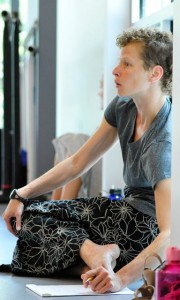
Photo: Grant Halverson © ADF
This past week in Choreolab, we've taken the monumental step of introducing language into our process. Talking about our experience of dance, either as the mover or the engaged viewer, has proven immensely complicated. We realize how language can thin things out, and how linear it is. In describing a single moment of movement, we must say so much! It can take minutes to flesh out in words a single, fleeting moment of dance and all that was contained within it for us. We cannot re-create the experience of those marvelous, simultaneously-occurring sensations in language that we experience in dance. In attempting to do so, we inevitably string out the experience. This flattening, or spreading out of a single moment over time through language, is unavoidable; it's what language does to any moment.
A variation of this same idea in a slightly different light, with slightly different implications: We've spent a lot of time cultivating our physical intelligence and our awareness of sensations when we move or watch people move with our whole self as an engaged observer. In moving to language to articulate our experience, we've realized the inadequacy of a word or phrase of words. For instance, I can say I thought something was exciting, but that word alone seems woefully inadequate to capture the layers of my experience. What does it feel like for me to be excited? What's the particular tone or quality of it? And moreover, my excitement is nestled in time: I realize in explaining it, I must address what caused it and the many places my excitement points to. The before and after of excitement are part and parcel of it: there's a trajectory to, or of, the sensation. This past week, we have come to realize that, while every sensation is embodied, else how can we feel it, the issue of expressing that sensation as a single word once we've had a richer, fuller sensation of a given emotion results in using language differently in order to express that this experience of a particular sensation is different, somehow, from our previous experiences. We've created, in effect, a new, more embodied experience of the word for ourselves that results in the impulse to redefine it in language.
Finally, we've discovered idea-experiences that cannot be described, transcribed, or translated fully into language. We've discovered what language can only point to or talk around. We've discovered the knowledge that there are some things that only live as experiences. This, we might say, is the body's knowledge. Where language proves inadequate, we find movement and the live moment's exclusive power. These are the building blocks of dance.
——————–

 Life as a Modern Dancer
Leave a comment