The American Dance Festival is one of the most important festivals and summer training programs in the United States. 2015 marks the 82nd year of ADF. Please join us on the blog this summer as Leah Cox, Associate Dean, offers a window into the festival through her lens as artist, teacher, administrator, and audience member. To read Leah's artist profile, click here.
—————–
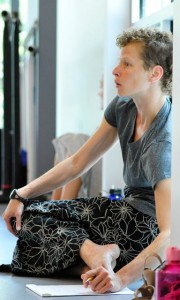
Photo: Grant Halverson © ADF
One of the greatest things we have as part of Choreolab is the festival performance season. It allows us to consider the experience of choreography-as-process against the experience of choreography-as-performance. We learn so much by being an audience, encountering different aesthetics and the realization of creative, physical logics onstage. The performance season’s wide scope enables us to see how makers with different value systems make those systems known—how the work communicates its own horizons. Through performances, we can analyze so many things: How does the work fulfill its promised scope? How does the work’s value system resonate in the larger world of dance and/or our current historical moment? Can we trace the work’s lineage, where it’s coming from as part of dance’s diverse history? What makes a work feel relevant to this moment in an undeniable way? What makes a work feel timeless? When does a work feel formulaic in its composition—as if we can see the bones outside of the skin, a bit too (predictably) exposed—and when does the work feel like its bones are inside its skin and working to create a marvelous, unexpected life form?
And… how do we share our ideas about a performance without fear of being judged? I believe that working from the seat of curiosity and dispassionate (which is not the same as uninvested) analysis enables us to separate our personal aesthetic from our analysis of other makers’ dances. Whether a performance evidences and serves as validation or justification of our personal aesthetic is less important than is our ability to understand the piece on its own terms: what’s activating in any given work and what is it doing? For many people, it’s scary to share their ideas about a given work because they fear that their opinion will impact others' assessment of their artistic credibility as choreographers (as in, if I indicate that a given work is valuable to the discourse, it means that I might as well have made the work). However, this is unreasonable and fails to serve the work and the person expressing their many-layered ideas about the work. It’s best to evaluate a dance on the terms it sets out for itself and to assume the person speaking to that work has the sophistication to differentiate her own aesthetic from that of the work she is encountering. To experience work as an audience member with the need for validation—to wit, that the work embodies one’s own values—is unfair to all parties. Such an approach perpetuates single-mindedness, erasing complexity and the horizontal perspective that there are many equally valuable points of view and value systems evidencing themselves in the performance landscape.
——————–

 Life as a Modern Dancer
Leave a comment