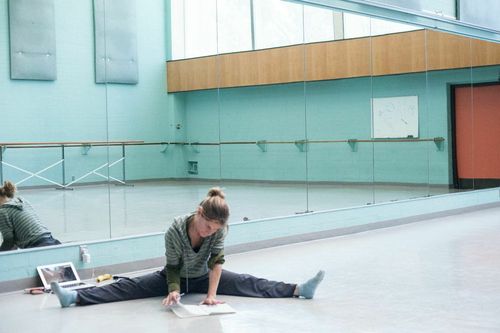
Kate Weare; photo by Keira Heu-Jwyn Chang
Over the past 3 years, choreographers have shared on the blog about their weekly schedules, balancing artistic and administrative work, and paying for projects. Below are thoughts from New York based choreographers Kate Weare, Ivy Baldwin, and Rebecca Lazier as well as Los Angeles based choreographer Stephan Koplowitz. Click on any name below to read an artist's full profile.
—
From Kate Weare:
My weekly schedule varies depending on the number of gigs I’m balancing at one time, between making new work for my company, rehearsing touring rep, creating outside commissions, teaching, actively touring, or various fundraising activities. The only two totally constant activities are being in the studio and managing administrative work alongside my executive director. Administration is a huge part of being a choreographer, in my experience, and never ceases to feel like Atlas carrying the boulder up the hill. Balancing the artistic and business poles did not come naturally to me. I’ve had to work hard at it and I’ve made a lot of mistakes. But one thing I routinely re-assess is whether the company is serving me as an artist, or I am serving it. The balance must be right or the whole thing is wrong.
From Ivy Baldwin:
Balancing the artistic and business sides of running your own dance company is an enormous challenge, and frequently, a real struggle. This past year, I was able to hire a part-time manager/producer, Meredith Boggia, to help with the administrative needs associated with the BAM premiere, and that has been incredibly helpful. We meet a minimum of once a week for 4-5 hours or so, and then there are many, many emails that go between us the rest of the week. Otherwise, I often spend 3-4 hours minimum every day on administrative activities. In addition to my weekly times in the rehearsal studio, I try to carve time out each day to just sit and think about my current work, write in my journal, watch video from rehearsal, read, listen to the score – whatever feels inspiring or helpful to the process.
From Rebecca Lazier:
There are weeks where I am full-time on company related rehearsals and administration. But during the semester I teach 2-3 days per week and I try and reserve two days a week for combined self-care (taking class, swimming, gyrotonic) and administration. I would love to have a weekly rehearsal schedule but intensive work during breaks from Princeton are more common and easier to schedule.
From Stephan Koplowitz:
Take what you do seriously. One of the best pieces of advice I was given was by Stuart Hodes when he first started working with me (he performed in three of my works over 9 years). After listening to me self-deprecating about my work, he interrupted and said to me: “If you don’t think you’re work is as important as Martha’s or Paul’s or Twyla’s, then why bother? You have to feel as though the world needs to have your work in it; you need to think and believe that what you are doing is as important as their work.” Stuart wasn’t saying my work had to be as “good as," just that I needed to believe in what I was doing at the same level of passion as his previous mentors and friends. It was a needed wake-up call. It made me stop with the excuses and negativity and gave me the confidence to ask the world (my community) to support my vision.
Another word of advice is this: do not be afraid to get/ask for the information you need when starting a project. Make sure you communicate clearly to your collaborators (performers, composers, costume etc). Have real conversations about what you expect and what they can expect from you. Think carefully about how much time and money a project is going to cost you and them. Do your research.
I made a decision very early in my career to take a full-time teaching position because having the security of a paycheck (and one coming from something related to my chosen field) gave me the freedom to use my time to focus on the projects that interested me. I didn’t have the stomach to be a “free-lancer," something that at first I felt would hinder and make it impossible for me to achieve my goals. But my passion to make work sustained me, and I worked consistently outside of my teaching responsibilities. I am by nature an impatient person, but my life has taught me to be extremely patient with both myself and with life.
Remember that the performers you work with and collaborate with are not tools but human beings who are giving you their time and a part of their soul. This goes beyond a paycheck. Try to make the process a success, not just the product (if you lose sight of that, you’ll lose sight of the humanity inherent of working in the performing arts).
————-

 Life as a Modern Dancer
Leave a comment