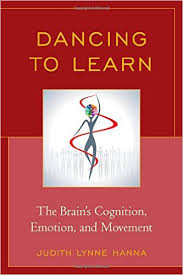
About Dancing to Learn: The Brain’s Cognition, Emotion, and Movement
By Judith Lynne Hanna, PhD
My interest in dance began in 1946 when a pediatrician told my parents that dance would make my flat feet strong. So I studied ballet. I don’t think it helped my feet, but studying many different kinds of dance has made me stronger physically and mentally and engagement with dance and anthropology led me to further explore the power of dance. When I discovered that brain scientists were studying dancers’ brains, I got excited and delved into their findings.
This exploration led to Dancing to Learn: The Brain’s Cognition, Emotion, and Movement (Rowman & Littlefield,2015). Recent research reshapes our understanding of dance based on profound shifts in knowledge about the brain, the human’s most unique, complicated, and precious asset.
My decades of dancing, teaching, studying about dance, and being a dance critic, as well as familiarity with the arts, humanities, and social and behavioral sciences, obviously influence the book’s focus. I draw upon my prior research that I rethought in light of recent groundbreaking revelations in the brain sciences. These discoveries are especially meaningful to me because they support aspects of fieldwork and theoretical analyses begun in the 1970s and reported in earlier books.
Dancing to Learn explains that dance is nonverbal language with similar places and education processes in the brain as verbal language. Thus dance is a powerful means of expression and communication.
Dance is physical exercise that sparks new brain cells (neurogenesis) and neural plasticity, the brain’s amazing ability to change throughout life—as a septuagenarian I'm still dancing—now flamenco, belly dance, jazz, and salsa! Moreover, dance is a means to help us cope with stress that can motivate or interfere with learning.
We acquire knowledge and develop cognitively and emotionally because dance bulks up the brain and, consequently, dance as art, recreation, education, and or therapy is a good investment in the brain. The brain “choreographs” dancer-maker, dancer, and spectator, and they change the brain.
To purchase the book: https://rowman.com/ISBN/9781475806052
For more information: www.judithhanna.com
—————–

 Life as a Modern Dancer
Leave a comment