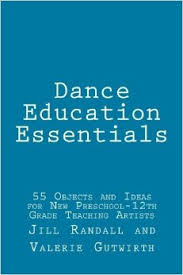
In August 2014, Valerie Gutwirth and I published a pocket guide/journal of 55 teaching tips we wished we had learned before embarking on a career teaching children and teens. This book is not teaching advice about content or lesson planning; it is about those essential details – the brass tacks (teaching supplies, paychecks, shoes for teaching, observing at the school before you begin, protocol for days when you are sick…). Whether you are teaching one class a week or twenty, these tips are practical and easily applicable right away in a wide variety of teaching settings including in a studio, preschool, or K-12 school. Since many dance teachers teach a variety of ages within a given week, Dance Education Essentials touches upon ideas that are universal to all dance classes as well as some specific to preschoolers, elementary age students, and teenage students.
For the next few weeks, we will share some of these teaching tips. If you would like to purchase your own copy of the pocket guide/journal ($7.99), click here.
We welcome college professors to print out these teaching tips and use within a college course on dance education.
———————————
TOPIC: BOOKS, WEBSITES, AND RESOURCES
Tip #18: The Local Public Library
Get to know your public library and especially the children’s librarian. Introduce yourself, talk about what you are looking for in terms of linking literature and dance, or ask for ideas. Check in monthly, and/or when you are developing new units or lessons. Subscribe to, or bookmark on your computer, the blog Dancing Words (www.dancingwords.typepad.com) to find out more about children’s books on dance and books that can be springboards for dance explorations.
Tip #54: For Your Bookshelf – Essential Dance Education and Child Development Books
Don’t be fooled by the copyright on some of these books – the information is timeless. Many of these books can be purchased used on amazon.com:
- Body, Mind, & Spirit in Action: A Teacher’s Guide to Creative Dance by Patricia Reedy; http://lunadanceinstitute.org/publication/
- Creative Dance for All Ages: A Conceptual Approach by Anne Green Gilbert
- Step by Step: A Complete Movement Education Curriculum by Sheila Kogan
- Wonderplay by Fretta Reitzes and Beth Teitelman
- Yardsticks by Chip Wood
- Brainstorm: The Power and Purpose of the Teenage Brain by Daniel J. Siegel, M.D.
Tip #53: Websites, Email Lists, Blogs, and Workshops
Valuable resources for dance educators include:
- NDEO (National Dance Education Organization; www.ndeo.org
- Luna Dance Institute; www.lunadanceinstitute.org
- Dance Education Laboratory (DEL); www.danceeducationlaboratory.com
- Lincoln Center Institute (LCI); www.lincolncentereducation.org
- National Dance Institute; www.nationaldance.org
- Eric Booth (leader in the field of teaching artistry); www.ericbooth.net
- Teaching Artist Support Collaborative of California (TASC); www.tascofcalifornia.org
- Edutopia; www.edutopia.org
- Dancing Words Blog (children’s books on dance and books to be used in dance classes); www.dancingwords.typepad.com
- Dancers Using Technology Blog (the many intersections of dance and tech in art and education); www.dancingwords.typepad.com/dancers_using_technology
- Life as a Modern Dancer Blog (artist profiles, including many ideas related to becoming a teaching artist); www.dancingwords.typepad.com/life_as_a_modern_dancer
Tip #55: Dance Standards and the Common Core Standards
Standards and Common Core – get to know them even if you aren’t required to use them. The language of the standards can be very helpful when planning for an age group new to you. The NDEO website contains a lot of information, including the standards for early childhood education (www.ndeo.org). Also, check out the K-12 visual and performing arts standards for your particular state. The new Common Core Standards are at http://www.nationalartsstandards.org/.
———————————
About the authors:
Valerie Gutwirth began teaching dance to children in high school. She graduated from Connecticut College in 1984, and received an MS in Early Childhood/Elementary Education from Bank Street College in 1992. She has taught movement, dance, and fitness classes to people from birth to age 80+, from Mommy and Me classes in church basements to Juilliard’s dance department, and everything in between. Valerie’s dance and performance experience includes companies in New York (1984-1991) and the San Francisco Bay Area (1995-present), most recently with Paufve Dance and the dance/singing/ body percussion group MoToR. Valerie has been thrilled, inspired, and challenged as a dance teacher in the Berkeley, California public schools for the past 17 years.
Jill Homan Randall graduated from the University of Utah in 1997 and has been teaching dance, or directing arts education programs, ever since. In the San Francisco Bay Area, Jill has taught in a wide variety of settings including preschools, community centers, dance studios, and public and independent K-12 schools. From 2004-2006 Jill was the Director of Education for the Lincoln Center Institute affiliate in Berkeley, California, and from 2006-2010 Jill directed Shawl-Anderson Dance Center. Jill currently teaches dance full-time at The Hamlin School in San Francisco. She has performed extensively with Nina Haft & Company and Paufve Dance. As a dance writer, Jill maintains three blogs on children’s books on dance, careers in modern dance, and the intersection of dance and technology. In 2013, Jill received the Herbst Foundation Award for Teaching Excellence.

 Life as a Modern Dancer
Leave a comment