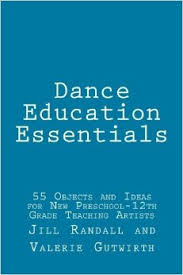
In August 2014, Valerie Gutwirth and I published a pocket guide/journal of 55 teaching tips we wished we had learned before embarking on a career teaching children and teens. This book is not teaching advice about content or lesson planning; it is about those essential details – the brass tacks (teaching supplies, paychecks, shoes for teaching, observing at the school before you begin, protocol for days when you are sick…). Whether you are teaching one class a week or twenty, these tips are practical and easily applicable right away in a wide variety of teaching settings including in a studio, preschool, or K-12 school. Since many dance teachers teach a variety of ages within a given week, Dance Education Essentials touches upon ideas that are universal to all dance classes as well as some specific to preschoolers, elementary age students, and teenage students.
For the next few weeks, we will share some of these teaching tips. If you would like to purchase your own copy of the pocket guide/journal ($7.99), click here.
We welcome college professors to print out these teaching tips and use within a college course on dance education.
———————————
TOPIC: OBJECTS
Tip #43: Blue Tape
For teaching artists working with preschoolers and elementary age students, blue tape is a simple and effective teaching tool to keep in your bag. This is “painter’s tape” that is blue in color. It is the kind of tape that easily and safely comes off of wooden floors, marley, and walls. Young students need visible and concrete cues to help them know where to stand, where to move to, and where to move from. You can easily make a large circle by placing enough small, one-two inch pieces of tape so that everyone can “find a spot” when you want them in a circle. Blue tape is also great to make lines, for traveling work across the room, and for labeling your stuff. You can purchase blue painter’s tape in bulk at the hardware store, Target, or Home Depot.
Tip #44: Sneakers
Wear sneakers if you’ll be teaching on concrete or a very hard surface. Your students might be barefoot, but they are dancing for 30-45 minutes, not five classes in a row. Invest in a cushioned pair of athletic shoes to take care of your feet and to prevent shin splints and plantar fascitis.
Tip #45: Band-aids and First Aid Kits
Keep a box of band-aids in your studio space. Better yet – have a first aid kit with latex gloves and antiseptic wipes as well. If you are teaching young children, you will need a band-aid policy: if they hurt themselves IN DANCE CLASS, they get a wipe and a band-aid. Without this policy, you could be supplying 100 band-aids each week.
Tip #46: Kleenex and a Garbage Can
You’ll need both of these staples in your classroom, hopefully next to each other. The school secretary will know how to get both, and the custodian will deal with the garbage. During your first class, point out the Kleenex to the kids.
Tip #47: Props from PE
Find out what props the PE department has and would be willing to share (and the quantity of each) – hula hoops, poly spots, gymnastic mats, ribbons, small balls, cones, and more. Ask how to sign out items, where items are stored, and how soon the props need to be returned.
Tip #48: A Big Bag
The big IKEA blue bag – the one sold at the checkout for 99 cents – is the easy way to carry tons of teaching supplies. Next time at IKEA, consider purchasing about 3 of them to help you transport and store supplies.
Tip #49: Teacher Discounts
Some dance stores and other clothing stores like Lululemon offer discounts if you show proof of your teaching. This might be a teacher ID card, the teaching schedule in print, or a paycheck stub. You can even ask at stores like the fabric store if they would offer a discount for the material you are purchasing for a public school project.
Tip #50: Props
Students of all ages love them (hoops, balls, ribbons, large pieces of fabric, chairs). With younger students, consider that you might need enough props for each child in the room (ex. 20 ribbons); young students will struggle “taking turns” and you also want to keep the class rolling along without kids sitting for long. No props available? See if the principal might find enough money for one set of new props each year ($50 or so).
Tip #51: Homemade Teaching Supplies
Supplies and costumes – what can you easily and cheaply make?
——
About the authors:
Valerie Gutwirth began teaching dance to children in high school. She graduated from Connecticut College in 1984, and received an MS in Early Childhood/Elementary Education from Bank Street College in 1992. She has taught movement, dance, and fitness classes to people from birth to age 80+, from Mommy and Me classes in church basements to Juilliard’s dance department, and everything in between. Valerie’s dance and performance experience includes companies in New York (1984-1991) and the San Francisco Bay Area (1995-present), most recently with Paufve Dance and the dance/singing/ body percussion group MoToR. Valerie has been thrilled, inspired, and challenged as a dance teacher in the Berkeley, California public schools for the past 17 years.
Jill Homan Randall graduated from the University of Utah in 1997 and has been teaching dance, or directing arts education programs, ever since. In the San Francisco Bay Area, Jill has taught in a wide variety of settings including preschools, community centers, dance studios, and public and independent K-12 schools. From 2004-2006 Jill was the Director of Education for the Lincoln Center Institute affiliate in Berkeley, California, and from 2006-2010 Jill directed Shawl-Anderson Dance Center. Jill currently teaches dance full-time at The Hamlin School in San Francisco. She has performed extensively with Nina Haft & Company and Paufve Dance. As a dance writer, Jill maintains three blogs on children’s books on dance, careers in modern dance, and the intersection of dance and technology. In 2013, Jill received the Herbst Foundation Award for Teaching Excellence.
———————

 Life as a Modern Dancer
Leave a comment