
Photo: Valerie Oliveiro
Hometown: St. Croix, U.S. Virgin Islands
Current city: Urbana, Illinois
Age: 54
College and degree: BFA – Adelphi University
Graduate school and degree: MA – New York University; PhD – New York University
Website: www.cynthiaoliver.com
How you pay the bills: University professor
All of the dance hats you wear: Choreographer, dancer/performer, teacher, collaborator.
Non-dance work you have done in the past: Modeling (runway, print, artists’), exercise instructor, receptionist, temp, studio/project manager, company manager, actor.
————————-
Describe your dance life in your….
20s: My 20s were hot and heavy. I danced at every chance I got. I danced with companies (Young Soon Kim, David Gordon, Nanette Bearden), on independent projects, in industrials. I auditioned for everything – even musicals despite not being able to sing! It was fun. I assumed I knew nothing, learned from everyone, toured the globe, made mistakes, had great successes, endured devastating loss (during the AIDS epidemic), worked very hard, enjoyed learning all about the city and dance world in New York and everywhere a tour took me.
30s: I began honing in on what really excited and meant more to me. Focused my dancing/performing/creating. Spent time with folks who changed my worldview and fortified me and the aesthetic choices I made relative to the values and life I was living – Laurie Carlos, Ronald K. Brown – and creating a body of my own work (with my composer husband and collaborator Jason Finkelman) was where I spent most of my creative energies at that moment in time. I was also in graduate school – NYU Performance Studies – bolstering my discoveries in the field with intellectual questions, challenging my own and other ideas I had encountered. Making new work relevant to those challenges.
40s: Making big changes in my life. Taking an academic job in a dance department. Becoming a mother. Experiencing fab dancing opportunities like working with Bebe Miller. Continuing to make my own work and have it move in the world. Then encountering cancer in my last year of my forties and having to fight for my life.
50s: Hopefully surviving cancer! Being challenged in the gorgeous works of Tere O’Connor, continuing my own and working with Leslie Cuyjet in our duet BOOM! Publishing more of my writing. Keeping going. Thinking about a slow shift in my own performance interests but maintaining my interest in making work and having it seen/discussed.
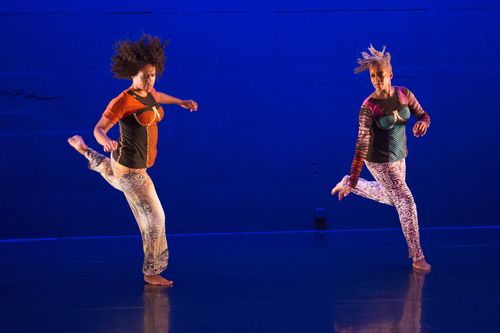
BOOM! Photo: Yi Chun Wu
Major influences:
The Caribbean where I grew up, my parents (Mary and Everett Oliver), and the worlds they exposed me to. My son Elias, who I am trying to protect and equip him for and from the dangers of a world that does not value his black life the way it should. Women who have made pathways for us (black women) to do the aesthetic creative work many of us do… Toni Morrison, Patricia Williams, Michelle Wallace, Lorna Goodison, Laurie Carlos, Dianne McIntyre, Jawole Zollar, Lorna Simpson, Carrie Mae Weems, Barbara Browning, Kara Walker. And the men…I read lots of James Baldwin as a young person and am returning to him. I have recently read Ta-Nehisi Coates, and am so moved by his clarity. Fred Moten. Stuart Hall. William Pope L. Arthur Jafa. Kehinde Wiley. Hilton Als. Tommy DeFrantz. And so many others.
Mentors/someone who believed in you:
My mother. Atti van den Berg. Randy Martin. Laurie Carlos. Barbara Browning.
Can you talk about your performing career with artists like Bebe Miller, Ronald K. Brown, and Tere O’Connor? How did you land these gigs (auditions, seen in class, etc)?
Well, this is a long and circuitous story. Hahaha. This is about measures of time. With all of these artists, I had been following their work for many years. With Ron, I had seen his work off and on whenever I was in town and not touring myself. I had followed it and was interested in it for a long time. Then I saw a work that changed everything for me. It was his Combat Review: Witches in Response, a multi-ethnic cast of amazing dancers/performers at P.S. 122. Jawole and I went to see it together. I turned to her afterward and said, “I have to do this.” I told Ron the same after that show, and he called me as he started thinking about and working on his next work (Dirt Road). We toured that work for a number of years and went on to do other great works.
With Bebe, I had known her for years as well. I had even auditioned once in my twenties and hadn’t gotten very far (she cringes at this story). And I am not sure what prompted her to ask me to join her in Necessary Beauty, but I was surprised and thrilled. I jumped at the opportunity and spent the next two years really enjoying being in close proximity to her and her ideas. We had a lot of great evenings with glasses of wine and the exchange of personal stories and big and little ideas.
With Tere, we were chatting with David Thomson at my 50th Birthday party and Tere asked if David and I had ever worked together. David and I realized that in all the years we knew each other – in that tiny population of black people in the “downtown” New York dance world in the 80s and early 90s – we had not. Tere said he would make something for us. We laughed and said, “Yeah. We’ll hold you to that.” But we didn’t have to. He called the next spring and said, “Let’s do it!” And he made Sister as the third of his three pieces that would inspire the larger work BLEED.
So with each of these performing experiences, a lot of it was time. Getting to know each other and seeing our trajectories as harmonious and compatible, even if we didn’t always agree. There is a high regard, a deep respect for one another, and I honestly love all these people.
Can you talk about dancing in Sister, and your growth as a performer over time? What do you continue to love about performing? What are you exploring right now in your performing work?
Sister was a challenge for two reasons, I was still recovering from the ravages of cancer treatment (chemo) on my body despite having made the duet BOOM!, which premiered in 2012 (with Leslie Cuyjet), and because it was the first time in a long time that I was the dancer/collaborator and not the maker of the work. I hadn’t been in someone else’s work since Bebe’s Necessary Beauty in 2008. This was 2013. So five years had elapsed and that is a LONG time for a performer. But I was up for the challenge, as it was also a moment for me to reclaim my body from illness and to be in a space with two men I adore and trust to make something uniquely for us. It was hard tho. Tere doesn’t suffer fools. He is a choreographer’s choreographer and his concern is about the shape and detail of the work. If your body hurts (which happens way more often at 50 than it does at 20, 30, or even 40!), you gotta figure it out and work through it because his concern is outside of that. That’s the dancer's world to negotiate. That’s our job. His resides in the piece itself. So we laughed a lot – a strategy he also uses to get you to somehow do what you think yourself incapable of. At the same time, he built something fabulously designed for David and I. It brought together many parts of us and then some. It enlivened worlds of reference that might be placed upon our bodies in the contemporary world without our consent and those that we consciously proffer and perform. We talked about all of this and about David and my own experiences as Caribbean people. This for me, is the thing I love about performing, not necessarily the performing itself, which is nice to share the work with others and hear about their experience, but more the intimacies of each process and the ways we make these worlds that we live in for a time which we then change. It changed as we toured and then it was gone. And now we are all on to other/new things. We move. That’s dance right?
The role of teaching in your career….what is the interplay in your work between art making and teaching?
That used to be a difficult synchronicity for me and has become less so. My worlds as a freelance artist were often separate. When I lived in NYC, I taught to pay rent. I danced with others for sheer satisfaction of doing, being in and testing the limits of my body. I made work because I felt I had a perspective, a point of view worth making manifest and wanted to see if I could do so. However, an academic job forced me to bring these worlds together. I had to think economically so that I was not pulled in directions that just exhausted me without return. I wanted to be a good teacher and learned how via pedagogic workshops as a young professor which were really helpful. I figured out how to connect my research to my teaching, my world views and cultural values to notions of technique, and to wrest what I did in the studio with students from the enforced hierarchical, biased and pervasive canon we have to negotiate in contemporary dance worlds. And lastly, I began using my choreographic experiments in the academy as research for what I do in the professional sphere, instead of simply as service (a nice piece to make on a couple dancers). Connecting everything taught me how to go more deeply in all areas of my research and the ways in which my ideas were connected even if I hadn’t initially thought them so.
What inspired you to get your PhD? What did your dissertation explore and research?
I didn’t set out to get a PhD. I came to a crossroads in my career. I had achieved my high school dream of dancing with a company (companies) and touring the world early and quickly. I had traveled a lot by my late 20s and suddenly I thought, “Is this it?” So I started searching for other interests. I was going to try arts management. I thought being in front of the curtain would assist behind the scenes. I took a position as manager of Urban Bush for a year. While I made lifetime friends with Jawole and others in the group, it was not an area I was interested in pursuing. I went into an interdisciplinary program at NYU’s Gallatin School and started along a path that led me to Performance Studies, where I found my passion. I went on to a PhD because as I was defending my Masters Thesis I was literally thinking…”I haven’t mastered anything!” SO I kept going and here I am 12 years out from having defended and now am considered a senior professor. Time is funny. My dissertation was a study of pageantry and black womanhood in the Caribbean. I used beauty pageants – which are plentiful in the region, as a means to discuss gender, nation, sexual and economic politics in the history and present of the US Virgin Islands. It also related to the excavations I had been doing choreographically throughout my career – that of exploring women’s worlds, always somehow anchored within Caribbean traditions and practices even if not overtly so.
What is on your calendar for the rest of 2015 – performing, teaching, scholarly work?
I am shaping up some writing for publication. I will be performing BOOM! or excerpts of it in Portland, Oregon, Chicago, Illinois and Dallas, Texas over the next 9 months. And I am continuing my teaching here at the University of Illinois. I have taken on the position of MFA Director in our program, so I am getting used to that responsibility.
What are the skills a modern dancer needs in 2015?
Flexibility and sharpness – sure, in relation to what our bodies can do, but even more importantly in your life practice. As human beings. Critical thinking. Fearlessness about so many things. And a willingness to speak back to power. Change the world. But not to attempt doing so without looking at ourselves first.
Can you offer three questions for modern dancers around the US to consider?
In what ways are you making a world you want to live in? In what ways might you not be? Does your art serve a purpose beyond being satisfying to you? What is it?
Advice for dancers about writing about dance, and the many ways writing might be a part of their artistic life.
We SO NEED dancers' voices. For so long others have interpreted us. Let’s interpret ourselves. Let’s give ourselves the authority to write about what we already know and be our own gatekeepers. Let’s write (generously!) about our work and about each others’ work. It’s not easy, especially when we feel like we are competing against one another for so little. But if we can find the generosity to write about what we are each trying to do, and how we are trying to do it, there is great value for us all in that. And the only way to get better at it is the same way we have treated our technical skills….is to do it over and over and over again.
Final thoughts – hope/belief/love of the profession:
I LOVE dance. It has saved my life so many times. It has taken me across the globe and introduced me to folks and cultures I would never have known. It constantly challenges and humbles me. It is my tried and true personal, spiritual and communal practice. And I’m not just talking about studio dancing. I’m talking about all of it. My Friday night dance parties with my husband and 11 year old son. I’m talking about the ritual of the club (and its remnants in my now 50 something body). I’m talking about the Orisha dances I have studied for decades. I’m talking about the wiggle my mother does in her wheelchair at 88 when she feels the notion. As well as what I do my best to offer an audience when they come and see a work I have made. I love dance in all its glory. I live for dance.
——————-

 Life as a Modern Dancer
Leave a comment