
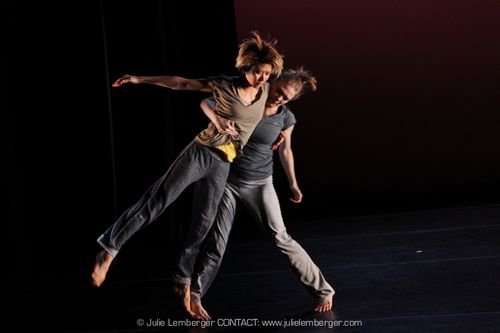
Photo: Julie Lemberger 2015, at NYU Tisch School of the Arts
Hometown: Eugene, OR
Current city: Brooklyn, NY
Age: 40s
College and degree: BA in Dance, University of Oregon Honors College.
Graduate school and degree: MFA in Choreography, Ohio State University. (I earned my graduate degree in my 20s.)
Website: www.tiffanymillscompany.org
How you pay the bills: I work solely in the arts, primarily as the artistic director and choreographer for the Tiffany Mills Company. Also, I am frequently commissioned to choreograph at colleges/universities and to set work on other professional dance companies. As well, I regularly guest teach in NYC and nationally at dance centers and festivals.
All of the dance hats you wear: As an artist, I wear multiple hats: choreographer, artistic director, dancer, teacher, and arts administrator (development, marketing, finances, etc.) for the Tiffany Mills Company. Throughout it all, I am constantly fundraising. At the moment, I am in the midst of running a Kickstarter campaign for our 15th anniversary season. Take a look: https://www.kickstarter.com/projects/tmc2015/tiffany-mills-company-is-performing-at-la-mama
——————
Describe your dance life in your….
20s: My 20s were a time to explore and to be free. I was open to all possibilities in terms of putting my work in front of an audience. At the time, I choreographed short works (typically 10-20 minutes in length), which were highly mobile and could be performed on a dime in any type of showcase or venue.
30s: My 30s were a time to hone and focus. I formed the Tiffany Mills Company as a not-for-profit 501(C)3 organization, organized a board of directors, and began creating longer works (typically 30-45 minutes in length). This was a time of firsts: My work began to be presented. I was commissioned to create new works at colleges/universities. The company began touring nationally. I began receiving funding support from foundations, corporations, and the government. All laid necessary groundwork for sustainability.
40s: My 40s is a time to expand. The company is rooting and building higher as we: gain visibility nationally and internationally, increase the size of the company, cultivate new outside collaborators, and grow our overall budget. Now, I am creating layered evening-length works that draw upon collaboration across mediums. We are being presented at larger, more established venues, which are iconic to NYC. Our touring continues to grow nationally, and now internationally.
Mentors/someone who believed in you:
Artistic mentors: Vickie Blaine, Bessie Schonberg, and Kay Cummings. Administrative mentor: Richard Caples.
What is on your calendar for the rest of 2015?
We are currently preparing for our 15th anniversary season, presented at La MaMa. For this landmark season we will premiere our newest evening length work, After The Feast, May 12-15, 2016. In preparation, we are busy in the studio crafting and fine-tuning this project, which has been in development for almost three years. Additionally, I was recently commissioned to create a new work, “Should we go?” (2016 NYLA Premiere) on the repertory company 10 Hairy Legs. Prior to this I created “It Only Happens Once…Yesterday and Tomorrow” (2013 NYLA Premiere) for 10HL.
As usual we have a busy schedule of teaching engagements and residencies. In September we had a week-long residency at Roger Williams University (RI), plus a second residency with Queensborough Community College/CUNY Dance Initiative (our first residency with QCC was in 2014). In spring 2016 we will tour to University of Wyoming (WY), Northwest Vista College (TX), Lewis and Clark College (OR), and to the Contemporary Dance Theater/National Performance Network (OH). In fall 2016, we will tour to South Korea.
As the company thrives, I am due to have my second child in December 2015! So in addition to all the excitement with the company’s 15th Anniversary Year, there will be a new member of our family.

Can you talk about the Salons? What is the format, and what is the goal?
We started our Salon Series in 2013 to build upon the company’s dedication to community engagement as an integral component of our artistic process. The performances are site-specific (some in studios, some in non-traditional spaces), and thus the structure and material shown differs with each salon. They are followed by an informal discussion with attendees during which time we invite people to share reactions and ask questions about what they saw. These conversations are meant to be an opportunity to de-mystify the artistic process, while providing us with valuable feedback about our current work.
By taking our company into different communities and neighborhoods, we hope to expose our work (and dance in general) to populations that have less exposure to the arts. This exchange always helps us move forward and feeds our final project. Because I am interested in exploring the human condition, and a diversity of perspectives and experiences, this Salon Series is an integral component of my process — we grow artistically while also serving and strengthening our community.
Please tell us about your most current project.
After the Feast is an evening-length dance project that fuses movement by Tiffany Mills, dramaturgy by Kay Cummings, music by Jonathan Melville Pratt, visual design by Dennis O’Leary, lighting by Chris Hudacs, costumes by Mary Kokie McNaugher, and performance by six ferocious dancers. La MaMa will present the premiere May 12-15, 2016.
This new work imagines an urban dystopia caused by vanishing resources. The highly physical movement and daring partnering propel the performers into this dire situation – the next phase of human existence. In the work, collaborators ask: Can a community emerge from an urban wasteland? What will remain after the final feast?
After the Feast turns an unflinching eye toward a possible future, theatrically creating the next phase of human existence when everything known has crumbled or become depleted, inviting catastrophe. Though a fusion of movement, music, and visuals, the piece questions what remains in a post-apocalyptic world and explores what shape new communities might take.
Images of possession, disembodiment, and dissection haunt the project. Yet, the performers (Kyle Marshall, Tiffany Mills, Jordan Morley, Kenneth Olguin, Emily Pope-Blackman, and Mei Yamanaka) eventually do find light.

Do you have a Rehearsal Director? How do you divide/share the work with this person?
While we do not have a rehearsal director, we do have a rehearsal assistant, Emily Pope-Blackman, who is our most senior company member. Additionally, my process is highly collaborative, so each dancer actively contributes physically, mentally, emotionally, and conceptually to our rehearsal process. We begin rehearsal each day with improvisation, and this is of course very personal, which is intentional. So, my dancers — as performers and people — contribute as complete individuals. By maintaining a discussion with all of the artists involved, the work evolves with multiple layers. Then, as choreographer, I ultimately craft the final product, drawing out those aspects I find to be most central to the piece.
When do you invite people into the process to offer feedback?
The Salon Series has become our primary platform for inviting others into our process. It is an integral component of our creative journey and key to our mission as an artistic organization. Additionally, we hold small, private showings where I invite other respected artists, agents, and presenters into the room. We value these dialogues to move our work forward.
The interplay between teaching and choreographing:
My teaching practice is influenced by my choreographic work; the reverse is also true. In the past few years I have become more dedicated to teaching improvisational partnering and composition. Many of the tasks I take into my classes are ones that the company explores during rehearsals.
Both teaching and choreographing require an openness to what is happening in the moment, and both require a kind of rigorous curiosity. They may be structured differently, but they are both ways of practicing creativity and exploring the depths of physical experiences.
Teaching is also a way of contributing to the community and health of the field. I am able to offer my own perspective and knowledge, but I receive valuable information in return. The creativity of the dancers in classes continues to inspire me and open up new questions and perspectives that I can take into the studio and into crafting new work.
How do you find dancers? What do you look for in a dancer?
When looking for a new dancer the company either holds an open audition or a private call. When hiring, I am always looking for a person who is curious and invested in a deep creative process; is inspired by a group of like-minded and highly articulate dancers; is trained in improvisation, partnering, and release technique; and is fascinated with fusing dance, theater, and other mediums.
What does choreographic rigor mean to you?
Choreographic rigor means investing oneself in a process for as long as it takes to discover something new. It means repeatedly returning to the studio to find some type of truth. It means fully immersing oneself in the journey — including losing one’s way in a dark forest.
Three questions for choreographers to consider:
1. What do you want to learn?
2. How can you push yourself to find new ways of exploring?
3. How can you be open to the unknown?
Please share some financial advice for dancers who are building their own company:
My financial advice is to find a way to stabilize and pay the bills, so that you can flourish as an artist. If you do not have a reliable job and a home, then you and your art will suffer.
Last performance you saw that really inspired you:
I am a Pina Bausch fan and have seen almost every show of hers at BAM since I moved to NYC in 1995. I love the fusion of forms, the dancing prowess, and the humanity.
What keeps you believing in and passionate about modern dance in 2015?
I love to work with dancers in the studio to discover something new. Those moments are worth all the hours and sweat.
Final thoughts: Hope/belief/love of the profession
If everyone could dance, the world would be a better place. Those that are in the arts should feel lucky that they are living their passion out loud.
——
Related posts:
My Dance Week: Sarah Lass (Company Administrator)
Spotlight on MFA Programs: Ohio State University
—————————————

 Life as a Modern Dancer
Leave a comment