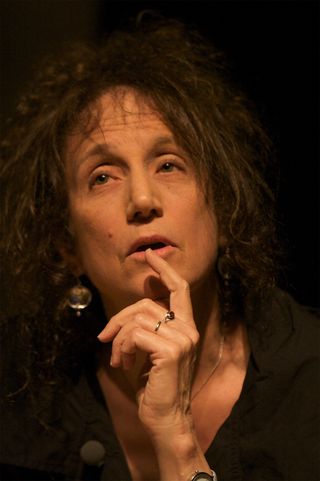
Photo: JS Rosenthal
Hometown: Born in Los Angeles
Current city: Baltimore, MD
Age: 67
College and degree: Eventually received my undergrad at University of Maryland in dance
Graduate school and degree: In my late 20s, I went to George Washington University and got a degree in human kinetics and leisure studies (that’s where the dance department was housed).
Website: www.lizlerman.com
How you pay the bills: I earn a living as a choreographer and an artist. The economic model is to sell my knowledge, not always my dances or the dance making. It’s a good model that could work for others, but you have to know what you know and you have to take some time helping others see how this knowledge fits into their lives.
All of the dance hats you wear: Choreographer, teacher, writer, performer, philosopher, advisor
——————
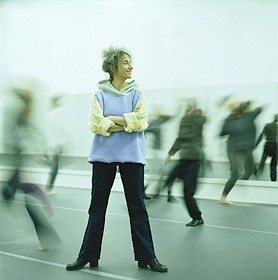
Photo: Lise Metzger
Describe your dance life in your….
20s: Full of questions, a time of testing whether the myths I had grown up with about dance and dancing were worth making come true.
30s: Development of an organization and a company, evolving a place where mixed ages, mixed genres, and mixed ideas could come together and building on the idea of equal commitment to concert and community.
40s: Testing that company nationally and internationally by touring and by building long-term partnerships around the country and overseas too.
50s: The move from large scale community based-projects to large scale interdisciplinary concert work with special structures for audience interaction, for example the “teas” in The Matter of Origins or the science choreography website that was built as we made Ferocious Beauty Genome.
60s: Leaving the Dance Exchange (DX) in good shape and in good hands and developing life as an independent artist. I am continuing to develop interactive artistic works for the public and pursuing my obsession about creative research and the development of shareable “tools” that artists make intuitively but rarely put in a form for others. Also doing keynotes in cross-disciplinary conferences so that people in engineering, conservatories, ceramics, and healthcare can come into contact with artistic ideas. I am also spending a lot of time evolving the Critical Response Process in new forms and in new settings. There is a lot of interest in the process around the world.
You are a pioneer in many ways, including making art with a multigenerational cast and also using text within the work. Did you have role models and inspiration for these concepts? Who?
I saw work with text including a solo Dan Wagoner made and a Merce Cunningham piece where John Cage told stories. They convinced me it was possible. As for older people dancing, it just seemed natural to me. The role models had existed for a thousand years. We just oddly forgot about it in western concert dance. But once I started working with older adults there was no going back. Too many good stories, too many ways to redefine beauty and virtuosity, and too many ways in which an intergenerational work place seemed healthier and more fun.
In 2015, do you think we still need to use the term multigenerational when talking about casting or a company? Or is it more common now that we do not need to use the term?
It’s not common enough. It would be nicer if we had to describe single generation companies as being the strange bird, not the other way around.
What is on your calendar for the next year’s time? Where can dancers study with you? See your work?
Dance Exchange (DX) is celebrating its 40th anniversary this year — I’ll be teaching at the summer institute in July. I have a new relationship with ASU, so I’m investigating ways for people to come and train with me there. I continue to make myself available for people who want to talk through projects by phone, Skype, or in-person meetings. My Atlas of Creative Tools (also known as the toolbox) is still in progress. And I’m starting a new performance project that will culminate in 2017.
 Healing Wars; photo by Teresa Wood
Can you share a bit about your most current project?
My piece, Healing Wars, just closed after a month long run at La Jolla Playhouse. I’ve been working on this piece for four years. Here are some descriptions of that from people who were in it:
“Working on Healing Wars taught me much about humanity; it carried me through times of personal challenge where I could reflect on how life stories meet and transform in theatrical weavings of sensation and collage. It humbled me to learn and relearn and never get tired of hearing veteran stories.”
“At La Jolla, a few days into previews you [Liz] said something that resonated to the core. It was during our daily tech meeting, and we were talking about the feedback the patrons gave on the preamble the night before at the talkback. You said something along the lines of how we're asking these people to adapt for this short amount of time, and how some people adapt constantly to the world, wordlessly, without the world knowing. 'You have no idea how much adapting I do every day. I don't want to live in your world.' 'We're asking you to step outside of your bubble for just a moment, and even that was unsettling.' That was incredible. I have thought that so often but there you just laid it out.”
“I love being around people of different generations – I feel like people who are the same age are usually thinking about/worrying about the same things, doing the same things…running around in their own little hamster wheels – when you spend time with people that are not your own age, you get to step outside yourself and your circle. Being around people who are older and dancing and performing was really great. To have these women that are educated, smart, funny, enjoying their lives, who have kids that actually like them and are performing and dancing and are so lovely on stage. That is what I want!”
I personally loved working on Healing Wars. It was a very deep and long process in which I confronted old demons (the use of history in art), old dilemmas (how “good” do dancers have to be at talking on stage and how do we make that work), and old concerns (about war, and conflict and the role of the outsider). But we did all of this in such new ways and with such an amazing team that it felt new and urgent every day. I tried very hard to find new audiences, and we did this by touring within the regional theater world. I hope that other narrative based movement artists look into this possibility. On two of our tour stops we had 30 plus performances… amazing for a dance based group.
In 2002 you received the prestigious MacArthur award. Through this honor and opportunity, what changed in your work and in your personal life?
In my personal life, I was able to start a retirement account and send my daughter to college. In my professional life, building partnerships across disciplines happened faster after the MacArthur (which isn’t always a good thing).
What is the interplay between teaching and choreographing for you?
In the early days, teaching dance technique provided the platform for testing movement material that got explored in rehearsal. I’m not sure if that was always good for students, but it was good for me. Later, teaching composition was where I got to work though processes. And leading workshops with multiple audiences is where I tested my tools. Also, when we (DX) were touring, there was a great relationship with the kinds of workshops we offered in relation to the material we were performing. This is something I urge younger choreographers to consider. As they make a new work, they are also coming to some new understandings and those can be tested in workshops – multiple outcomes for the same research.
Some of your exercises and choreographic tools are now available online. How do you feel about the online format?
I think online formats are exciting. I think there are ways (working with software developers) where online formats can be even more like the ways our bodies and minds work. But I am interested in a blended format that includes online interactions and studio life and even an artist residency online… stay tuned for that.
Podcasts are a newer medium, that definitely could be used more in the dance world. How was your experience with the Podcasts on Process project? What has the response been so far?
I think podcasts are still wildly unexplored. I enjoyed being a part of Podcasts on Process, but I am unsure of its impact.

Cassie Meador and Liz Lerman; photo by Enoch Chan
Can you share a little about each of your published books? How did you get into writing? Advice to dancers on the role of writing within their artistic lives……
Perhaps one of the myths in the dance world is that we don’t need language. And I was once one of those people. The first time I had to talk in a theatre class, I cried. After years of dancing in silence! But I’ve come to see that words are a mediator between our embodied selves and the world. It doesn’t take away from the dancing to be able to be articulate, to describe the phenomena that move us and to try to bring people into understanding our passions.
The first book was a result of a teacher saying to me, “You know your master’s thesis could be a book.” I did my thesis on dancing with older adults because I wanted to capture what I was learning and share it.
Critical Response Process was written in response to requests. We had overwhelming numbers of requests from around the world, so that is why we wrote it. The language of that book is shared with John Borstel.
Hiking the Horizontal helped me leave the Dance Exchange. It was an opportunity to put history in my own words and claim a space for the stories that would be unclaimed in most history books. The writing was a joy and a surprise.

Non-dance movement practices important to you:
I like walking but I think that is a dance. I like watching people and nature and things move, but I also think of that as choreography.
Last performance you saw that really inspired you:
I saw a solo of Marjani Forte’s online that I just loved. I saw Gesel Mason in an improvisation and in a Rennie Harris piece, and she was brilliant in both. And I saw Jawole’s new biography of her own life and appreciate her commitment to narrative. I am always inspired by her work for its generosity, its boldness, its craft, and its bountifulness.
What are you reading right now?
Several books about the history of witches, which is really a history of how the world sees older women. I am also reading a book called Not in My Neighborhood about the segregated housing patterns of Baltimore. And I am checking out the end of the year best fiction works so that I can pick up a few of those for my next long travels.
Three questions for choreographers to consider:
How are you using your knowledge and skills to understand what is happening in the world?
If you could change the reward system in dance, would you make something different than what you are making?
How would you reconstruct the institutions that support art to be more effective in how they work with artists and the public?
Final thoughts: Hope/belief/love of the profession:
Since our institutions are failing all around us, artistic practice is truly one of the great opportunities to make our worlds better. I for one am willing to give up our specialness in order to be more engaged. This can be small and tiny (like teaching dance in a senior center once a week) or it can be large scale (changing curriculum or even the way we think artists should act in the world)…
And also, having just been part of a festival of dance in NYC in the past few days, a real request that we question ourselves. What are we doing? Why? Why this movement here? Why this dance now? Asking questions is a way to revive the self, and renew the world around us. At least that has been my experience.
——————
Related posts:
Podcasts on Process (with Liz Lerman)
Artist Profile #53: Peter DiMuro (longtime dancer with Liz Lerman)
My Dance Week: Alli Ross (dancer in Healing Wars)
Becoming an Arts Administrator: Erin Donohue (Project Manager for Liz Lerman)
—————————-


 Life as a Modern Dancer
Leave a comment