
Banning Bouldin, Artistic Director of New Dialect in Nashville, TN
What was the inspiration for you to start your own company?
Growing up in Nashville, there was nowhere for me to get the kind of education I needed to pursue a career as a professional contemporary dancer; from the time I decided that was what I wanted for myself (I was 15) I knew I had to leave. I have had numerous opportunities in my career to connect with incredible makers and dancers in my field and wanted to share those artists with Nashville; I wanted to build a resource for dancers, teachers, and makers that would allow artists to gain access to the kind of training and contemporary dance career available in other cities around the world. In 2013, I formed New Dialect – not because I wanted to have a company that performs my work, but because I wanted to create an organization that would allow many artists to come together to deepen their research and advance our art form. I make work as part of that, but that’s not the sole purpose.
What does “collective” mean to you? Do you use this term in regards to artists working together, or do you run it jointly (artistically and financially)?
Collective for me is indicative of our creative process. There are models where a choreographer/director comes to the studio with her dancers or a meeting with designers and composers and says, “This is what I want. Let’s do it this way.” As a collective we emphasize collaboration in what Helen Simoneau calls a “horizontal hierarchy;” I trust the artists I’m working with to co-lead with me and make significant contributions to the works we make together. I may come up with constructs and themes, but at the end of the day, the work is ours.
Atlas Kid (in rehearsal at Metro Parks), Kevin Bouldin photographer
Is New Dialect for-profit, fiscally sponsored, or an official nonprofit?
New Dialect has been a 501 (c) 3 nonprofit organization since 2013.
Do you have your own space – that you lease or rent?
We primarily use two different spaces. For our open to the public classes, we rent space at a reduced rate through our partnership with an organization called abrasiveMedia. We are also fortunate to have an ongoing residency for our rehearsals with Metro Parks, which allows us to rehearse Mondays-Fridays rent free.
Do you have any “training requirements” for your dancers? Do you have a company class? Do you pay for their classes?
During rehearsal periods I require dancers to take New Dialect’s morning community class as a warm up. These classes are free to dancers in the company all year long, whether or not we’re rehearsing, and include Feldenkrais, Gaga, Bartenieff, Skinner Release, Countertechnique, Ballet, Contact Improvisation, Contemporary Forms, Improvisation Tools, and others.
How do you find dancers? What do you look for in a dancer?
The dancers I am working with currently are dancers that I have previously worked with on projects outside of New Dialect and dancers who have attended any number of our intensives and classes. I’m not interested in one particular aesthetic or “type” of dancer. What I’m looking for is difficult to see in an audition, which is why I don’t look for new dancers this way. I’m interested in the choices they make, their ability to work with prompts to generate material, their ability to connect with other dancers in the room, and their personalities. I’m interested in curating a diverse group of artists who possess different influences, believing that when we come together united in purpose we are able to create something we could not make without each other. This is where the name New Dialect comes from.
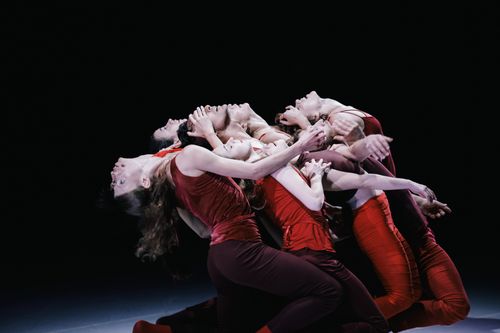
Fight/Flight, Zachary Gray photographer, courtesy of OZ Arts Nashville
What does collaboration mean to you in your artmaking?
Since New Dialect’s first season, I have sought to collaborate with dancers, choreographers, fashion designers, composers, architects, and visual artists in the curation of our performances and the development of new works. We also collaborate with local organizations devoted to advocating and placemaking for artists in a variety of mediums. My love for contemporary dance and belief in the importance of community building are the foundation of both New Dialect’s business model, our outreach and performance programming, and my work as a choreographer. I believe a community of diverse viewpoints and voices united in purpose is greater than one. And, I see this in the creative process I facilitate to develop new movement vocabulary with dancers, in the moving tableaus of bodies that are becoming emblematic of my work, in the themes I explore, and in the stimulating round table discussions I regularly have with artists from Nashville and all over the world.
Artistic/mission/vision advice and wisdom to pass onto dancers building a dance company:
Starting a company requires more than a desire to choreograph on a group of dancers. You need to find a city that needs what you have to offer and develop a sustainable business model. The most effective missions I’ve seen are the ones that aim to truly engage and invest in communities. Community outreach and education are essential. I know you’re excited to tour and perform as many shows as possible. Don’t forget about audience development and building relationships with the people in your community who make it possible for you to do what you love. And don’t use “Community Outreach” and “Partnerships” as a means to get to do what you really want to do. Invest yourself wholeheartedly in them. Your work will grow and so will you. Don’t go it alone; with the help and support of people who possess different skill sets than you (a Board of Directors, community volunteers, administrative staff, advisors, etc,) your company can accomplish your plans and goals with greater efficiency and success. It’s normal to wear many different hats in the beginning, and learning how to delegate responsibilities one piece at a time will help your company to grow and ensure that you can keep making the work you care about. Take one day a week off. There will always be something for you to take care of as long as you are running a company, and working yourself nonstop won’t change that. Rest and staying connected to your life outside of your dance company is important to your ability to keep moving forward. It will also make you a more patient leader.
Be kind to everyone you meet and work with. The dance world is small.
Financial advice and suggestions to pass onto dancers building a dance company:
For New Dialect it has been important for us to develop streams of revenue that help offset our need for grant support and donations. If you’ve already started building your company then you know it’s expensive to rent studio space, pay dancers, cover production costs of performances, the list goes on. Ticket sales, a $5000 grant, and a kickstarter campaign very rarely cover all those costs. On top of this, in your first years as a nonprofit (if you choose to go that route), the grant support you're eligible for is significantly less than it will be once you have a three year financial history. (The big operational support comes when you have audited financial statements for the past three years.) So the question becomes, “How do we make it through our first three years?” Many companies and choreographers choose to opt for fiscal sponsorship in the beginning, so they don’t have to worry about maintaining a nonprofit. I agree that this is a good fit for some, but there’s a limit to how much you can expand under fiscal sponsorship. For us, becoming our own nonprofit from the very beginning has been essential to the success we’ve experienced. Our status enables us to accept donations and apply for grant support, in addition to offering classes and performances, all of which generate revenue for us and we don’t pay a percentage to anyone. I also can’t recommend highly enough developing a Board of Directors. Your Board can help you save money by volunteering to take care of responsibilities within their skill sets (accounting, legal work, etc.) They also help you to expand your network of financial support (at a certain point you’ll need to start asking more than the same 25 people for donations.) Since 2013 we’ve offered over 600 classes, hosted 8 choreographic residencies, and performed 30 times, and all of this while staying in the black and in a city where I was told repeatedly that it couldn’t happen. I’m here to tell you it can, if you have a sustainable business model, develop a team, and take the long view.
Dreams and goals for the next 5 years:
My dreams and goals are for New Dialect – I’d love for us to expand our class programming and intensives, continue to host 4 choreographic residencies a season, increase the number of performances we offer in Nashville and incorporate touring, expand our team to include an Executive Director, increase the number of weeks the dancers are working and their pay. One day I’d like for us to have our own home.
I’ll keep making work and doing everything I can to be a resource for dancers and choreographers until I can’t breathe anymore.
——————–
To find out more, read Banning's full artist profile here.
Related posts:
Building a Dance Company: Fiscal Sponsorship
Building a Dance Company: Creating a Budget
Non-Profits and For-Profits Explained
——————————————

 Life as a Modern Dancer
Leave a comment