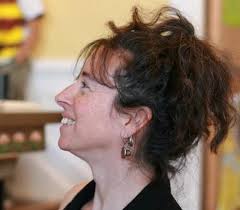
Hometown: Born in Washington, DC
Current city: San Francisco
Age: 50
College and degree: Duke University, BA Political Science
Website: www.flyawayproductions.com
How you pay the bills: Teaching/choreographing/administrating
All of the dance hats you wear: Artistic Director, Executive Director, Choreographer, Teaching Artist, Community-based Artist, Grant Writer, Dancer
——————————
Describe your dance life in your….
20s: I began training as a dancer at 20, after 13 years as a competitive gymnast. My first class was an African dance class offered by Chuck Davis in Durham, North Carolina. From there it was a fast journey to modern dance, just enough ballet and contact improvisation. I began training as an aerialist at 21, when I moved to SF and met Terry Sendgraff and Joanna Haigood. I began dancing professionally at 23, with Joanna Haigood’s company, and continued to invest in modern, contact and aerial training, including an intensive study of Chinese pole acrobatics at the SF Circus Center. I also began to choreograph work with and among other young dancers.
30s: At 30, I started my company and started developing a body of work that wrapped politics and art together, always through a feminist lens. To be politically active has been one of my goals since I was a teenager.
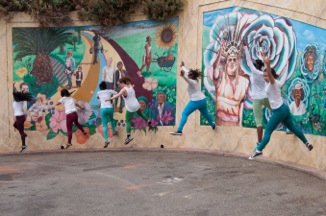
40s: In my 40s, I worked to clarify and sustain a vision of my company as an arts organization centering on site work, aerial work and community empowerment. I make dances for a female eye. My past includes 20 years of framing female physicality in dance, the democratization of public space cultivated through my site work, and my GIRLFLY program, designed to empower young women and girls. My work lives at the intersection of social justice and acrobatic spectacle. I have a notable track record working with invisible populations of women. With my company I have exposed the hidden history of women who built the Bay Area’s bridges; of older homeless women; of women activists who have carved out safe space in the city via The Women’s Building, and of women touched by wage insecurity in the garment industry. I also created GIRLFLY –an arts and activism program for low income teen girls. It is a summer program that offers girls age 14-19 a stipend to come learn about how creative processes feed both artistic and activist outcomes.
Now: In my 50s, which have just begun, I want to take the model of community informed site work I have been cultivating these last 20 years to places that are not my own city. This is an ambitious goal but I am up for the challenge. We’ll see how it goes.
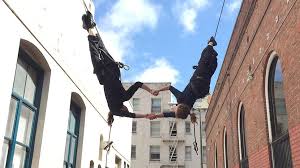
Photo: Yayoi Kambera
What is on your calendar for 2016?
2016 holds three large projects for Flyaway and I. We have been commissioned by the Labor Archives and Research Center (LARC) of S.F. State to dance on their 8-story library. Our task is to bring the oral histories of women workers (that LARC has collected over the last 30 years) to life via a site-specific dance on the library wall. I have done a lot of work with women in the trades and am thrilled with this project, because it is a new piece within a set of stories that I am already familiar.
Summer of 2016 brings the 10th year of GIRLFLY. At the request of our students from last year and the year before, we are continuing to explore issues of body image for young women. The teens I have worked with have been extremely articulate about the mixed messaging they receive about their bodies. They are simultaneously shamed and sexualized for having a body and have to work pretty hard to sort through media, peer and family messaging to figure out who they are within this confusion. GIRLFLY gives them the space to do just that. We try to guide them without telling them where to land. The curriculum is both artistic and political, in that there is an activist project that they design and carry out within the program, as well as dance creation and performance. The program alternates between site work and aerial work.
And in the Fall of 2016, we will create a new site work that looks at murder ballads through a feminist lens (see below).
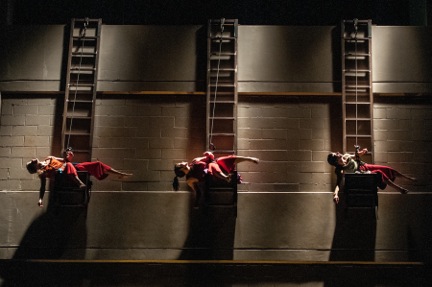
Photo: Austin Forbord
Links to a few of your works:
ALONG THESE LINES 2015: https://vimeo.com/147533656
MULTIPLE MARY AND INVISIBLE JANE 2014: https://vimeo.com/111574968
GIRLFLY in the Gardens: https://vimeo.com/139332248
Please describe your most current project and the questions you are asking yourself right now as an artist.
As I mentioned above, in 2016, Flyaway is heading over to Fort Mason’s firehouse space to create “GRACE AND DELIA ARE GONE.” “Grace and Delia" is a site-specific dance exploring violence against women through the exposition of murder ballads. Historically, murder ballads were written as a way of telling news in small, spread out village communities. They functioned as a warning to wayward girls or as tabloid gossip about women who stepped outside the lines of contained femininity. “Grace and Delia” will frame a few chosen ballads through a choreographic lens, exploring personal stories of women who were killed for being pregnant, or killed in a rage of jealousy. We will expose the stories from the point of view of the women victims, rather than the killers, which is more often how murder ballads are sung. Flyaway is partnering with Fort Mason Center. Their site, an ex-military base, offers us access to the best of what we do– making dances in unusual places, while exposing the range and possibility of female physicality.
According to the CDC, 1 in 3 women has experienced some form of physical violence within their lifetime and 1 in 5 women in the US has experienced rape. With this new work, I am less interested in a broad political statement and more focused on the use of intimate, singular stories to ignite compassion in our audience. I hope to bring domestic and gun violence out into the open for public contemplation.
This project brings me back inside, away from the discarded needles, condoms and crack-pipes I have been working among lately. With subject matter as raw as violence against women, it’d be easy to slip into cliché. I look forward to the challenge of not doing that. This is why I have chosen the ballads as our primary fabric. I hope my work rises to the level of artistic integrity the ballads themselves embody. I look forward to working with my seasoned artistic team, as they keep me free of rhetoric and grounded in the magic of making things up.
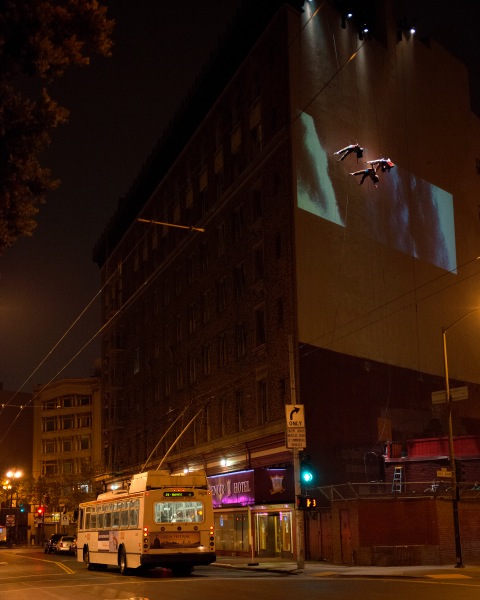
Photo: Austin Forbord
How do you find dancers? What do you look for in a dancer?
I find dancers every way I can. Most are dancers first and aerialists second. A few are like me in that they have managed to equally balance their dance and aerial training. Some are former divers, gymnasts, track stars. I choose dancers I see in technique class, in my workshops, or who write to me from other places. I look for someone whose creative instincts are as sharp as her technical lines and as deep as her ability to breathe with her whole body. I like to work with dancers who can create independently within the scores and narratives I set up. I work in a collaborative process with dancers.
Sometimes I create from the outside move by move. This happens most when we are working with a new object or a new physical challenge, like dancing on a wall with a suspended steel hanger and dress, or an upside down umbrella. When the physical risk is high, we create together, frame by frame. Other times I offer an object and an image, send the dancer to another corner of the space and come back to full phrases that can be easily linked into a whole. We mostly create on site, so I need to work with people who are interested in site work, both its joys and its hardships.
Current movement practices and care for the body:
Weekly dance technique, yoga and light aerial training. Occasional contract improv, climbing at the gym, and Pilates. I spend a lot of time raising my son, so my own training has taken a bit of a back seat to what it used to be. But I really like to be warmed up for my own rehearsals, first because I jump in and out of sections to show something or develop something so it is a strategy for injury prevention, and second because I think I am a better choreographer when I lead with my body.
The role of teaching in your career….and the interplay between your work as a teaching artist, choreographer, and performer…..
I try hard to balance teaching and dance-making (and paying the bills). When I am in the thick of the deepest part of my choreographic process, I try not to be teaching, so that all of my energy is free for creation. It is a privilege to be free from teaching for a part of the year, and I land in that privilege about 75 percent of the time. But I also thrive on teaching. I especially like teaching the 8-11 year olds. They inspire me. They remind me that dance is one of the most important things in the world.
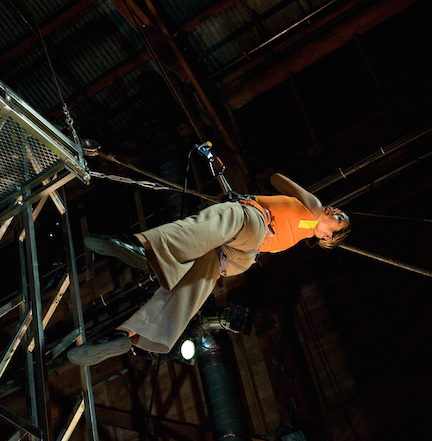
Photo: Austin Forbord
Please pose three questions for choreographers to consider:
How is the movement vocabulary you chose central to what you are trying to communicate?
How does your dance make the world a better place?
How do you write about your work?
Can you talk about the development of your company? Was it fiscally sponsored for a few years? When did you know it was time to take the leap to gain 501(c)3 status?
I made my first evening length dance in 1996. I didn't think I was starting a dance company, but I was. We formed a board in 2000 and were incorporated by 2001. Looking back, this step was less significant than people give it credit for. It was a means to an end for better funding opportunities.
When Flyaway turned 10, that’s when I really started thinking organizationally. I thought a lot about what I wanted the whole rest of my life to look like as an artist and how an organization could support that journey — how an organization could support both the creation of public art, and the creation of art that brings us, as a nation, just a little bit closer to justice. These two creative acts still guide me through the muck of running an organization, which is code for running a small business.
How do you balance artistry with administration/logistics?
I try to dance or do something in the physical realm every day, to keep myself in balance. I am a much better administrator when my body is happy. I try to outsource the tasks I am not good at, or that make me incredibly irritable. After 20 years, I am now, for the first time, about to hire a paid staff person. I am really wanting a partner to help me grow the business of Flyaway. This is a new desire for me, and thankfully the funding community here in SF has come through to make it so.
Last performance you saw that inspired you:
First, the San Jose Earthquakes. They are a professional soccer team. I chaperoned my son’s U10 soccer team when they went to the professional game. The physicality was so daring, precise, wild and intentioned all at once. It was, to me, amazing dance. I don't know who won the game.
Second, the reunion of Sara Shelton Mann’s Contraband that just took place at YBCA in December. Here it was not necessarily the physicality that pulled me in but the power of art — of dance in particular — to create and sustain a community. At the performance, which went on for 5 hours, I had profound fun being in the audience with so many people I have grown up with, literally and artistically. I also reveled in the dancers on stage who are in their 50s and are still going strong…
Final thoughts – Hope/belief/love of the profession:
It’s hard to separate my thoughts about the profession from my thoughts about the world in general. For me, dance making is the place where I explore that relationship, so the two queries are intertwined.
I am a bit taken aback with sorrow at the moment, for where we stand as humans in general and as Americans in particular. We are in a moment of intense throwback, in terms of race, class and gender (and presidential politics), and that is giving me pause. I keep reading comments from feminists who live in other countries, who are shocked at how regressive the US is in term of women’s rights. Today on the radio I heard an interview with the two women who created the movie “Suffragette.” In the interview they could not believe the attacks on abortion-providing clinics and pro-choice law that we are living through daily.
But at the same time, I know it is the artists who are crucial to fighting back. And I am seeing that the field is making room for artists who are at that cutting edge, when it comes to pushing form and content.
As a profession, I wish us great stamina, because the road to justice continues to be long, uphill and ominously slow.
——————
Related posts:
Artist Profile #32: Christine Chen (former dancer with Jo Kreiter)
A Modern Dancer's Guide to the….San Francisco Bay Area
Dancing and Reflecting: Dancers in Their 50s
————————————

 Life as a Modern Dancer
Leave a comment