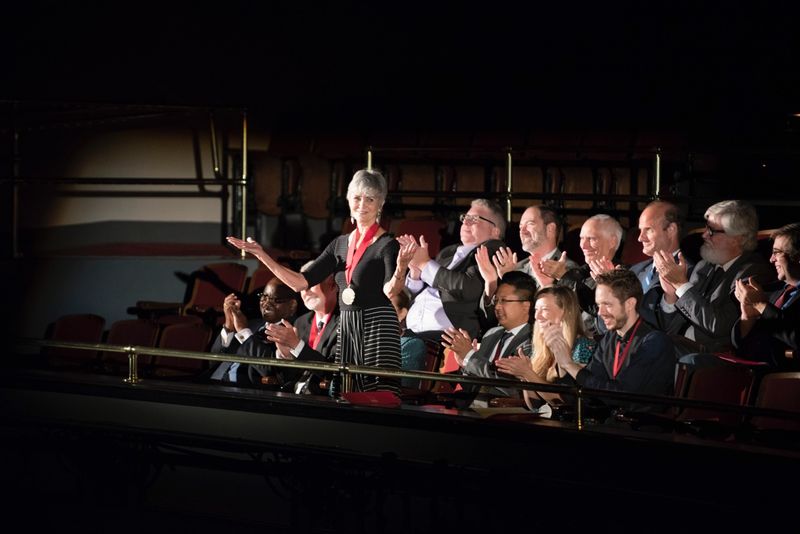
 Phyllis Haskell Tims receiving the Distinguished Alumni Award at the University of Utah (2015)
Hometown: Santa Barbara, California
Current city: My husband and I spend half the year in Tucson, AZ and the balance of the year at our historic backcountry homestead in the Frank Church-River of No Return Wilderness on the Salmon River in Idaho where we are an hour by bush pilot from the closest town.
Age: 75
Attended an arts high school? No, I attended Santa Barbara High School where you could take Modern Dance for your PE requirement.
College and degree: BA degree in Education from the University of Arizona
Graduate school and degree: MFA degree in Modern Dance from the University of Utah @ age 30.
Website: Campbellsferry.org (a website for our historic homestead and book, not a dance website)
All of the dance hats you wear or have worn: Professional dancer, choreographer, teacher, guest artist, and administrator
Non-dance work you did: In New York I supported my dance habit as a flight attendant for American Airlines and later Pan American. Subsequently I taught kindergarten in San Francisco.
—————
Describe your dance life in your….
20s: By the time I was in my 20s I had studied ballet for 16 years, Spanish dance for 6 years and some modern dance training in high school and college. After receiving my undergraduate degree I moved to NYC, studied dance at various studios when I could afford the classes, and performed with some pick-up companies. At 25 I moved to San Francisco and danced with a local company. At age 28, I started graduate school at the University of Utah and began dancing with the Ririe-Woodbury Dance Company. I worked summer stock for Starlight Theatre in Kansas City as a dancer, but I also had the opportunity to be cast in some singing and acting roles.
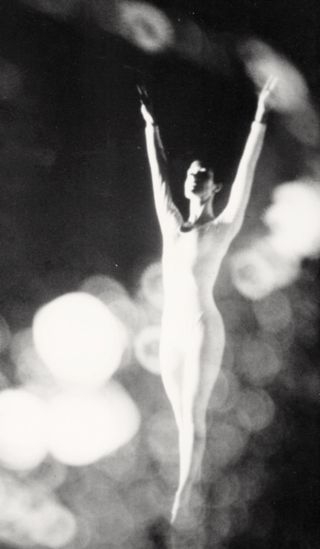
Performance photo from Shirley Ririe’s “Prisms”
30s: After receiving my MFA, I was hired to teach dance technique and choreography by the dance department at Arizona State University, but continued to perform with Ririe-Woodbury when schedules allowed. When RW became a full-time company through the Dance Touring Program and Artists in the Schools, I resigned from my position at ASU to dance with Ririe-Woodbury. The company toured extensively, so for most of my 30s I was living out of a suitcase, sharing hotel rooms with other company members. When we were not on tour, which was very seldom, I was often taken in by Joan Woodbury, Shirley Ririe or one of the other company members who had a place in Salt Lake City. I truly felt like a gypsy and I loved it, especially the international touring. It was an exhilarating, exhausting, expansive lifestyle. During this time I learned a great deal about dance but even more about myself. I was not only dancing for the company but also serving as assistant artistic director.
40s: Turning 40 caused me to consider what was “next” in my life. I thought about returning to university teaching but wondered if I was ready to stop performing. Almost on a whim I applied for an opening at the University of Hawaii, which I thought would be so competitive that my chances were slim. The company was on tour when I received a call with the job offer. I was honored, conflicted, and a bit stunned when I told Joan and Shirley. Fortunately, I loved Hawaii. There was so much to appreciate: the dance program and its beautiful students, being able to choreograph my own work, and having my own place. Having been raised on the beach in California, I felt very at home in the lifestyle. Carl Wolz, the director of dance, became a dear friend and a valued mentor. I also had many opportunities to continue to perform. When Carl left to become the Dean of Dance at the Hong Kong Academy of Performing Arts (HKAPA), I was surprised to learn that I had been appointed director of dance at UH. Without my seeking it, my administrative career had begun.
A few years later, Carl offered me a full-time dance position at HKAPA. I was newly married so was reluctant to make such a big move for both of us, so I agreed to come as guest artist for a year to test the waters. Not long after I had signed the one-year guest-artist contract, the University of Utah Department of Modern Dance asked me to apply for their department chair position. To make a long story short, I was offered that position as well, and they agreed to wait for a year while I fulfilled my contract with HKAPA. At age 47, I found myself back at the University of Utah as chair of a department where 80% of the faculty had been my professors. I arrived at Utah during a difficult period for the modern dance department. I had little experience in working with conflict management, so the first year was challenging. Thankfully, the common goal of the faculty was their commitment to excellence in teaching, choreography, and performance and. As a group, we were able to solve contentious issues and re-build a strong team.
50s: After serving as Chair of the Department of Modern Dance for 10 years, at age 57 I became Dean of the College of Fine Arts and two years later took on the additional role of Associate Vice President for the Arts. In other leadership capacities, I served as president of the national Council of Dance Administrators and on the board of directors for the International Council of Fine Arts Deans.
60s: I retired from the University of Utah as Dean Emeritus and AVP Emeritus a month before my 66th birthday. Since my retirement, I have served as a consultant and as a program reviewer for international dance programs, choreographed dance works for various companies, served on dance boards and taken dance classes. While I still enjoyed dance, I found my interests expanding in other areas.

Phyllis speaking with Stephen Koester at the University of Utah (2015)
70s: My husband and I published a book, Merciless Eden, about the history of our historic homestead where we live April through October. It is difficult to keep up with any regular appointments or commitments when one lives surrounded by 4 million acres of wilderness seven months out of the year. I write a daily journal and an occasional blog about my life in the wilderness and continue to choreograph once in a while when I find my self in civilization. Restoration and preservation of the homestead are my major responsibilities these days. When in Tucson I spend time at the gym daily, needlepoint, write, take extension classes on various subjects and enjoy life with my husband and my friends.
Major influences:
My earliest influence was the brilliant ballet teacher, Madame Maria Kedrina, a Russian ballerina who had studied with Petipa and danced with Nijinsky & Pavlova. I was introduced to a different tradition and teaching style by Eligio Herrera when I began my Spanish dance studies. In graduate school I was influenced by the brilliant faculty at the University of Utah but was profoundly mentored by Joan Woodbury and Shirley Ririe, who were wonderful models of female artists and leaders. Dr. Elizabeth Hayes awakened an interest in dance administration. Through Ririe-Woodbury, I was introduced to and influenced by the work of Alwin Nikolais and Murray Louis. I studied with and danced in works by Hanya Holm, Paul Sanasardo and Viola Farber. Carl Wolz broadened my international perspective, introduced me to various Asian traditions and was also a leadership mentor.
What did you love most about your time dancing in Ririe-Woodbury?
I loved DANCING. I just loved moving…in the studio or on stage. Rehearsing, performing, learning new works, perfecting older works. I loved the touring, meeting new people, seeing new cultures. Learning from Joan and Shirley involved not just dance itself but so many related fields — lighting, costuming, fundraising, grant writing, working with the state legislature and dealing with sponsors. I loved working with the guest choreographers, gaining new perspectives, feeling expanded by their points of view. I cherished those rare moments of transcendence on stage when there was no “thinking," no “effort”…the times when I exited into the wings and thought, “Wow! What just happened here?”

Studio rehearsal from Ririe-Woodbury days
The role of teaching in your dance career:
It was teaching that opened the door to my dance career after performing, and ultimately to administration responsibilities. Quite honestly, when I consider all the roles I have played in my career in dance – performing, teaching, administration and choreography – I found teaching to be the most difficult. I liked teaching but I did not love teaching. I enjoyed the students, seeing their engagement and growth, but teaching was more of a challenge than any of the other. I found it hard to meet my own standards. Having said that, there were many rewarding aspects, and I certainly did a great deal of teaching throughout my career. There are very few dancers who forge a career without finding themselves teaching at some point.
You were also an excellent administrator. Advice to dancers on becoming arts administrators:
Thank you for the compliment. In graduate school, I was introduced to dance administration through Dr. Elizabeth Hayes’ class, which I enjoyed very much. I remember feeling like it was something I could do. In retrospect I would have been wise to get a doctorate in Educational Administration. The University of Utah has an excellent one, and I am sure there are a number of others. I have been impressed with the knowledge and capabilities of people who have obtained this degree and feel it would have been very helpful to me as well, so I would suggest it to anyone who feels they would be interested in administration. Obviously leadership courses or workshops are helpful as are offerings in fundraising, public speaking, and grant writing. The National Association of Schools of Dance offers individual memberships that give access to their annual conferences and pre-conference workshops. The information presented and exchanged is valuable, and there is the added benefit of meeting dance leaders from various institutions around the country. As a new administrator I found these people willing to go out of their way to advise and mentor. My advice: don’t be afraid to reach out for help.
Can you describe a few of the biggest changes in modern dance over the span of your career? What has really surprised you? Impressed you?
I appreciate you asking these questions because they caused me to reflect on how different the world of dance has become. Some things have not changed: the daily technique class, the dedication and hard work are the same but the world of modern dance has expanded profoundly.
When I left high school I had no idea one could get a college degree in dance, despite having danced since preschool, nor would I have had any idea how to find out. In fact, I believe, only the University of Wisconsin was offering such a degree at the time. Now well over a hundred institutions offer various types of degrees in dance, and the internet has made it easy to research any type you desire. Consequently, more dancers today have more depth of education in their field, the areas of specialization are vast, and teaching is informed through disciplines that were non-existent at the time.
Dance technique itself has improved through the years, and there are more professional dance companies and performing opportunities for dancers. That is not to say that the field has become less competitive. Schools are churning out many more beautiful dancers than there are full-time job opportunities. One of the great things that higher education has done in recent years, I believe, is to inform and prepare dancers for broader opportunities in related fields and for life after a professional career.
There are more diverse dancers, more diverse dance training, more diverse dance opportunities and more diverse dance companies. The world of dance is both smaller and larger. Smaller in that it is far easier to access the modern dance world either through travel or YouTube but larger in that there is so much more variety.
Last performance you saw that really inspired you:
I truly don’t see nearly as much dance as I used to, partly because I live in the wilderness for seven months of the year and partly because having seen so much dance for so many years I have become more difficult to impress. The last performance I found truly inspiring was Doug Varone & Dancers at the Joyce Theatre a year ago. It was the farewell performance of one of my former students, Eddie Taketa. It was moving for me not only to see Eddie’s beautiful performance but also to appreciate once again the evocative, lush motional content of Doug’s choreography as communicated through the facile physicality of his dancers.
Final thoughts: Hope/belief/love of the profession:
Dance has been/is (and likely will always be) a more perilous career choice than many others. Still, it will always attract a passionate following willing to take the risk. The reward is its total physical, mental and emotional involvement. A dancer lives in the most irresistible and profound sense of life in the moment.
—–
Related posts:
Spotlight on MFA Programs: University of Utah
————————-


 Life as a Modern Dancer
Leave a comment