Today I am re-reading Jo Kreiter's artist profile, which was published on February 2, 2016. Excerpts are shared here, related to building a dance company.
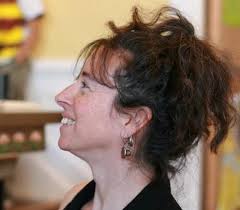
Website: www.flyawayproductions.com
How you pay the bills: Teaching/choreographing/administrating
All of the dance hats you wear: Artistic Director, Executive Director, Choreographer, Teaching Artist, Community-based Artist, Grant Writer, Dancer
——————————
My 30s: At 30, I started my company and started developing a body of work that wrapped politics and art together, always through a feminist lens. To be politically active has been one of my goals since I was a teenager.
40s: In my 40s, I worked to clarify and sustain a vision of my company as an arts organization centering on site work, aerial work and community empowerment. I make dances for a female eye. My past includes 20 years of framing female physicality in dance, the democratization of public space cultivated through my site work, and my GIRLFLY program, designed to empower young women and girls. My work lives at the intersection of social justice and acrobatic spectacle. I have a notable track record working with invisible populations of women. With my company I have exposed the hidden history of women who built the Bay Area’s bridges; of older homeless women; of women activists who have carved out safe space in the city via The Women’s Building, and of women touched by wage insecurity in the garment industry. I also created GIRLFLY –an arts and activism program for low income teen girls. It is a summer program that offers girls age 14-19 a stipend to come learn about how creative processes feed both artistic and activist outcomes.
Now: In my 50s, which have just begun, I want to take the model of community informed site work I have been cultivating these last 20 years to places that are not my own city. This is an ambitious goal but I am up for the challenge. We’ll see how it goes.

Photo: Austin Forbord
How do you find dancers? What do you look for in a dancer?
I find dancers every way I can. Most are dancers first and aerialists second. A few are like me in that they have managed to equally balance their dance and aerial training. Some are former divers, gymnasts, track stars. I choose dancers I see in technique class, in my workshops, or who write to me from other places. I look for someone whose creative instincts are as sharp as her technical lines and as deep as her ability to breathe with her whole body. I like to work with dancers who can create independently within the scores and narratives I set up. I work in a collaborative process with dancers.
Sometimes I create from the outside move by move. This happens most when we are working with a new object or a new physical challenge, like dancing on a wall with a suspended steel hanger and dress, or an upside down umbrella. When the physical risk is high, we create together, frame by frame. Other times I offer an object and an image, send the dancer to another corner of the space and come back to full phrases that can be easily linked into a whole. We mostly create on site, so I need to work with people who are interested in site work, both its joys and its hardships.
The role of teaching in your career….and the interplay between your work as a teaching artist, choreographer, and performer…..
I try hard to balance teaching and dance-making (and paying the bills). When I am in the thick of the deepest part of my choreographic process, I try not to be teaching, so that all of my energy is free for creation. It is a privilege to be free from teaching for a part of the year, and I land in that privilege about 75 percent of the time. But I also thrive on teaching. I especially like teaching the 8-11 year olds. They inspire me. They remind me that dance is one of the most important things in the world.
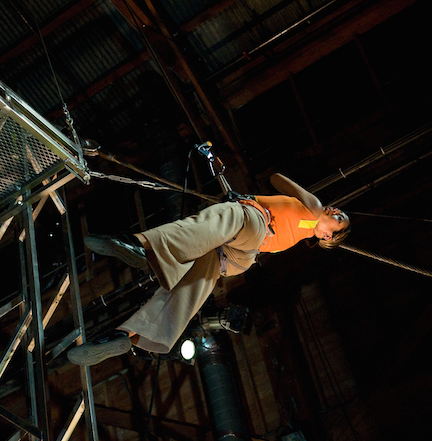
Photo: Austin Forbord
Please pose three questions for choreographers to consider:
How is the movement vocabulary you chose central to what you are trying to communicate?
How does your dance make the world a better place?
How do you write about your work?
Can you talk about the development of your company? Was it fiscally sponsored for a few years? When did you know it was time to take the leap to gain 501(c)3 status?
I made my first evening length dance in 1996. I didn't think I was starting a dance company, but I was. We formed a board in 2000 and were incorporated by 2001. Looking back, this step was less significant than people give it credit for. It was a means to an end for better funding opportunities.
When Flyaway turned 10, that’s when I really started thinking organizationally. I thought a lot about what I wanted the whole rest of my life to look like as an artist and how an organization could support that journey — how an organization could support both the creation of public art, and the creation of art that brings us, as a nation, just a little bit closer to justice. These two creative acts still guide me through the muck of running an organization, which is code for running a small business.
How do you balance artistry with administration/logistics?
I try to dance or do something in the physical realm every day, to keep myself in balance. I am a much better administrator when my body is happy. I try to outsource the tasks I am not good at, or that make me incredibly irritable. After 20 years, I am now, for the first time, about to hire a paid staff person. I am really wanting a partner to help me grow the business of Flyaway. This is a new desire for me, and thankfully the funding community here in SF has come through to make it so.
———
Related posts:
Artist Profile #124: Jo Kreiter
The Choreographic Moment: Ideas from Jo Kreiter
Blog Series: Building a Dance Company
A Modern Dancer's Guide to the…..San Francisco Bay Area
———————————–

 Life as a Modern Dancer
Leave a comment