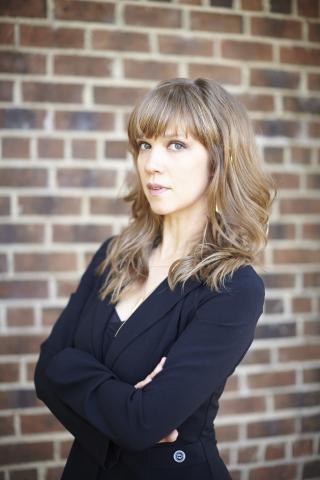
Photo credit: Danell Beede
Can you talk about your role as Director of School Administration? How many hours a week do you work, and what are your main tasks? How many people do you supervise/support/mentor?
As the American Dance Festival’s Director of School Administration, I oversee all operations and management of the ADF School programs, which include the Winter Intensives in New York and California, and the Six Week School, Three Week School, and Dance Professionals Workshop during our summer festival in Durham, NC. I work closely with the ADF Dean, Leah Cox, to bring her vision for the school programs into fruition. This position encompasses a wide range of tasks and responsibilities. I create and implement the logistics for all class schedules and studio spaces, serve as a central contact for the ADF faculty, and oversee all transportation, school events, and student support services. I am the primary liaison between ADF and Duke University regarding studios, dorms, meal plans, and any other Duke services that would impact the school or students. I oversee marketing for the ADF school and implement extensive student recruitment strategies. I coordinate a national audition tour and travel to most of the sites, which helps forge crucial relationships with prospective students and artists at national and international universities. I am also involved, to varying extents, in other ADF departments when a school representative is required.
Work hours fluctuate depending on the time of year. Fall is busy, but tends to be the quieter part of the year in the office and I generally work what would be considered normal business hours. Once December arrives, the workdays begin to get longer, and February through May brings very long workweeks, especially once I begin to travel for scholarship auditions. During the festival, an average day is usually around 10 hours, with some longer days depending on the events or programs taking place. Sometimes during busier parts of the festival I might arrive at the office before 8am and not leave until after 10 or 11pm!
The ADF School has a department of three permanent staff; therefore, we rely heavily on seasonal staff, interns, and work-study students to help produce our winter and summer programs. In the fall, winter, and spring, I supervise an average of 2-3 staff members, interns, or work-study students, and in the summer I oversee an average of five staff members, six interns, and an array of student workers. Typically, our seasonal staff and interns are new to ADF each year, which provides an interesting challenge as a supervisor. However, it is also profoundly inspiring to witness the devotion and commitment each staff member brings to their work when they are only at ADF for such a short period of time.
How is arts admin also a creative/artistic endeavor?
There are many ways to encounter creativity and artistry in the work of an arts administrator. The unique challenges found in a nonprofit organization, often due to the reality of small-scale budgets, necessitates creative problem solving. It may not always feel artistic, but you certainly must be resourceful and inventive when you can’t just throw money at a difficult situation. As an arts administrator, you might get the opportunity to direct the design of marketing materials, create a curriculum or syllabus, or curate a performance series. These, and other arts administration tasks, require a creative background and can be artistically satisfying in a myriad of ways.
The artistic experience, whether a theater or dance performance, orchestra, museum, or book reading, takes a group of people with different skills to produce. The art presented could not be fully actualized without a full production team. Arts management is a major component of the entire artistic experience. As an artist-turned-administrator, it is important keep this in mind when pushing through some of the less creatively gratifying work of administration: spreadsheets, budgets, reports, database entry, etc.
Are you performing, choreographing, and teaching as well in 2016?
I began dancing at a very young age and spent the majority of my childhood and teenage years dedicated to intensive dance training. I graduated from Virginia Commonwealth University with a BFA in Dance and Choreography is 2005, and after living abroad for a year, began working for ADF in 2006. As a young dancer, my sole focus and trajectory was always towards performing and choreographing, but I made the transition from artist/performer to arts administrator when I was hired at ADF.
Unfortunately, performing, choreographing, and teaching have not been a part of my life in 2016 so far. This is primarily due to the fact that I recently completed a masters degree program. I graduated from Goucher College’s Master of Arts in Arts Administration program in July, which allowed me to pursue graduate study while simultaneously working full time at ADF. This meant that the last three years of my life have been completely devoted to schoolwork and ADF, which left little time for any creative endeavors. Now that I have graduated, I am slowly finding my way back into the studio. While I do not foresee performing, teaching, or choreographing as a major part of my professional career anymore, I hope to reconnect with my dancing self and enjoy some form of creative output again soon!
What do you love and enjoy about arts administration?
I have always had a fervent obsession with the behind-the-scenes aspects of the arts. I attend performances or events and lose myself in daydreams about the bustling of the production crew behind the curtain, the rehearsal process of the performers, and all the other facets of the work necessary to producing an artistic event. As a young artist and performer, I often appreciated and loved the process of coordinating a show more than the performance itself.
Now that I have been working in arts administration for ten years and completed a master’s degree in this field, what do I love about arts administration?
- I love interacting with artists.
- I love taking something that is often theoretical, intangible, or abstract and assembling it into concrete, organized, and structured plans. (And finding a balance between both!)
- I love the creative teamwork and multi-disciplinary crossovers necessitated in arts administration.
- I love that my job is essentially constant organization (I have a bit of Type A personality when it comes to work).
- I love that there is often no right or wrong answer when problem solving in arts administration. This yields some interesting debates!
- I love that it allows you to experience a bit of the artist lifestyle, yet still (usually) provides a regular salary and health insurance.
- I love seeing the fruits of my labor realized in the form of art.
- I love working with passionate people who care deeply about the future of the arts.
Advice to dancers who are interested in arts administration, but have little experience in it….where and how to begin….
The best way to get started in arts administration is to find an organization that interests you and offer your help through volunteering or an internship. All arts nonprofits are understaffed and overworked; therefore, very few organizations will decline the offer of free assistance. Be willing to work in any department and complete any work, but don’t be afraid to speak up if there is a particular aspect of arts administration that you are interested in learning. Be confident in your skills—dance training produces some of the smartest, most hard working, creative problem-solving, organized workers. These assets will take you far; all you need to compliment those skills are practical knowledge and experience in the unique facets of working in arts nonprofit.
Volunteering or interning is a great way to gain practical arts nonprofit experience and form a relationship with an organization that you may be interested in working with in the future. Those interested in higher-level positions may want to consider some form of arts management education: certificate programs, undergraduate degrees, or graduate study. Arts nonprofits are complex and unique, and I found the skills and knowledge I gained in Goucher College’s Master of Arts in Arts Administration program critical to my potential success and development as I continue working in this field.
My advice to those starting out in arts administration: always present your most positive attitude, show up on time, and prove yourself to be indispensable. Practice your best formal writing and if you don’t already know how to use excel, find a friend or colleague to teach you. Say yes to opportunities even if they don’t seem one hundred percent perfect at the moment, as they will likely open doors to greater possibilities.
ADF offers summer internships in arts administration and dance production every year. Please feel free to contact me (school@americandancefestival.org) if you would like to learn more about these opportunities or Goucher College’s Master of Arts in Arts Administration program—I highly recommend either of these programs to anyone interested in pursuing arts administration!

—-
Related posts:
Goucher's Arts Administration Masters Program
Masters Programs in the United States
Artist Profile: Leah Cox of the American Dance Festival
Summer Correspondence: Leah Cox at ADF
————–

 Life as a Modern Dancer
Leave a comment