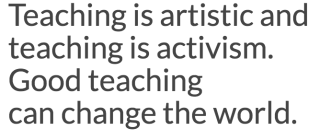
-Quote from teaching artist Juliana Monin
I know, I know…..I am suggesting adding one more thing to the "to do" list. But, a simple, monthly action step can build your program, inform families and school administrators, and keep your program on the radar of decisionmakers at your school or district. It is about building programs, keeping and maintaining programs (on the schedule and in the budget), and advocating for the integral and valuable role of dance within your school.
Today I share a few strategies I have used during the past 6 years at a middle school in San Francisco. Many of these 10 strategies are frequently used by teaching artists throughout the country and are not completely original to me. The ideas apply to both programs in public schools as well as independent schools. As you can see, a consistent, multi-faceted approach to advocacy can cover the many people involved within your program – directly and indirectly. Today I also want to thank several colleagues who helped create this post with edits, input, and distillation of ideas: Valerie Gutwirth, Linda Carr, Juliana Monin, and Kristin Blatzheim.
Here are a few ideas on my mind these days. Maybe considering trying one idea each month this school year?
WEB. Does your school have a website? Is there an arts page or dance page? What is the content? What are the images? How often can you update the page?
SCHOOL NEWSLETTER OR E-NEWSLETTER. Does your school offer a paper newsletter or e-newsletter once a month or even once a week? How can you use this format as an opportunity to offer a window into the work? Could you contribute a few pictures each month? Could you share a little about your units/themes/projects? What about a student quote or two about dance?
Juliana Monin, a high school dance teacher at the Bentley School in the San Francisco Bay Area, shared:
This has been a great avenue for me in getting dance more visible at my school. Dance is a new program and we are still figuring out when in the schedule and where on campus we can hold showings and performances. In the meantime, having even a small blurb about special activities, guests, and field trips helps get dance out into the public mind. This doesn't solve the problem of getting students more aware of dance, but I think it helps to excite parents and administrators about what's happening in our classes. When possible, I ask the school photographer to come and snap shots for the story as well.
Kristin Blatzheim, the dance teacher at Apple Valley High School in Apple Valley, Minnesota, shared that
We have a school news show and I have had kids on that and/or have asked them to do a story about us when we have shows coming up or something unique going on.
PTA OR PARENTS ASSOCIATION. If your program/position is partially or fully funded by the PTA, strongly consider attending at least one meeting a year to be a presence and to share about your work. How many opportunities are there each year for you to be in dialogue with families?
PRINCIPAL. This area was something that I focused on a lot over the past 6 years. I taught at an independent middle school in San Francisco. I frequently invited the Middle School Head (i.e. principal) and Head of the whole K-8 school to open classes, showings of final projects, and much more. While they didn’t always attend, at least they had a clear sense of my program and how much was going on. I created a culture where the admin were always welcome and invited into the dance program. The students loved having guests and loved hearing feedback from the other adults on campus.
DISTRICTWIDE KEY PLAYERS. First, who are the key players in the district? Is there a Dance Coordinator and a Director of Visual and Performing Arts? A monthly email or phone call/phone message can keep your program on their minds. Share a lesson plan, photo, or story of a student. Invite him/her to your upcoming performance. Email a recap/reflection of the recent performance that he/she missed. Consider once a year sending a “press kit” for the year – sharing lesson plans, photos, student reflections, an outline of your projects, etc.
DOCUMENTATION. This all leads to another question for yourself – how and what do you want to document? Every dance artist and every program needs something different. How do you capture the students, content, arts integration, and growth of the students over time? Ideas include: lesson plans, videos, photos, student quotes, and parent quotes. Do you keep a file on your computer desktop or on Google Drive?
YOUR OWN WORK/ACCOLADES. Putting pride aside, don’t forget to share with your colleagues and employers about your own professional work. When are you performing? Was there a review of the show? Did you get interviewed on a blog recently? All of these items should be celebrated and shared as much as you can – with students, families, teacher colleagues at your school, and administration.
COMMUNITY CONNECTIONS. How are you sharing with the greater community? How are you connecting with local artists – by bringing them in for performances and master classes, or taking students on field trips?This is all important information to share and publicize. Do your students get to perform off campus too?
ANECDOTES. If appropriate for your school culture, I highly recommend sharing stories and quotes whenever you can. Throughout the school year, I used to share stories with the head of our school and our middle school head. It kept everything personal and real. I usually would email them with a subject line like….”Quick note – story from dance today.”
AN ANNUAL REPORT OR SUMMARY. I used to make a list of all of my special projects, guests, arts integration work, and student performances. I would bring hard copies of this to my annual review in the springtime with the Middle School Head or the Assistant Head of the school. It was a great conversation starter and documentation for the year, highlighting all of the work going on in the dance program.
Juliana Monin also added:
Two other things come to mind…..
PHOTOS. I always invite our school photographer whenever students are showing something or when we have guests. Even if I don't use these photos, they become part of the school catalogue that may be chosen for advertising/promotional materials.
YEARBOOK. Second, and this wasn't intentional on my part last year, but worked out well for dance – get dance students on the yearbook! Having dancers on yearbook enabled students to really highlight the program in the yearbook, complete with student quotes. Maybe in a broader sense, this just means having student dance ambassadors on campus.
—–
I hope that these ideas can be useful and applicable this school year. Please add to the conversation here by leaving ideas in the “comment” section below. Here’s to a great year ahead.
—————–
Related posts:
Artist Profile: Linda Carr of Berkeley High School
Artist Profile: Juliana Monin of Bentley School
My Dance Week: Teaching Dance Full-Time in a High School (Kristin Blatzheim)
———————————

 Life as a Modern Dancer
Leave a comment