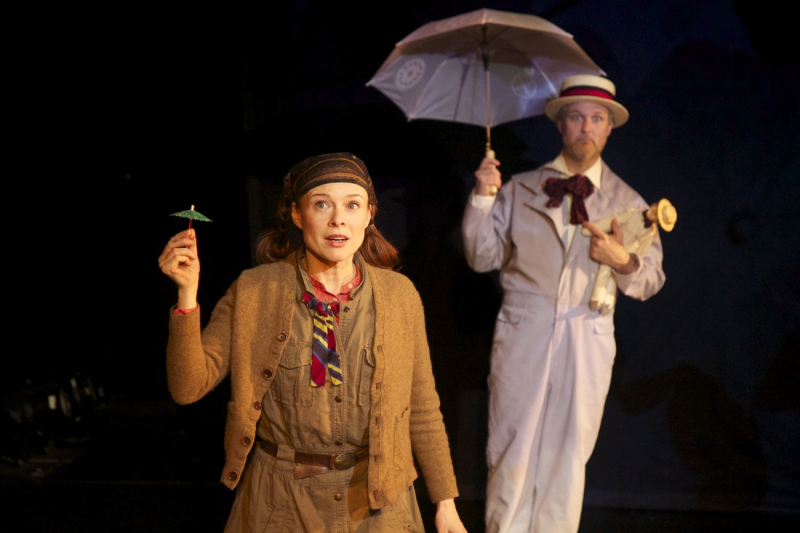
 Tami Stronach, Paper Canoe Theater Company
From Tami Stronach (Brooklyn, NY):
Bartenieff Fundamentals, improvisation, cycling, contemporary classes, ballet barre, Pilates, running Path on the beach
As a choreographer, questions on your mind right now:
- Who gets to dance
- How my personal politics reside in the choices I make in my work – as subtext not as content
- Unearthing vocabularies that are stripped of classroom phrase defaults
- Why so much work seems to value physically punishing its performers
- Resisting beauty as a dominant paradigm
- What is the right structure for each work
- How amazing it is that we can pay attention to so many disparate things at once

Christy Funsch
Can you talk a little about your performance practice? What has been your growth as a performer? What are your strengths? What are you working on and exploring these days?
I practiced a lot of weight sensing as a child, and as a kid I was encouraged to improvise around the house. I would say whatever strengths I have as a performer come from longevity of practice. In college I went to a small school, and the benefit there was that I always had access to studio space – and I was encouraged to use it. So I developed a comfort level with being in the studio by myself without necessarily having a goal or deadline. My initial teachers were martial arts practitioners and also CMAs, so there was a lot of variation in effort and a lot of floor work….and they were making pretty experimental work. In graduate school I found myself still making experimental work with colleagues but having to fit into pretty rigid formal structures in faculty works. So this set up an interesting tension for me where performing was sometimes behaving and sometimes rebellious. Around this time I starting tracking my consciousness during performances. I would write down as soon as possible after performing what I could recall as “the ride” that the piece took me through. I was then (and still am) fascinated by performance cocktails of control and surrender. Somatic practice help widen my performing range and so did cross training. My interests now are following my nonlinear consciousness of movement the same way I would let my thoughts flow during a free write. I'm trying to do more but perform less so the intention is not that I'm presenting a performance facade but that I'm bare and vulnerable and letting the viewer in on my experience. I've never been a performer of conventional virtuosity or prowess. I've been fortunate to have really supportive collaborative practices throughout my development that have helped me dig deep grooves into my movement profile while nudging me out of my comfort zone.
From Linda Carr (Berkeley, CA):
My 40s: My daughter was born 4 months before my 40th birthday, and my son was born two years later, which changed my relationship to my teaching and to my dancing. As a teacher, I’ve learned to become more efficient and more focused. I have to make the most of the time I am at school, because I can’t spend hours afterwards thinking and preparing. I’m also more creative in my choreography at school now, since I’m no longer getting that creative energy out with a performance company of my own.
In my forties, I’ve returned to technique class. After a neck injury some years back, I took a break from Contact Improvisation and looked for other dance forms to get my fix. I find that my older body is happy revisiting the structure of good old modern dance classes. It’s helpful to me as a teacher, of course, to see how others orchestrate their classes, but also it’s just so much more fun to be in class now. I get the same kind of joy out of class now that I did as a child – before I wanted anything from dance, as a career. Now, again, I find that I can just enjoy the challenge and the beauty and the pleasure of dancing, without the painful internal monologue of my earlier years – when I was in a constant state of comparison, frustration, etc. Now, again, it’s dance for dance, and I love it. I’m so grateful for that.
In recent years, I’ve begun taking Cuban Salsa classes, which are incredibly humbling, and I’ve returned to a girl group I dabbled with years ago, doing body rhythm with Evie Ladin’s MoToR. I was on stage with that group last fall (for the first time in a decade) and had a blast. As my body and interests change, the style of dance and performance I’m attracted to shifts, too, but overall, dance has been a constant in my life. It’s where I go to feel myself and to feel inspired.
Advice to dancers wanting to get into teaching in a K-12 public school:
Go for it! There is work, despite what my mentor Bobbie Boatman said to me. I’m actually surprised by how many dance teaching jobs there are in the Bay Area public and private schools – many more than I ever imagined when I was growing up.
I love teaching in an institution, because I don’t have to hustle for my students. They are right there. I have ultimate respect for teaching artists who travel the globe giving workshops, but I always knew that I did not have the stamina or ego for that kind of personal promotion. Also, I like being a part of a community. In some ways, schools are at the center of community life, and I enjoy the influence that that brings. The artistry we present on our stage impacts not just the dancers themselves, but the audience of friends, parents, grandparents, etc. And the more invested I become in this community, as a resident and parent myself, the more I appreciate the influence that teachers have on the spirit of the community as a whole.
From Jennifer Edwards (New York, NY):
My 40s: In my 40s I have come back to dancing – as a choreographer, movement director, and dancer. I just, one month ago, had my first dance residency at Omi International Dance Collective. It is weird. Like moths to a flame I watch friends, students and other dancers I work with struggle with this form and the system we have silently agreed to participate in. The system continues to make me feel an outsider in a field that regularly turns to me for leadership/processes/answers. My deepest desire is that we/dancers co-create an empowered, equitable values-driven new idea of what "dance" is and the space it can hold in society. I had a taste of that this summer at Omi – it is a beautiful dream.
In your recent Dance Magazine article, you used the phrase “sustainable dance career.” How would you define this?
In several recent meetings, the director of NEW INC introduced me by my title and then added that I am a dancer and choreographer. She stated that she’s seen how this informs the work that I am doing and how I approach the material. Her commentary was unsolicited, and we’d not talked about this prior. It is an example of what I mean when I talk about sustainability + dance + "career." I encourage dancers to never leave the skills we have or the identity of "dancer" at the door. Bring dance into everything – parenting, walking, working, relationship-building – leverage your kinesthetic intelligence on stage and off. We need to broaden our understanding of what dance means – for dancers. The rest of the world values us based on how we value ourselves. We need to craft and own our stories far better. Currently, we are denying ourselves and the world the valuable wisdom we hold.
————
Dancers Reflecting about Their 40s:
Amy Foley, Reggie Wilson, and Tiffany Mills
Adriane Fang, Sarah Wilbur, and Dawn Stoppiello
Jennifer Nugent, Carley Conder, Damon Rago, and Rebecca Johnson
Jennifer Salk, Rebecca Lazier, and Kate Weare
Katie Kruger, Annie Rosenthal Parr, Sarah Crowell, and Jeanine Durning
———————

 Life as a Modern Dancer
Leave a comment