
Liz Lerman Photo: Lise Metzger
My 60s: Leaving the Dance Exchange (DX) in good shape and in good hands and developing life as an independent artist. I am continuing to develop interactive artistic works for the public and pursuing my obsession about creative research and the development of shareable “tools” that artists make intuitively but rarely put in a form for others. Also doing keynotes in cross-disciplinary conferences so that people in engineering, conservatories, ceramics, and healthcare can come into contact with artistic ideas. I am also spending a lot of time evolving the Critical Response Process in new forms and in new settings. There is a lot of interest in the process around the world.
In 2016, do you think we still need to use the term multigenerational when talking about casting or a company? Or is it more common now that we do not need to use the term?
It’s not common enough. It would be nicer if we had to describe single generation companies as being the strange bird, not the other way around.
Three questions for choreographers to consider:
How are you using your knowledge and skills to understand what is happening in the world?
If you could change the reward system in dance, would you make something different than what you are making?
How would you reconstruct the institutions that support art to be more effective in how they work with artists and the public?
My 60s: I have become well-known in the field of Parkinson’s as a teacher, speaker, advocate, and creator of videos. I have presented my work around the country and in Europe, and have recently been profiled in a book called Brain Storms by the BBC journalist Jon Palfreman. Neurologists in most movement disorder centers here in NYC refer many of their patients to me. But what gives me the most satisfaction is to be able to make people with this disease enjoy the beauty and soulfulness of dancing while they courageously cope. These PD “dancers” are quite beautiful and inspiring in their own way.
Hope/Belief/Love of the Profession:
Dancers don’t realize the talents they have and what hard workers they are. I hope that in the world of health that dancers' knowledge – how body mechanics work, how to use rhythm, how to transform yourself through imagery and how to communicate through movement – will be understood, valued, used and appreciated for all that it has to give. It is neurologically complex, and one of the most beautiful things to experience.
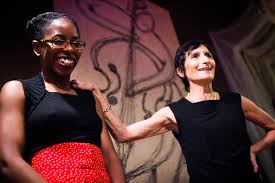
Tiffany Rea-Fisher and Elisa Monte
Can you talk about the process of transitioning the company and selecting Tiffany Rea-Fisher? What are your wishes and dreams for the future of the company? On passing the torch and the legacy…
Tiffany had been a dancer with the company for nearly a decade. She, at one point, decided to pull back from dancing and concentrate on AD of the company. She started with educational initiatives, and that continued to grow in responsibility as she gained experience. We worked on ensuring her respect from EMD’s board of directors, funders and presenters. There is a firm trust that was established in her abilities to both care for the works that exist and for growing the creative life of the company. I’ve given her reign to go artistically wherever she feels compelled to. Artistic vitality depends and is fed by daily mutable personnel choices.
I would like to see the work I’ve created continue as a living repertory as well as the company being a vibrant creative place, offering energy and vision to the art of performing dance.
As you head into the next phase, what are you wanting to explore (traveling, reading, writing, family, etc)?
I will continue to choreograph. I have freed myself from the daily AD worries and return to the luxury and terror of just creating.
I’ve always loved traveling and will continue to. I’m not a writer, so I don’t see that in the horizon. Always loved reading…and family forever!
Three questions for choreographers to consider:
- How do I access what I want (need) to do?
- How do I share that information? That is, manifest it in mine and other bodies?
- Has what I’ve created touched others?
Can you describe a few of the biggest changes in modern dance over the span of your career?
The individualization of vocabulary from the classics to an endless variety of approaches that have been influences by contact, hip hop, somatics, circus, and more.
The decline in support that has forced innovation but also made the company construct more and more impossible.
A decline in appreciation for craft. The proliferation of choreographers….everyone who dances now thinks he/she is a choreographer.
The impact of technology that allows audience to watch screens instead of live performance.
What skills (attributes) do you think a modern dancer needs in 2016?
Everything. Not only must dancers be well-versed in many movement vocabularies, but if they wish to "make it," they must be skilled self marketers, good networkers, be effective administrators and fundraisers and have something authentic and meaningful to say.
Final thoughts: Hope/belief/love of the profession:
Dance is the mother of the arts, the most intimate and primal form of creative expression and the most honest — the body never lies. I hope our country will one day embrace the value of all the arts as the most important and valid vehicle for human creativity, expression and growth. Without the arts we lose our humanity.
In times like these we need it more than ever.
————————

 Life as a Modern Dancer
Leave a comment