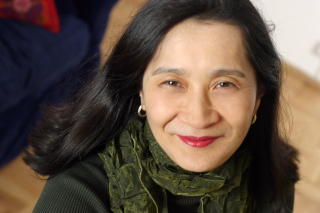
Hometown: I grew up in various cities in Orange County, California – City of Orange, Costa Mesa, and Newport Beach
Current city: New York City
Attended an arts high school? I attended Villa Park High School which was not an arts high school. In high school my plan was to apply to medical school, as I wanted to be an ob/gyn. During my senior year, there were two choices for PE – tennis or orchesis. I was terrible at tennis and didn’t want tennis to affect my perfect 4.0, and since I had taken ballet when I was younger, I thought the dance class was the preferred option. During the dance class we had to create a nature study. For my study, I stood back to back with a friend while I made a cracking sound, and then we both fell apart and fell to the ground. My teacher asked what was that and I replied, “A tree struck by lightning.” She announced that I was an “abstract” choreographer. Instead of a tree being struck, I felt I was hit by lightning. I had no idea what she meant but I knew that’s what I was. I came home and announced to my mom that I wasn’t going to med school and that I was going to be an abstract choreographer. When she asked what was an abstract choreographer I replied, “I don’t know what it is but I know that’s what I am!”
College and degree: California State University, Long Beach – BA in Dance
Graduate school and degree: Long Island University, Brooklyn – MFA in New Media and Performance, which I was later asked to come back to as Artistic Director of the MFA program.
Website: www.donnauchizono.org
How you pay the bills: I pay the bills mainly through teaching and sometimes through commissions.
All of the dance hats you wear: Ah, the many lives in one body – I am a dance maker, a dancer, teacher, an unfortunate grant writer (since the process is so painful), an outdated video editor (still using an older version of Final Cut Pro as I continue in the painful preparation of video samples), administrator, bookkeeper, mentor/advocate for younger dance makers, and a very lucky mom.
——————————
Describe your dance life in your….
20s
I attended Orange Coast College to get back into dance before auditioning for a BA or BFA program. It was in the second year at OCC that I was introduced to Viola Farber, who taught a week-long workshop and whose company performed. The next year I went to U.C.L.A., and I met Lynn Dally and Jeff Slayton (a former member of Merce Cunningham Company and a member of Viola Farber Company) who were guest artists at U.C.L.A. I was asked to join Lynn Dally and Dancers – a modern dance and tap company.
After the first quarter at U.C.L.A., I moved to New York to study with Viola Farber. Jeff Slayton was still in Farber’s company but was offered a job at California State University, Long Beach (CSULB) and told me he was going to return to California and asked if I would be interested in being in his dance company. I returned to California and danced with Jeff Slayton and Dancers for six years. While dancing with Jeff, I met the extraordinary Nikki Castro. Nikki was my closest friend who believed, from the very beginning, that I was a choreographer. I danced with Jeff Slayton and Dancers until he disbanded the company in 1983.
I was always interested in making my own work, and after the dissolution of Slayton’s company, I went through an intensive period of “exorcising” the Farber/Cunningham style from my body to discover who I was as a dancer maker. Simultaneously I also started to study Performance Art with Rachel Rosenthal. I made a duet that was performed at the 1984 Los Angeles Olympic Arts Festival. At the time, Los Angeles felt bereft of a thriving dance community and I felt isolated.
In 1986, I moved to New York, and when I discovered the “downtown” dance scene, I felt like I found a community that I felt kinship with. At first I wanted to audition for dance companies, but Nikki Castro kept encouraging me to make work. She kept saying to me, “Donna you’re a choreographer!” But I didn’t know where to start. No one knew who I was as I didn’t dance with a visible New York company. With Nikki’s encouragement I started to choreograph a trio with Nikki, Becky Hilton and myself.
30s
I gathered three other choreographers to rent Danspace Project (through their Community Access program) and made my New York debut with Surfacing in 1988 at Danspace Project. From that point on things moved rapidly. Bebe Miller came to see Nikki perform since Nikki was in her company, as well as members of Stephen Petronio’s company because of Becky Hilton. Bebe Miller approached me with sincere congratulations and sent other choreographers to see my work. Several of Petronio's company members asked if they could be in my next piece.
Richard Elovich, then director of Movement Research, offered a performance at Ethnic Folk Arts. Sondra Loring, who was performing with me while performing with Neil Greenberg, saw Deborah Jowitt (critic of The Village Voice) and told her that she must come to see my performance. Jowitt came and wrote a little note and said that she didn’t have much room but had to write something in The Village Voice.
The next year I was offered a shared program at Danspace Project, and in 1990 I presented my first evening length work, San Andreas, at The Kitchen. That was the year I started Donna Uchizono Company, which became a non-profit in 2001. From The Kitchen performance I was invited to perform at the Wiener Internationales Tanz Festival (Vienna, Austria), Spring Fest (Budapest, Hungary) and Centro Cultural de Belem (Lisbon, Portugal) – our first European tour. I continued making work and continued collaborating mainly with dancers Nikki Castro, Becky Hilton and Jodi Melnick.
I saw composer/cellist Tom Cora perform in 1989 and felt he thought about music the way I thought about dance. We collaborated over 11 full evening length pieces and performed in many improvisational settings until his premature death at the age of 44 in 1998. I was heartbroken.
During my 30s I met visual artist David Hammons, with whom I was in a relationship with for 9 years. An artist of strong convictions and integrity, his impact on my life was immense in terms of how he viewed the world as an artist and as an artist of color.
From my 1988 choreographic debut I was known for wit, spice, and rich invention with dances saturated with dense, highly physical movement flavored with my predilection for speed. Towards the end of my 30s brought a major shift and evolution in my work. “Drinking Ivy” (1994) ushered in experimentation with time and stillness.
40s
With Nikki leaving New York in 1996 and the untimely passing of composer Tom Cora in 1997, a new era of working with dancers who were no longer my peers and collaborations with new composers began. In 1998 I started working with dancer Levi Gonzalez, who would become my right hand for years to come and who remains a dear friend and assistant. I also started to work with the genius composer James Lo and costume designer Wendy Winter and continued to work with lighting designer Stan Pressner. From this collaboration came State of Heads (1999), heightening the interest in stillness. A redefined sense of "virtuosity" emerged – a virtuosity that determines excellence from minute observations of human behavior made extraordinary through patience and devotion to timing.
In 2002, I collaborated with composer Guy Yarden, and we both received a “Bessie” for Low. I started to work with dancer Hristoula Harakas in 2005, and in 2006 I was commissioned by The Baryshnikov Foundation and created a piece for Mikhail Baryshnikov. I started a long (12 year) process to adopt a child from Nepal during my early 40s. I continued my collaboration with composers – Yarden on three works and developing a 10-year relationship with composer James Lo. And I became dedicated to the advocacy and mentorship for the younger generation to come which continues today.
50s
The duality of life became very present in my life during my 50s – I created longing two (2010) – a dual-location work and Fire Underground (2013) – a dual perspective work. My latest work, Sticky Majesty (2016), has two dances occurring simultaneously with two perspectives.
The most wondrous part of this time is my beautiful daughter Tara, who was finally allowed to come home with me in 2011 after a long, painful international adoption process which included a horrific fight with the U.S. State Department. She is a “hoot” of a spirit and inspires me minute by minute.
State of Heads (1999) Photo credit: John Cyr
What is on your calendar for 2017?
Over the last two decades, education has been an important part of my artistic life. After teaching as a guest artist over the last 20 years in many universities, I just started teaching full-time at Long Island University, Brooklyn – which is very exciting because of the diversity of the dance students in addition to giving me a home to nurture the development of dancers and dance makers over a period of time.
I plan on developing and creating Iron Wings and seek to present it initially in less traditional spaces for dance in 2017, where the audience necessarily engages with the work differently than in a proscenium space. Feedback from these early showings will inform an evening-length premiere in 2018 in a more traditional performance venue.
Please describe your most current project and the questions you are asking yourself right now as an artist.
I am currently working on a new piece, Iron Wings (working title). I just received the 2016 United States Artist Award which has given me the funds needed to start the project. Here is a description just written for grants so it’s in “grantese” language:
Iron Wings, a new work for five dancers, will challenge expected hierarchies of weight by investigating “the weight in-between” and other concepts less often considered. In this work I will weigh the space between — the pauses between words, colors we see, and the skin color we wear. As we strive upward towards an ethical grace, our heaven is simultaneously charged with the grounded weight of the courage it takes to be human — our iron wings.
I follow in the lineage of post-modern experimental dance but, as an American woman of Asian ancestry, I have always carved my own space in that framework. While questions of race don’t always explicitly inform my work, the weight that physical perceptions bear on my identity and heritage are always present. Following my journey as a choreographer of color in a predominantly white field, Iron Wings will explicitly delve into the weight of such implied assumptions.
The process of creating “Sticky Majesty” (2016) exploded me open: two dances occurred simultaneously with two separate audience perspectives, leading to two “truths” amplifying the weight of the uncertainty between them. Its creative aftermath left me resplendent with an electrified freedom that inspires this new work. The contemporaneously abstract and expressively vivid Iron Wings will offer reverence grounded in grit as well as the organic vigor of gravity and the weight of uncertainty.
How do you find dancers? What do you look for in a dancer?
I normally like to work with a dancer over several projects. I do see a lot of performances, so when I see a dancer I think might be right for a future project, I will keep that dancer in mind. Sometimes I will have an audition but that’s on rare occasions.
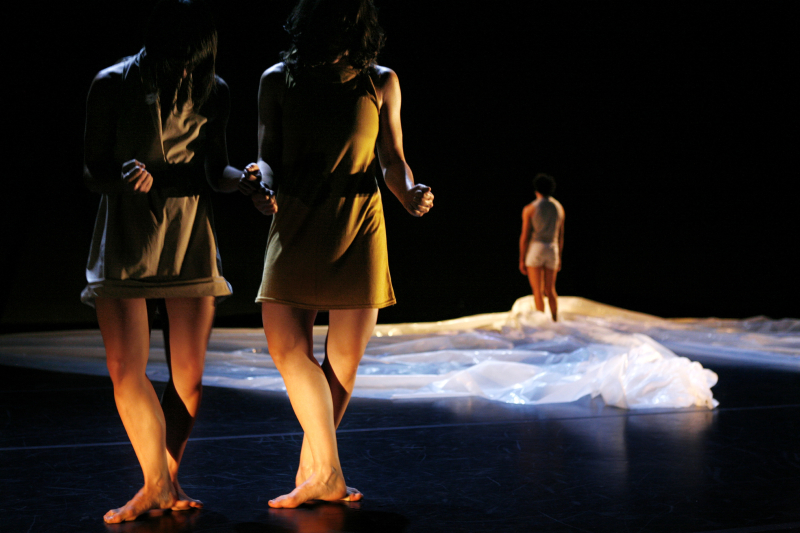 Thin Air (2007) Photo Credit: Julieta Cervantes
Current movement practices and care for the body:
Currently I’m recovering from a rotator cuff and bicep reattachment surgery. Thus I am under the guidance of a really good physical therapist who has given me an exercise regime that takes at least 1.5 hours a day to accomplish, not leaving much time for my other practices.
The role of somatics within your own practice, your teaching, and your work with your company members:
My own practice involves the integration of Klein Technique and Alexander Technique with more traditional techniques. I am also a certified Zero Balancing Practitioner (a therapeutic body modality) and certified in Vinyasa Yoga. In teaching a technique class, informed by Klein and Alexander Technique, the structure of the class is influenced by the logical sequencing of Viola Farber’s class in which the dancing combination that happens towards the end of the class, is intertwined and introduced within in the warm-up.
What keeps you believing and passionate about modern dance in 2016?
As old-fashioned as it sounds, I do feel this is my calling. I’m compelled to make work and can’t imagine not making work. I am suspicious of words, and because I’m not adept at writing, I always feel a bit crushed by the majesty of the word. I’m grateful for dance as I feel it is able to engage humans on a level beyond the verbal – a way to address the space between words.
Non-dance activities important to you:
Being with my daughter Tara is the ultimate dance for me. I am privileged, honored and ever so grateful to be a mom of this innately kind, bright, wondrous spirit of a girl. What a gift!
Sticky Majesty (2016) Photo Credit: Scott Shaw
Final thoughts – Hope/belief/love of the profession:
I truly know the world needs us to keep making work more than ever, and as an advocate for the next generation of dance makers. I believe in you. This profession honors the courage to be human in a time when we must be the quiet giants and giantesses that provide the world a grace that lies in the grit of what we do.
———————

 Life as a Modern Dancer
Leave a comment