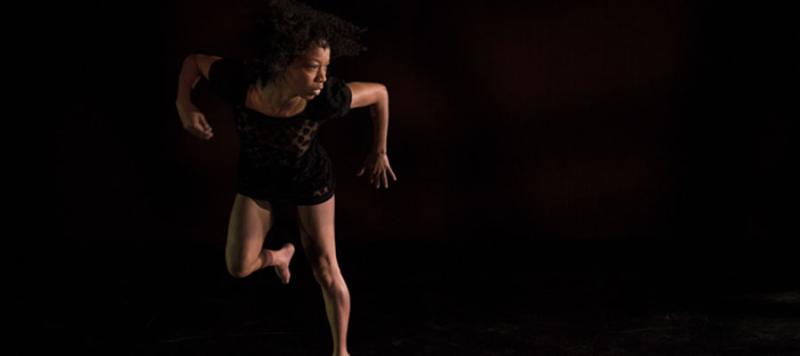
 Gesel Mason. Photo by Daniel Beahm.
Your growth as a performer over the years:
I trained many years in traditional ballet and modern dance techniques. Now I often perform dances with no recognizable steps in them, yet I believe I‘m a better “dancer” now than I was then. I had to learn not to copy and perfect, but instead to question, investigate, and be honest to the choreography’s intent or the artist’s vision.
Current training and movement practices:
Teaching and taking my own class “Afro-po-mo” – Modern and Postmodern movement techniques with influences and approaches from the African Diaspora
Cross-training at the gym
Dancing with friends
Taking classes and master classes offered in our dance department including Modern, Ballet, Alexander Technique, Conditioning, and House Technique with Rennie Harris
Getting Rolfed
On sacrifices and setbacks:
It sucks. And sometimes for a while. But it will continue to suck if you let a setback define you. I realized there was no such thing as a setback unless I let it set me back. And I did, and I have. But success and opportunity come in many packages. I have trouble taking no for an answer when I want something bad enough. The dream/desire/hope/destination/project may morph into something different than I imagined or planned, but if I follow my heart I’m still moving towards my heart’s desire. A “no” may be a “yes” in disguise. But, at first, it sucks.
Is it sacrifice if it’s for something you love?

Pamela Geber Handman
Pamela Geber Handman (Salt Lake City, UT):
40s: My 40s can be summarized as one of shifting landscapes, inspiring me to prioritize differently, become more serious about self-care, learn how to manage my span of passions and try to be more efficient. I’ve been learning how to say "no" to certain things in order to make space for interests of greater importance.
The biggest transition came earlier in my 40s with the birth of my son, a child born with a congenital heart defect and Down syndrome. While some people might respond to this news by apologizing and sympathizing, I prefer to say that I feel completely graced by the presence of such an amazing human in my daily life. This powerful little person changed the course of my own personal, artistic and professional life and bridged us with a broader community. Within my 40s, I have become a strong advocate for inclusion rather than separation between those with special needs and everyone else and an even more committed advocate for arts integration in our educational system. It is through the arts that communities can come together in celebration, honor individual voices, and share experiences and concerns. With fellow parent and writer, Melissa Bond, I co-created Jump Start, a weekly workshop for individuals with Down syndrome and their family members in which we shared dance, story sharing and word play in 2013, creating a documentary film of the process. I have collaborated with a special education professor at the University of Utah, Kristen Paul, developing a teaching methods course that brings dance and special education college students together and heads into the Salt Lake community’s special education classes spanning from pre-K through high school in various settings.
In my 40s, I’ve also rekindled my love of visual art, exploring my own work with oil paints as guided by fellow parent and visual artist, Kindra Fehr. I’ve hosted a couple more conferences, bringing together educators and special guests including Irene Dowd. I’ve choreographed more dances.
Now in my later 40s, I’m wondering about performing again, hoping to fulfill a little bit of that desire. I feel that my own teaching has gotten increasingly clearer, sharper, more detailed, more responsive. I feel that I’m better able to help students find the specifics and yet, relate a focus to larger context and meaning-making.
Current movement practices and care for the body:
I keep returning to yoga, concepts from Alexander Technique, Tai Chi principles, and conditioning sequences I’ve collected from many sources, developing variations for myself for strength, stability, mobility and when possible, cardiovascular endurance. With a full-time job and family, maintaining a regular practice of self-care is challenging but important. When time allows, I find huge satisfaction in movement improvisation. I have taken a tiny amount of Gaga and am in love with the approach thus far. I’ve never been good at getting enough sleep, so this is my next challenge to address.
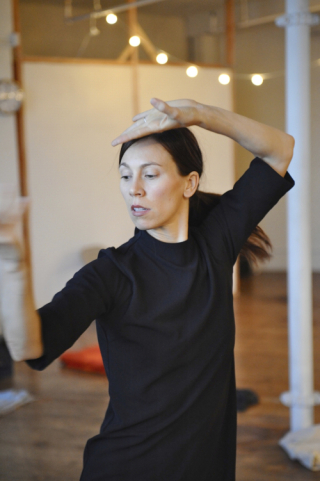
Jess Humphrey. Photo by TEO.
Jess Humphrey (San Diego, CA):
40s: Family, learning/teaching, and dancing no matter what
I’m almost 41. Just thirteen days after my 40th birthday last year, and a few months after we started our project with Deborah Hay, Eric Geiger’s husband, Carl, had a massive stroke. I am still trying to make sense of what this means for our work together, while he is fighting for both of their lives. I cherish every moment we get in the studio together these days. Leslie and I are still working on the piece we started with Deborah, and I began a Body-Mind Centering (BMC) training program. LIVE is still finding its new identity. For my 40s, I envision being in the studio as much as possible, and I am working to establish that in these first few years in my new position at SDSU. I’m also determined to make more time for my family. There is no way I’d be where I am now in the dance without my husband, Ron. We have been together nearly 19 years, and Hazel is almost 5, and I am falling more in love with them both all the time. We live a fun, rowdy, artful life in a tiny house. We’ve made a home where we can truly be ourselves with each other. As I write this, Ron is learning Rocket Man on the guitar and Haze is singing along while building a rocket ship out of cardboard boxes. It is wild and wonderful and worth it.
Current training practices:
Body-Mind Centering, LIVE practice, contact improvisation, Feldenkrais ATMs and FIs (mostly with Leslie, who just finished the training last year), napping, meditation, Kundalini Kriyas, rebounding, dancing with Hazel, anything that gives me a chance to practice any kind of listening, and various other practices for my health including eating the best food/fuel possible, far-infrared sauna sessions, supplements, and working with an acupuncturist (still Adrian Bean) and a functional medicine practitioner. I grew up in an abusive household and have had head injuries, so I’ve found that the only way I can thrive within the demands of the dance field is if I take very good care of myself. It’s a dynamic, creative process.
What is the role of teaching within your dance life? What do you love about teaching? What does the phrase “teaching artist” mean to you?
Lineage is so important to me…sometimes I wonder if I have anything original to offer, or if my superpower is more about learning, integrating, and articulating others’ genius.
Teaching is a way of learning for me. It’s a somatic practice, a mirror, a dance…it’s exposing, risky, exhilarating, inspiring, exhausting, nerve-wracking, and life-giving…sometimes all within the same class! I felt ready to teach dance long before I started, but I’m glad I identified more as a student for so long. I learned as much from terrible and abusive teachers as I did from my favorites, so I believe that students are more responsible for their learning than their teachers are.
Being a teaching artist means that I am co-creating knowing and knowledge with students. I try to reveal my preferences, desires, and biases. I know I’m not “neutral," so I put my stuff out there as much as possible. When I think of my favorite teachers, there is some relationship between vulnerability and credibility that comes to mind.
Teaching is not policing. Remembering that can be a challenge in a university setting when freshmen are learning to live as adults for the first time. Parker Palmer talks about student-centered, teacher-centered, and subject-centered classrooms. I like it when the center moves around a lot (in the classroom, dancing, life), but I try to make classes mostly subject-centered.
———————
More stories and ideas from dancers in their 40s:
Tami Stronach, Jennifer Edwards, Christy Funsch, and Linda Carr
Reggie Wilson, Tiffany Mills, and Amy Foley
Adriane Fang, Sarah Wilbur, and Dawn Stoppiello
Jennifer Nugent, Carley Conder, Damon Rago, and Rebecca Johnson
Jennifer Salk, Rebecca Lazier, and Kate Weare
Katie Kruger, Annie Rosenthal Parr, Sarah Crowell, and Jeanine Durning
———————————–

 Life as a Modern Dancer
Leave a comment