Jan Erkert
From Jan Erkert (Champaign, IL):
What is the interplay between teaching and choreographing for you?
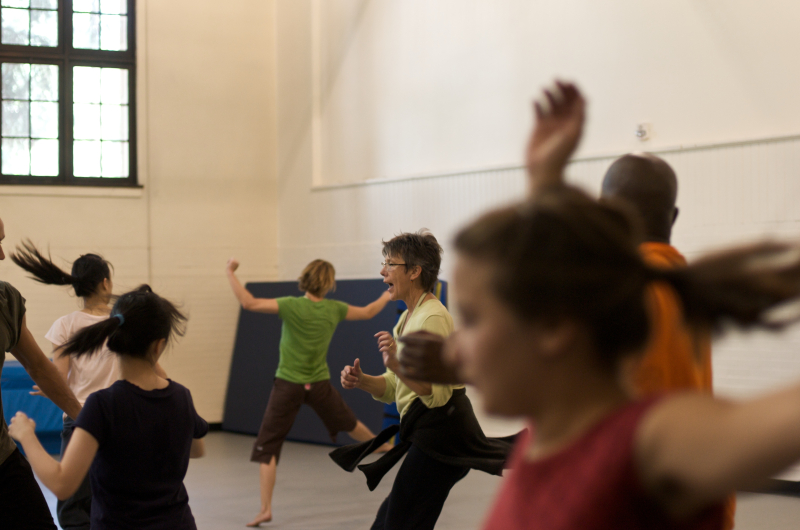
Choreography has become a way of thinking about living and learning, so it is the ground floor of teaching. When teaching, whether choreography or technique, I set up questions or problems that the students must negotiate. Attentive listening is required in order to read the needs and desires of the dance or the person. For me, choreography and teaching have become so intertwined; it is hard to distinguish one from the other anymore. Even the product could be considered the same. Transformed space, time and energy. Transformed lives.
From Gesel Mason (Boulder, CO):
Advice for other dancers on teaching, learning how to teach, and the role teaching will most likely play in their careers:
Teaching made me a better artist because I couldn’t lie. It helped me question and articulate what I believed about dance to others. I never set out to become a teacher, but I’ve always enjoyed teaching. I enjoy watching students grow and trying to figure out how I can facilitate that. Almost every dancer I know teaches or has taught in some capacity. I continue to try and stay curious about what I am teaching so that it also fuels my interests. I found this approach shifted my teaching from regurgitating simply what I’ve been taught to trying to find my own voice and unique approach to dance training.
From Jess Humphrey (San Diego, CA):
What is the role of teaching within your dance life? What do you love about teaching? What does the phrase “teaching artist” mean to you?
Lineage is so important to me…sometimes I wonder if I have anything original to offer, or if my superpower is more about learning, integrating, and articulating others’ genius.
Teaching is a way of learning for me. It’s a somatic practice, a mirror, a dance…it’s exposing, risky, exhilarating, inspiring, exhausting, nerve-wracking, and life-giving…sometimes all within the same class! I felt ready to teach dance long before I started, but I’m glad I identified more as a student for so long. I learned as much from terrible and abusive teachers as I did from my favorites, so I believe that students are more responsible for their learning than their teachers are.
Being a teaching artist means that I am co-creating knowing and knowledge with students. I try to reveal my preferences, desires, and biases. I know I’m not “neutral," so I put my stuff out there as much as possible. When I think of my favorite teachers, there is some relationship between vulnerability and credibility that comes to mind.
Teaching is not policing. Remembering that can be a challenge in a university setting when freshmen are learning to live as adults for the first time. Parker Palmer talks about student-centered, teacher-centered, and subject-centered classrooms. I like it when the center moves around a lot (in the classroom, dancing, life), but I try to make classes mostly subject-centered.
———————-

 Life as a Modern Dancer
Leave a comment