
Hometown: Norwell, MA (until age 12), Skowhegan, ME from then on
Current city: Wakefield, RI
Age: 55
College and degree: BA from Colby College: Major in English, Independent Major (now called Self Designed Major) in Dance
Graduate school and degree: MFA from Smith College. I was 25. I went to grad school only a few years after finding dance. I needed training. I did not know at the time that I would end up teaching at a college. I knew that I wanted to learn to dance, and at that point to be somebody else’s dancer. I headed to NYC for the second time, more wisely, after grad school.
Website: elephantJANEdance.com
How you pay the bills:
Now: faculty position at Connecticut College.
In NYC, at first I had various retail jobs: clothing stores, sci-fi bookstore, etc. Then I found the best job ever: sewing for Penny Babel Couture. I could work any hours that I was free. I could leave to go on tour and come back and have a job. I could work as many hours a week as I could fit in. I could bring work home. I was a grandmother- trained home seamstress when I started, and a very experienced couture trained seamstress and when I finished. I had a job in which I was exposed to newness, good people, a huge amount of learning rather than simply working to pay the bills. Bebe also paid as substantially as was humanly possible in dance at the time, it helped.
When I left NYC to teach and have kids, I was an adjunct teacher at a few colleges for seven years.
All of the dance hats you wear: Teacher, dancer, choreographer, costumer, dance mom (I have daughters who dance)
———
Describe your dance life….
20s: I started dancing at 20. I was almost finished with my English Major, and I found a class called Modern Dance in the course catalog. My first and primary college teacher, Tina Mitchell Wentzel, was incredibly encouraging. She was supportive from the start. After dancing for a year and a half, I graduated and naively went straight to NYC. I lived on a gracious friend’s couch. I took workshops at Joyce Trisler and Hawkins and Taylor. I tried everything and grew stronger but had no direction. I scooped ice cream. I drowned in the sea of real dancers. I went to auditions and was often kept for a few cuts because my body looked like a dancer’s. At some point, I would see the light dawn in the eyes of the company director: “Wait, she may have good feet but she can’t dance!” I headed to Boston, where the dance scene seemed safer and where a college friend needed a roommate. I got a job working the desk at what is now the Dance Complex, in exchange for free classes. I took three classes a day. I danced for Liss Fain, who saw that, though I had little training, I could do what she told me to do. She was generous.
Grad school seemed like an extension of training. I loved school. I love liberal arts schools. Though enrolled in the dance program, I got to study painting with Stanley Lewis, which trained my eye and my mind to see beyond things. I was pushed to think about how and why I dance, by amazing teachers like Susan Waltner, Peter Schmitz and Gemze DeLappe. I saw a performance of Bebe Miller Company. I followed her to the Bates Dance Festival for five summers. I wanted only to dance with Bebe.
30s: Just before 30, and for a bunch of years, I got to dance with Bebe. A dream that was as soul filling and deep and wholehearted and promising as I had hoped. I danced with other amazing folks too: Nina Weiner, Sondra Loring, Peter Schmitz, and Matthew Brown.
I spent lots of time studying and dancing Contact Improvisation, which opened me. I studied Klein Technique and Flamenco. I went to ballet classes that taught me about anatomy, with Cindy Green and others. I saw dance every weekend. I have never grown sick of watching dance.
I met and danced with amazing friends in classes, in companies, at summer festivals. Friends that still circle in and out of my life.
Funny, that although this may have been the thickest, dancy-est time of my dancing career, it feels like the hardest to write specifically about. It feels like words do not do the excitement and the learning justice. It feels like a whirlwind of experiences that were and are still glorious. It feels like a long time ago.
In my mid/late 30s I was ready to leave the city and to have a kid. I had two girls at ages 36 and 39. I was teaching adjunct at Roger Williams University during both births. I danced with Paula Josa Jones for the year of the first pregnancy. Performed that piece for the last time two weeks before my oldest was born. I have fond memories of having to keep adding to the counts in the place where we had to get up from the floor. I had a very stretchy costume made by a ballet costumer who was appalled at my weight gain. I got to dance with the amazing Tonya Lockyer.
I find I am marking the time here not by decades but by places. Boston, grad school, NYC, RI. These seem like the shifts in my dancing life more than the tens multiple tables of age!
40s: Fifteen years ago, I was so lucky to get a full-time job teaching in the dance department at Connecticut College. I have a whole gang of colleagues who believe in what dance has to offer our students and our lives beyond a perfectly pointed foot, who teach and share multiple forms, who work hard and are joyful. We get along together (which is sadly rare). I get to teach improvisation in a department that honors the practice. I have brilliant people on hand to give me thoughtful and helpful feedback. I have smart students to experiment on and to play with. I get to follow the careers of so many former students and feel like the proudest mother hen of all. (Molly Lieber, I adore you.) Someone may have to scrape me off the floor of the Martha Myers Studio at age 90.
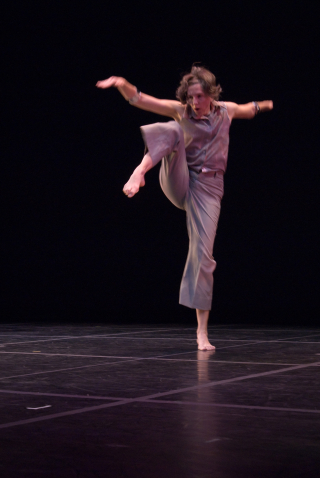
Photo by Nikki Carrera
Major influences:
Bebe Miller, Judson movers/thinkers, Nancy Stark Smith, Trisha Brown, Karl Rogers
What is on your calendar for 2017 (teaching, choreographing, performing)?
- Teaching.
- A new solo.
- Performing and choreographing with Doppelgänger Dance.
- A show in Cambridge in the fall.
- Mom-ing (this cannot be left out).
Current training practices:
Contact Improvisation but not often enough, yoga, walking my dog, figuring out how to make my own technique class not unbalance me, sleep.
The role of somatics in your artistic life:
Things that I think about that relate to somatics: feeling my feet softening and yielding to the floor, the meaning of touch, the shifts in “the small dance” (also called the “stand”), how not to grip things unless absolutely necessary.
What is the role of teaching within your dance life? What do you love about teaching? What does the phrase “teaching artist” mean to you?
Teaching for me is an exchange of ideas, two or more ways. I am continually trying/learning to be more open, more ready to be surprised, more thoughtful, less assumptive. I don't always live up to my expectations. I know that I have a specific way of moving, of being in the body, to teach. There is always a way of being in the world that I can learn to be better at. I love teaching choreography. I love challenging the idea that there is a way to make a dance. I love exposing students to Contact Improvisation, helping them find themselves through the form.
On most days, I am a teacher first and an artist after that, slipping the artist into the cracks in time between the duties of teaching. I think that I trust my teaching more than my making dances. So sometimes teaching may be avoidance of making. I also procrastinate by sewing.
Can you talk a little about your performance practice? What has been your growth as a performer? What are your strengths? What are you working on and exploring these days?
As a performer, and given that I only perform what I make these days, I have been working on finding quiet in my body, on pausing for long seconds, on a stillness of the body if not the mind. I am not sure that I can separate the maker and the performer. I like to make movement that I can barely do. I like to pretend that what I make does not have meaning.
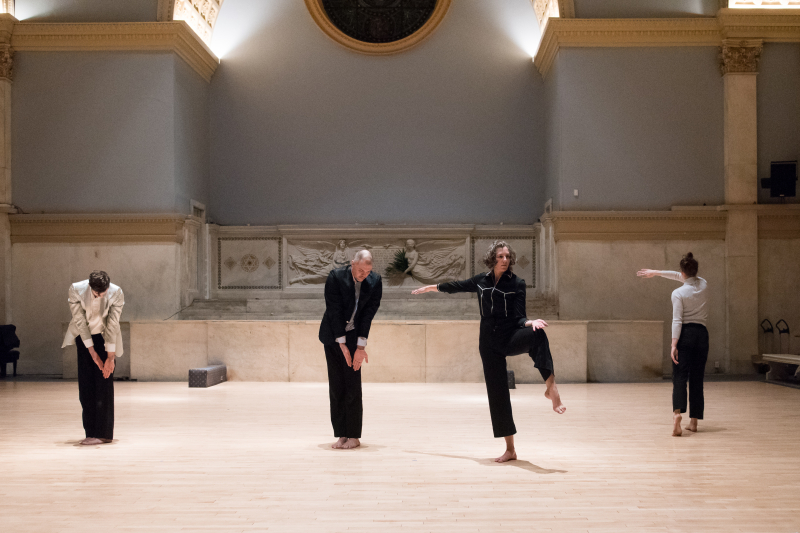 Photo by Ian Douglas
What are the skills a contemporary dancer needs in 2017?
Softness in the body even during exactitude, willingness to find texture, letting go of the assumptions of many so-called classical techniques while at the same time being facile in those forms, caring of the other during partnering.
As a choreographer, questions on your mind right now:
How boring can I be? How can I stick to making what I make despite the fact that I do not make evening-length pieces about issues? Waffling between caring and not caring if lots of people see my work.

Photo by Nikki Carrera
How do you find dancers? What do you look for in a dancer?
I look for specificity: dancers who can move the way I need them to move and who actually see what I am doing, who see the complexity and the delicacy of a certain kind of specificity without turning it into what they already do. I find dancers by asking dancers that I admire in other companies. I do not produce work every year, so this is more like a pick-up who-is-available situation. I only want to work with people who are lovely to be in a room with while I sort out my insecurities in front of them.
Financial advice to pass onto dancers just embarking on starting their own company:
I have no idea! I don't really consider what I do to be a company. I have never made the mental or structural leap. I see ambition as a necessity for this path.
Advice to dancers on writing on the subject of dance and flexing that artistic muscle:
The only way to learn anything is to do more of it. Get a deadline. Get a reader waiting for your writing. Write even when you do not know who the audience will be.
How would you describe the dance scene in Providence (or RI in general)?
Tiny but growing. Supportive. Do not come here for paid dance work. Come here if you’d like to start small and on your own. There are no regular morning classes. There are not many advanced dancers, whatever that means. But there is space and time and some very nice dedicated people.
Final thoughts: Hope/belief/love of the profession:
I feel so lucky that I have found a thing to do in this life that brings me joy, that helps me to be a better person than I actually am, that I can keep working hard at without ever getting to some fictional epic place, no end in sight.

——–
Related posts:
Artist Profile: Molly Lieber (Connecticut College alumna)
Artist Profile: Angie Hauser (dancer with Bebe Miller)
—————–


 Life as a Modern Dancer
Leave a comment