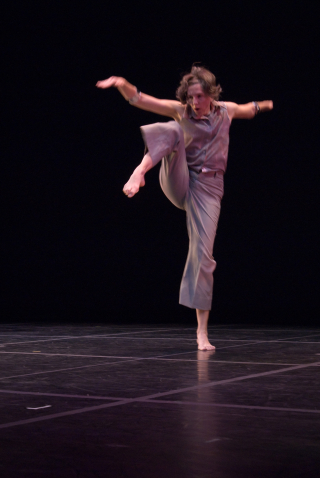
Heidi Henderson; photo by Nikki Carrera
As of late, I have been asking, "What is the influence of somatics on your training, teaching, and artmaking?"
Things that I think about that relate to somatics: feeling my feet softening and yielding to the floor, the meaning of touch, the shifts in “the small dance” (also called the “stand”), how not to grip things unless absolutely necessary.
My yoga practice, study of improvisation and partnering, some training and practice in Laban fundamentals and study of experiential anatomy combine with my own research and experimentation as a mover to sustain my dancing, performing and teaching life. Returning to the classroom each year feels like an act of radical repositioning. Even as I return to the knowledge, experience and accumulated memories of my teaching and creative practice, I look to ways to restructure the ways I deliver information and search for new methodologies of learning, making, and doing.
Pamela Geber Handman:
A HUGE influence! I have studied several discrete somatic forms, the principles from which permeate every class I teach from studio to classroom. My own teaching philosophy assumes a somatic approach.
My own practice involves the integration of Klein Technique and Alexander Technique with more traditional techniques. I am also a certified Zero Balancing Practitioner (a therapeutic body modality) and certified in Vinyasa Yoga. In teaching a technique class, informed by Klein and Alexander Technique, the structure of the class is influenced by the logical sequencing of Viola Farber’s class in which the dancing combination that happens towards the end of the class, is intertwined and introduced within in the warm-up.
Jess Humphrey:
Slowing and softening are a lifelong endeavor for me. I’ve been in so many situations where I’ve had to fight, and that’s taken some time to unravel. My trauma history is part of it, but I also come from a long line of strong, loud, intense women and grew up doing gymnastics where coaches yelled both punishments and praise at me hourly. Somatic practice helps me with modulation. It also helps me appreciate and leverage my speed when I need it.
I’m interested in cultivating as many perspectives as possible. Somatic systems offer such detailed and nuanced methods for waking up to one’s first-person experience. This waking up is artful. It is beautiful. I’m also interested in what happens when a relatively objective or “it” perspective is added/integrated.
A somatic pedagogy involves harvesting existing knowledge from individuals/groups, and moving from that process into the introduction and integration of new energies and information. What do those in the class already know? What is the collective knowing of the class? Starting there is a somatic practice.
I’ve been paying attention to what somatic and contemplative practices can do within dancemaking processes for some time, and here’s how I’m thinking about it lately:
- State Induction (for both creation and execution, and sometimes at the same time)
- Generation of Material
- Support for Execution of Choreography
- The Dance(ing) Itself
Michelle Boulé:
I do a lot of exploring on my own, with influences coming from Body-Mind Centering, Feldenkrais, yoga/Ayurveda, BodyTalk, qi/energy work, and the breath and vocal training I’ve done. Over the years, I’ve done a lot of private sessions with practitioners. I’d like to start taking classes with people more, which I moved away from when I was performing and touring so much. I knew what my body needed, and oftentimes, didn’t have the time for class. Now it feels like time to find a practice that involves more community.
——
Related posts:
Artist Profile: Sondra Fraleigh
Writing Dancing: With Andrea Olsen
————————

 Life as a Modern Dancer
Leave a comment