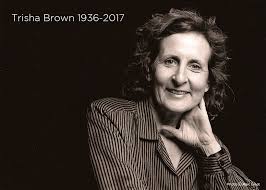
With Trisha Brown's recent passing, we have lost a key figure in contemporary dance in the United States, who made a wide and lasting impact over six decades.
Personally, I think I got into the work of Trisha Brown after getting to know dancer Shelley Senter, when Shelley lived in the Bay Area for a short period of time. I also vividly remember the first time experiencing the company live, probably around 2000 at Cal Performances in Berkeley. Ease, elegance, movement for movement's sake.
For my MFA research on outdoor site-specific dance, I extensively researched Trisha's work from the early 1970s on rooftops and sides of buildings.
Today, I am reposting some pieces related to Trisha Brown from the blog.
The Six Degrees of Trisha Brown
These 5 artists worked with Trisha Brown – as dancers, rehearsal directors, and repetiteurs. Click on any name to read further about their work in the company and the impact of Trisha on each of their lives:
Tamara Riewe (dancer in the company)
Shelley Senter (dancer in the company, repetiteur)
Gwen Welliver (Rehearsal Director)
Neal Beasley (dancer in the company)
Todd McQuade (dancer in the company)
New Book on Trisha Brown
This is a repost of a piece the author wrote for the blog in November 2016:
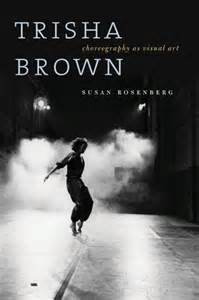
Trisha Brown: Choreography as Visual Art
By Susan Rosenberg
The process of writing this book on Trisha Brown’s work was joyful and daunting. Trisha created nearly 100 choreographies, 6 operas, a single ballet – as well as a body of graphic work that has earned recognition in numerous exhibitions. With an oeuvre of such breadth, depth and richness, how could it all fit into a single volume?
The problem was made more acute since, as a trained art historian, I wanted to (and did) give each of Brown’s individual dances its due, addressing each work as if it were an painting or sculpture: by analyzing its formal components, its effects, its genesis, its predecessors and its relationship to the visual art that informed her works’ making.
One of the most enjoyable and informative aspects of the project emerged from the interview process, which was the basis for reconstructing Trisha’s thinking and understanding how she crafted her dances. I was lucky to interview Trisha regularly from approximately 2007 to 2011. However, about one year into the process I gained two new insights into how best to use the gathering of oral history in my book’s writing.
The first revelation came when I recognized that Trisha, as an artist, was – and always had been – focused on the creation of new works, and not on the maintenance of her choreographic repertory. When I first met her she was simultaneously creating choreographies for the stage, directing operas, and engaged in the process of creating large-scale drawings that emerged from improvisational practices. Plus her company was touring the world constantly – and Trisha often joined them. Many things were happening in her present life, and it became more important to document all of this than to constantly ask her to dredge up past memories, or to re-tell stories about her work and thought that had been recorded elsewhere, and earlier.
So my approach changed – a switch flipped – and this transformed the course and substance of our conversations going forward. Trisha became the source I went to in order to grasp the concepts and research processes that went into her development of the choreographies. However, then it became essential to interview the individual dancers who had worked with her, and thus to organize this information in a unique mosaic: often the dancers did not know what was in Trisha’s mind, and likewise, Trisha could not recall every movement or impulse that went into her dance’s making.
Ultimately the most difficult part of writing the book was ending it. I had gathered so much material, but was stuck with the limitations of a word count. A great deal of writing got filed away for the future; I focused my mind on the rationale for my book’s ending, which neatly turned out to be at the end of the first 25 years of her fifty-year career. However, I did not decide on this endpoint solely based on the elegance of the number itself. Rather, I decided that the last dance that my book discusses – Trisha Brown’s magisterial 1987 collaboration with artist Donald Judd on Newark (Niweweorce) – could be understood as the culmination of the ideas about Brown’s work on which my book focuses: in particular how Trisha insinuated visual art ideas into her works’ creation, staging and performance.
To purchase the book, please click here.
And lastly…..Slow Dancing
This is not something from the blog, but a personal favorite digital dance project. If you have not experienced David Michalek's work yet, click here to see the video of Trisha Brown.
—-
Thank you, Trisha, for all of your gifts and inspiration. – Jill

 Life as a Modern Dancer
Leave a comment