Post by Rebecca Stenn
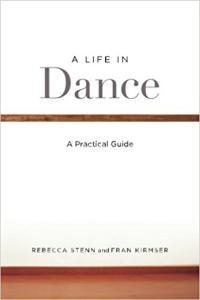
A Life In Dance: A Practical Guide is a book written with the intent to broaden a dance artist’s knowledge of the possibilities available to them — providing inspiring stories of dancers both known and unknown, who have trodden multiple and varied paths. The first half of the book delivers enlightening and personal narratives from over 40 dancers from all generations and genres including Concert Dance, Broadway, Film, and Television. In writing and editing the book, we strove to be true to the extreme diversity of the dance world by including as wide-ranging and all-embracing a group of artists as possible. The second half of the book offers a resource guide for dancers, including outlets that can help answer questions and provide direction for: student loan debt, health insurance, legal advice, funding resources, financial planning, studio space rental needs, and much more.
The inspiration to write it:
Five years ago, while teaching a class at The New School, I had a simple, clear idea about how we might broaden the notion of what a life in dance could mean, and I decided I would write a book that endeavored to delve deeply into this awareness.
I started with this recognition: In dance, a largely wordless art, our shared history is passed down chiefly through visual imagery. We learn to dance by watching our predecessors, by listening to the way they move their bodies and subsequently tuning in to our own movement sensibility. There is a rich practice in this, but something else is required too. In addition to rigorous physical and artistic training, dance artists also need to take part in the extensive tradition of storytelling that other art forms champion to learn the basic realities of having a career in dance, of existing and thriving in the dance world, and of widening the definition of what a life in dance can mean. In short, dancers need to learn how to advocate for themselves, and they need clear, concise guidance about how to do it.
For almost a decade now, I have taught a course entitled, The Practical Side of Performance. I began creating the course with this simple idea: we learn by first observing, then experiencing, and finally by reflecting on what we’ve seen and done. The idea for the course came about as I watched and listened to each group of graduating seniors in the arts as they wrangled with the concept of reconciling all they had learned about craft, rigor, and discipline with ways of actually going out there and creating work, showing work, and making a living doing it. In other words, How did one parlay all that training in one’s craft into an actual career in the real world, beyond the walls of the academy? There was a genuine, tangible need for this course, as the students who had trained in dance, theater, film, visual arts, music, and creative writing faced the ominously practical realities of supporting themselves as serious artists.
As I approached the development of a course outline, I knew I had to stay true to the maxim that we learn by observing and then doing. How could I do this with a class made up of students spanning all of the artistic disciplines? Because my own personal background is in dance, and because the class would be populated so broadly, I determined early on that the best course of action would be to invite guest speakers from each of the disciplines to come into the class to share their stories. At first glance, the idea of sitting around listening to stories from working artists might not appear to be particularly academic or rigorous. But I knew this would work. The stories and anecdotes led to questions and discussion, and even heated debate. The observation phase of the learning had begun. Taking in the way someone else had navigated and created the map of a life and career was helping students to become aware of the possibilities and to start to think about all of the inherent choices that lay ahead.
Along the way (while assembling reading lists for my students), I noticed that there was a conspicuous absence of resource type books in dance, that addressed these particular needs. There was one such book and it was excellent, but the most recent edition had last been published twenty years ago. My students and I joked that someone should write a book. It wasn’t until I had the epiphany of sorts that I mentioned at the start of this article, that it became clear to me, that I should begin writing and gathering histories.
In thinking about how to organize the book, I knew it had to be true to the same narrative and maxim I had employed both in my class and in my life: that we learn from listening and watching first and then undertaking our own paths. Therefore, I determined early on that the book would be filled with profiles of people who have made a life for themselves in dance. We would sit around and listen to stories.
Who should read it?
A few years into the process, Fran Kirmser (Tony award winning Broadway producer, consultant and former dancer) came on board as co-author, and things really started to roll. We began to make comprehensive and far reaching lists of people we thought offered unique perspectives on the field and subsequently asked them to share their stories with us. There are many beautiful voices that populate the book and through this, we hope that young, emerging dance artists (and others too) will find in it sources for vision, courage and possibility.
In our time, with the advent of the internet and the proliferation of information available there, it becomes less important for a book like this to list every possibility. For us, the significance is discovered, rather, in the personal stories, the anecdotes and tales that aren’t found in lists of performance venues on the internet. The book does include a comprehensive resource guide with plenty of pertinent information, but it was more so our intention to guide with the profiles and the stories they impart and to allow readers to find their own way.
Finally, in putting the book together, I began to identify a recurring theme that has, over the years of my career in dance, become infinitely important to me: there is no one path to success or indeed one correct way of doing things. There is truth to the notion that to attain great skill one needs to put in hours and hours of work and years of discipline, but the belief that all is lost if one doesn’t fit a certain mold is both wrong and dangerous. We aim, in the book, to open up the definitions of a successful career in dance, to widen the conventional path, and to present the countless options that continuously unfold as a career matures. We hope that by offering these many varied profiles, we present an enormously broad perspective. Becoming a dancer is a constant evolution, muddy and complicated and overlapping and joyful and tremendously scary and meaningful.
Websites:
To purchase the book on amazon.com, click here.

Photo: George Del Barrio. Rebecca Stenn (left) and Fran Kirmser (right)
Bio of Rebecca Stenn
Rebecca Stenn – dancer, choreographer, educator, and writer – founded Rebecca Stenn Company in 1996. The company has since performed to critical acclaim and sold out houses in over 50 cities including such venues as The Copenhagen Festival, The Edinburgh Festival, The Joyce Theater, BAM Fisher, The Kitchen, Danspace Project, New York Live Arts, Joyce SoHo, Symphony Space, Dance New Amsterdam, La MaMa ETC and Jacob’s Pillow Dance Festival among many others. The company has received support from the National Endowment for the Arts, The New York State Council for the Arts, The Joyce Theater Foundation, and the American Music Center and has been hailed in the New York Times as a company with “Wit, concision and gutsy passion…a collective force.” Recent performances include a return to the Edinburgh Festival, The Joyce Theater Family Matinee series, and solo performances at the Rubin Museum.
As a principal dancer with MOMIX from 1989 to 1996, Stenn performed in over 30 countries and throughout the U.S. and appeared as a featured performer in films for Italian, Spanish and French television. Also with Momix, Stenn assisted in the choreography of and performed as a principal dancer in Lina Wertmuller’s production of Carmen at the Munich Stats Opera, was a featured performer in the first ever 3D Imax film, Imagine, and assisted in the choreography of the Emmy Award Winning PBS Special, Pictures at an Exhibition. Stenn is a founding member of Pilobolus Too with whom she toured throughout the world from 1996 to 2002, creating and performing numerous works for the repertoire and a piece for the Radio City Rockettes. Stenn has been a contributing editor at Dance Magazine and has published work in the International Journal of Dance and the Brooklyn Rail. She has been the Choreographic Mentor for the National Young Arts Foundation and with them has choreographed numerous performances presented at the Kennedy Center. Stenn is currently on faculty at The New School and Princeton University and is Choreographer-in-Residence at Dartmouth College. She has enjoyed Artist in Residencies at Barnard College, Montclair State University (New Works Award), University of Wisconsin (Alumni Award), Keene State College and Lafayette College among others. Stenn most recently choreographed the new multi-media opera Cracked Orlando at The Juilliard School and premiered a new duet at BAM Fisher, and is currently making a new evening length work for Rebecca Stenn Company, to be premiered July 2018 at the Gowanus Loft. Stenn holds a BFA from The Juilliard School and a MFA from The University of Wisconsin Milwaukee. She is the proud mother of Jonah and Elie Weissman.
Bio of Fran Kirmser
Fran Kirmser has worked as a consultant and dance producer with artists and arts organizations for 20 years and has facilitated the work of hundreds of artists to stage. She began her professional career at the age of 14 as a dancer. After a career-ending injury, she started working on the other side of the stage. In 1997, she founded Fran Kirmser LLC, one of the first consulting companies dedicated to fundraising and promotion efforts for the emerging artist. Past and present consulting clients include Francesca Harper, Lisa Giobbi Movement Theater, Shen Wei Dance Arts at Lincoln Center Festival, Pascal Rioult Dance Theater at The Joyce Theater, Lucinda Childs Dance Company at BAM, Helen Simoneau Danse at BAM/Fisher, Doug Varone and Dancers, Darrah Carr, and Jessica Chen. In 2002, she launched The Biography Project, a series of biographical plays that tell the stories of artists in an effort to recognize their voices, better archive their creations, and explore their influence on culture. The first was Isadora …No Apologies about American dance icon and feminist Isadora Duncan, choreographed by Lori Belilove.
On Broadway, Kirmser co-produced August Wilson’s Radio Golf and earned a 2009 Tony Award for Best Musical Revival, Hair, choreographed by Carol Armitage. In 2008, off the heels of the financial crisis, Kirmser conceived a sports series for stage to explore leadership, competition, teamwork, drive and resilience. She first developed Lombardi, based on the life of the iconic leader and renowned football coach Vince Lombardi, starring Dan Lauria and Judith Light. Produced by Kirmser/Ponturo Group and in association with the National Football League, Lombardi opened in 2010 and was the longest running play of the 2010-2011 Season, where it brought an estimated 146,000 new patrons to the theater for the first time.
Additional Broadway credits include Magic/Bird, Bronx Bombers, Glengarry Glen Ross, and Who’s Afraid of Virginia Woolf?, which earned the 2013 Tony Award for Best Revival of a Play. Fran serves as Executive Producer of the feature film Lombardi, based on the Broadway play and produced by Legendary Pictures, and the feature film Louis Vs. Schmeling.
She has served on funding panels in the fine and performing arts such as New York Foundation for the Arts and has taught at Columbia University, The New School, Fordham, and colleges across the country as well as Commercial Theater Institute and The Field where she sits on the Advisory Board. Fran serves as a 2016 Tony Voter and is a member of the Broadway League. Having started out her performing arts career as a young professional dancer and self- produced choreographer, her passion is teaching self-producing and fundraising to emerging artists and helping them to realize their projects to stage!
———-
Contributors to the book A Life in Dance, who have also written for Life as a Modern Dancer, include:
———-
Related posts:
For a Senior Seminar Course: A Reading List
For an Undergraduate Composition Course: A Reading List
For a Technique Course: A Downloadable Journal
——————–

 Life as a Modern Dancer
Leave a comment