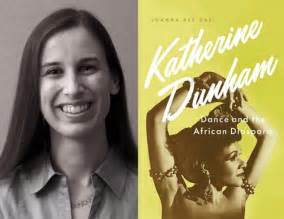
By Joanna Dee Das, author of Katherine Dunham: Dance and the African Diaspora (Oxford 2017)
What inspired me to write this book? And who should read it?
I never met Katherine Dunham, but she shaped the course of my life. At age nine, I began to take jazz dance at the Center of Creative Arts (COCA), a community arts center in University City, an “inner ring” suburb of St. Louis, Missouri. I had only a vague awareness that my teacher, Lee Nolting, doubled as the ballet mistress for the Katherine Dunham Children’s Workshop across the river in East St. Louis. After taking a Dunham Technique class at age twelve with Lee’s husband, Darryl Braddix, I realized that many aspects of my jazz dance training, including the arm positions and body-part isolations, came from Dunham Technique. Even more influentially, Lee based the COCA dance program on Dunham’s philosophy of intercultural communication through the arts. Lee insisted that COCA offer scholarship programs that drew black students from the north side of St. Louis and white students from rural areas in Missouri and Illinois. I was part of an organization with a mission to create community and challenge racial segregation.
In graduate school, I decided that the best way to combine my interests in social justice and dance was to write about Dunham as an intellectual and activist. To do so, I delved into her personal archives at Southern Illinois University and the Missouri History Museum; I interviewed former students and company members; I traveled to Haiti to get a sense of her connection to that nation and its people. In 2010, I began to re-learn Dunham Technique and eventually became a Certified Instructor. It has been a true blessing of this research to make a connection with the communities of people working hard to keep Dunham’s dance legacy alive. It is my hope that this book contributes to that effort by exposing a wider audience to Dunham’s importance for American and African diasporic history as well.
In the book, I think through the question of what it means for an artist to be an activist. Both onstage and off, Dunham took steps to create the change she wished to see in the world. Her story is relevant to our present moment, in which artists and others are thinking through how they can make the work they do relevant to social justice movements, particularly Black Lives Matter. I also see Dunham’s story as an important reminder about the value of intercultural communication and an internationalist perspective. I argue that Dunham was one of the creative forces who brought the concept of the African diaspora to a broader public, laying a cultural foundation for political unity. She did so not only through performance and choreography, but also through education, scholarship, and the example of her own life. In our current political climate, we see the rise of white nationalist, xenophobic discourses on the right. Dunham’s vision inspires us to challenge that rhetoric. Her story also adds nuance to discussions about cultural appropriation. Much of the work Dunham created in the 1930s and 1940s would be deemed cultural appropriation today by the increasingly narrow standards adopted for intercultural exchange. Embracing interculturalism without reproducing cultural hierarchies or inequalities is a challenge Dunham leaves for us today.
While Katherine Dunham: Dance and the African Diaspora makes a scholarly argument and is thoroughly researched, it is a book for the general public. I hope that anyone interested in dance, 20th century American history, the African Diaspora, and the relationship between art and politics will find it a useful and inspiring text.
To purchase the book, please click here.
—-
Related posts:
————–

 Life as a Modern Dancer
Leave a comment