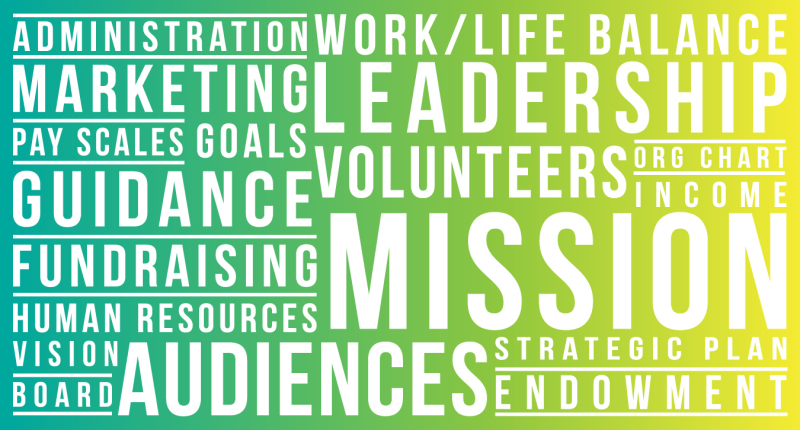
 Design: Jenny Lederer www.jennylederer.com
Throughout 2017, we will be using the alphabet as a novel way to unpack the many concepts of arts administration. Please join in. Thank you to the following arts administrators for adding ideas to the project:
- Ashley Thorndike-Youssef, Now Next Dance
- Fernando Maneca, BAX | Brooklyn Arts Exchange
- Hillary Kooistra, Abraham.In.Motion
- Kathryn Humphreys, Hubbard Street Chicago
- Katie Kruger, Shawl-Anderson Dance Center
- Liz Hitchcock Lisle, Shotgun Players
- Phyllis Haskell Tims, University of Utah (retired)
- Rebecca A. Ferrell, University of Illinois, Urbana-Champaign
- Sarah Crowell, Destiny Arts Center
- Tammy Cheney, Lines Ballet
Arts administration relates to work at dance centers, arts councils, arts education programs, companies, and college programs. Please read on to explore the many and varied topics within arts administration. While not every topic applies to every setting, we hope that you will still find one or two ideas in the post that are useful and applicable to your particular setting. Please feel free to add ideas and links in the comments section below.
This week, we will talk about the letters Q and R:
- Quickbooks
- Quotes
- Questions
- Recruitment
- Revenue sources
- Restricted funds
- Reserve/rainy day fund
- Retirement
- Research and reports
- Reflection
- Risk management
- Residencies
- Retreat
- Reading list
———-
Let's unpack, consider, and reflect upon each one of these terms and phrases. Even before reading further, you might want to take the list of ideas here and simply journal for your organization. What do these words mean to you at your organization?
Q is for Quickbooks
For many arts organization, Quickbooks remains the main option for accounting of income and expenses. As Hillary Kooistra, Company Manager for Abraham.In.Motion, recently shared:
I actually took the Quickbooks training through one of our Dancer Development Program seminars…this was one of 8 seminars designed specifically for our dancers to strengthen their administrative skill sets (they also took seminars in pedagogy, marketing/branding, building a website, and more). The Quickbooks training was through the Actor's Fund.
Q is for Quotes
A simple concept – but helpful for yourself and your staff. Keep a quote at your desk or start off a meeting with an idea or two.
- Check out quotes pulled from the past 5 years and the 150+ artist profiles on the blog. Click here.
- Check out the Dance and Change ideas shared each month throughout calendar year 2017 (post-election art making). Click here.
- Also, as we continue as a field to talk about our lives as teaching artists, and what this phrase "teaching artist" means….read these 50 beautiful quotes as well.
Q is for Questions
Just as the Lincoln Center Institute's model of aesthetic education offers a "line of inquiry" into a work of art, what would you say is your main guiding question these days at your site?
To quote the incredible, questioning artist Liz Lerman,
Since our institutions are failing all around us, artistic practice is truly one of the great opportunities to make our worlds better. I for one am willing to give up our specialness in order to be more engaged. This can be small and tiny (like teaching dance in a senior center once a week) or it can be large scale (changing curriculum or even the way we think artists should act in the world)…
And also, having just been part of a festival of dance in NYC in the past few days, a real request that we question ourselves. What are we doing? Why? Why this movement here? Why this dance now? Asking questions is a way to revive the self, and renew the world around us. At least that has been my experience.
R is for Recruitment
Considering a higher ed lens, how are you recruiting students? What is your mission and vision with your students? How are you supporting equity, inclusion, and accessibility? Logistically, what is your budget for advertising, marketing materials, presentations locally and nationally at high schools, and through social media platforms? Concretely, how many students do you need enrolled in the program next year (undergraduate students, dance minors, and masters students)?
If you are an organization with internships, how are you recruiting for these positions as well? This also relates to accessibility and information about the programs and opportunities. Please consider reading Darren Walker's op-ed about internships from the New York Times:
Internships are Not a Privilege
R is for Revenue Sources
Revenue sources – how many ways do you receive funding and generate income? Can you diversify it further? What are restricted and nonrestricted funds? It is a worthwhile exercise as well to open up a blank Excel spreadsheet and input these numbers to create a pie chart of all of the revenue sources. What do you notice?
For artists with companies, here is a simple template of a budget, which already lists several potential revenue sources:
http://blog.lifeasamoderndancer.com/2015/02/building-a-dance-company-creating-a-budget-for-2015.html
R is for Restricted Funds
Related to revenue, what is a restricted fund for your organization? Does every staff member understand the parameters and guidelines related to this funding? It is of utmost importance to follow through with all restricted funds from foundations and individual donors to see an idea through to fruition and use the money as described.
R is for Reserve/Rainy Day Fund
A reserve – or "rainy day fund" – is your organization's cushion in case of major events or disasters. If an earthquake happened, and you had to shut down, could you still cover costs for a few months? Your board should set a reserve policy for clarity and commitment. You base this figure on your operating budget. How much does it cost to run the organization each month? In general the reserve should cover at least 3 months of operating expenses, or even upwards of 6 months.
R is for Retirement
Established, sizable nonprofits and schools will have the ability to offer retirement programs, and possibly matches as well.
If not, what are other creative ways to still support this conversation about saving for retirement?
Reposted here is text from the August 2015 blog post on this topic:
Saving for retirement is a grey area for many dancers. While holding down multiple freelance gigs, dancers usually do not have one main employer and the opportunity for a formal 401(K) program. But, that does not mean that dancers should not take this on on their own. Whether you are 22, 30, or 40, it's never too late or too early to begin saving. Many artists who have been profiled on the blog over the past 3 years have suggested to begin saving early.
I asked my financially savvy spouse to help with today's post. You can go to your bank to set up some form of a retirement plan, such as an IRA, or even online through Schwab or Vanguard.
The following link from CNN Money also offers some basic information and a retirement calculator. The information is sobering; definitely consider talking this through in person with a family member, friend who works in finance, or someone at your bank. Click here. (Just a reminder….during retirement you will collect social security as well as use the money in your retirement savings.) Forbes.com also published an accessible article on this topic as well.
The key is the compounding of the money. The longer the money is in the bank, the better the benefit.
Personally, I probably started my IRA in my early 30s. It was not until age 34 that I was in a job that offered a 401(K) program (plus a match). And a word about matches from your employer – if your employer does match some of the money you place into your 401(K), I highly suggest maximizing this benefit. For example, an employer might offer to match up to 5% of your annual salary. It is a gift to you (free money) – potentially several thousand dollars a year on top of your salary.
Ultimately, you need to decide how much you can comfortably tuck away each month. Even beginning with $25 or $50 a month clearly benefits you. For many dancers, the thought of putting away 10% of your income each month might not be possible while in your 20s.
Here is an example. If a dancer puts aside $50 a month from age 25 until age 65, that money compounds to be $119,781 (with a 7% average annual return). Starting early clearly will have its benefits. Compare this to starting at age 35 (ending at 65 with $56,676) and starting at age 45 (ending with $24,597). You will want to save more than $50 a month when you can, and reach that ideal number of saving 10% of your annual income each year, but you get the idea. Starting early is important.
R is for Research and Reports
If your site is not actively conducting research, consider look to a few other organizations to find relevant documents and data to support your own work and advocacy, including:
SNAAP – Strategic National Arts Alumni Project
Americans for the Arts (including economic impact of the arts)
National Endowment for the Arts
R is for Reflection
Reflection….so integral to our work as arts leaders. Whether a monthly activity to reflect, or a weekly one, reflection deepens our work and asks us to pause for a few minutes from our busy schedules. Through reflection, can we maximize each opportunity, each project….instead of just crossing it off the list and rushing into the next thing?
Kathryn Humphreys (Director of Hubbard Street Education, Youth & Community Programs) recently shared:
I like to ask if what we are doing is moving the work forward. If our systems are helpful or getting in the way. What have we learned this year? What do we want to know? Does our programming still fit the biggest need? Are we teaching our students to be dancers and choreographers (which seems so obvious, but I think it's important to reflect on the most basic goals). Are our students learning what we intended them to learn? I like to make sure we position ourselves as learners alongside our students and that we create opportunities to share (and notice) our ah ha moments.
Katie Kruger (Youth Program Director of Shawl-Anderson Dance Center) also added:
What is the relevance of the work that we are supporting in this day and time and in people’s lives? How do we recognize these relevant outcomes, and what is the support system behind them?
R is for Risk Management
"Risk management" is a formal term that can feel out of context for our field. But, truth is, there are a lot of considerations in this category, such as:
- Injury reports when a student or teacher gets hurt in a class; documentation and follow up
- Liability insurance
- Workers comp insurance
- Sexual harassment trainings for staff
- First aid, CPR, and AED trainings for staff
- Employee manual
- Background checks on employees
- Monthly assessment of your building and safety needs
- Managing the entrance and exits to the building in terms of rain, snow, and ice
- Exit signs in every room
- Exit plans/pathways noted in every room
- Fire code/room capacity signs
- Staff trainings in terms of exiting the space in case of emergency
- Pre-show announcements and mentioning safety related details (like the emergency exits)
- Field trip protocols – who can drive students
R is for Residencies
Speaking on behalf of the larger dance field in the United States….residencies are gifts and opportunities we can offer the dance community. Residencies can offer the gifts of time, support, publicity, and connection. For our own sites, residencies bring in vibrant new voices, build connections, and create new works of art.
Residencies can take a variety of shapes. Some residencies give time and space for artists to work. Other residencies involve numerous community events, discussions, and performances.
I also want to advocate for more teaching artist residencies – to support dancers with their teaching craft and pedagogy. And, what about a "company in residence" who also can do their administrative work onsite for a given amount of time?
Off site, are your teachers or graduate students artists in residence in a local school, community center, or senior center?
Another "r word" - reciprocity – is key within this conversation as well. What is the give and the take? What are the requirements? Is this clear from the start of the residency?
Here are a few examples from around the country:
Dance Place's New Artist in Residence Program
Gibney Dance's Community Action Artist in Residence Program
Triskelion Arts' Artist in Residence Program
Dancers Workshop in Jackson Hole, WY: Visiting Artists in Residence
Queer Emerging Artist in Residency Program at Destiny Arts Center in Oakland, CA
R is for Retreat
This might sound completely luxurious for our field, but the possibility and opportunity of a "retreat" away from your site for 1 day a year (or 2 days) can be a beautiful opportunity to build community, reflect, pause, and revisit the core ideas of your work.
Consider finding a beautiful and peaceful space within an hour of your site. It could be a board member's home, a donor's home, a church or synagogue, meditation center, artist in residence site, botanical garden, or even a K-12 school closed for the summer.
The activities throughout the day can include discussion, reflection, of course some movement activities, and a guest facilitator. Eating together, moving together, taking a walk together….simple and valuable.
R is for Reading List
Last, what's on your reading list? Is there a particular book you are reading right now, or articles of interest? Are you able to bookmark things and carve out 1 hour every Friday afternoon to catch up on reading?
Check out the blog's rolling list of new dance books published in 2017. Click here.
Right now I am in the midst of reading two work-related books. Plus, I have a third one already lined up. And, we are re-reading a Hewlett Foundation report this week as well:
Strange Tools: Art and Human Nature by Alva Noe
Moving Arts Leadership Forward: A Changing Landscape by Emiko M. Ono
———-

 Life as a Modern Dancer
Leave a comment