Over the years, I have asked various dancers to speak openly and proudly about their strengths as a performer, as well as what they are exploring these days on stage and their growth as a performer over the years. Looking back through the 150+ profiles, today we share 5 dancers' experiences. Next to each person's name I list a few of the artists they have performed with, though these are abbreviated lists. All 5 performers have worked with multiple artists throughout their careers.
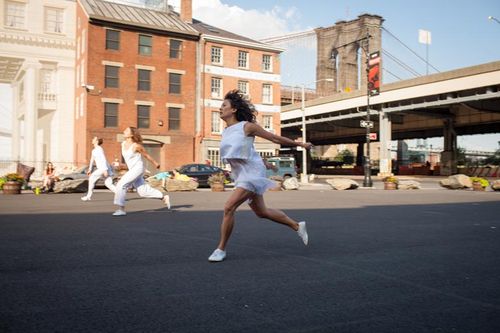
Michelle Boulé “White” Photo: Ted Roeder
Lia Bonfilio (Then She Fell, Lucky Plush Productions)
Describe your growth as a performer:
This is inextricable from my growth as a human. The older I get, the more comfortable in my skin, and the more experienced, the richer and fuller my performances become. The less I chase something that might be considered bigger or cooler or more reputable, and the more I value what I have, the deeper I am able to go into embodiment. For me, dance is something I do. It is not who I am. This is important for me because I may not do it forever. I want my true self to shine brightly no matter how I spend my time.
Michelle Boulé (Miguel Gutierrez, Deborah Hay, Bebe Miller, and in her own choreography)
Can you talk a little about your performance practice? You have performed extensively over the past decade. What has been your growth as a performer? What are your strengths? What are you working on and exploring these days?
I learned in an early rehearsal with Miguel (in 2001) that everything was visible when I was onstage. He could read me through my body. I couldn’t control all the variables of what people saw, but I could try to become more and more aware of myself and my actions. There was also a point when I realized that if I was engaged, the audience probably was too, and perhaps my strategy was to engage with as much as possible, not in a spastic way but in a connected, aware way. Not a “performance of engagement” either. That’s kind of annoying. I just did a Vipassana meditation retreat, and performing is sometimes like that…getting out of the way to feel sensation throughout my body. My body and my perception are alive. My imagination sometimes tosses me into energetic worlds that may seem bigger than reality, but I try to not be delusional. I enjoy reading the energy of the room. I like the accountability and responsibility of being seen and carrying information. Being witnessed serves as a bullshit meter in some ways…going back to how everything is visible.
I’m currently looking more deeply into what is made possible via performative presence. I’ve also been exploring the invisible, less tangible architectures and energies that we “dance with,” as well as the etheric body and how that directs the physical. I would love to do more coaching of performance, as I feel like I’ve spent so much of my time watching the tactics and direction (or lack of direction) of the performers. Only recently have I begun to prioritize watching the choreography! Not that I wasn’t watching that…I just am beginning to watch choreography with the detail with which I’ve watched performing over the years.
I feel like a lot is said through how the body and presence are used, and it feels important to be conscious of the statements we are making and what they are supporting in the world.
Gesel Mason (Ralph Lemon, Liz Lerman, and in her own choreography)
Your growth as a performer over the years:
I trained many years in traditional ballet and modern dance techniques. Now I often perform dances with no recognizable steps in them, yet I believe I‘m a better “dancer” now than I was then. I had to learn not to copy and perfect, but instead to question, investigate, and be honest to the choreography’s intent or the artist’s vision.
Joanna Kotze (Daniel Charon, Wally Cardona, in her own choreography)
Can you talk about your work with Wally Cardona? How did you land the position in the company (audition, seen in class, workshop, etc)? How did you grow as a performer through those 10 years working with him?
It is hard for me to speak briefly about my time with Wally but I will try…I auditioned for Wally in August 2000. I remember it well as I almost did not go. I was not having a good day and my audition slot was at 5pm, or something like that, right at the end of the day. But, I did go. I think about 100-150 women auditioned. He made several cuts that day and then had a few of us work with him and the company for the next two weeks. Then, I got the job!
From day one I knew working with Wally was going to be special, challenging, inspiring and a privilege. Wally immediately challenged my notion of who I thought I was as a dancer and what I thought I could do. He constantly pushed me to new places, new boundaries, sometimes more than I could handle in the moment but in the end fully appreciated. He challenged me on always wanting to be right and what that meant. Learning to let go of “getting something right” and continuously pushing what was unknown was a hard lesson but one that I am forever grateful for.
Wally introduced me to a new technical way of using the body – the way he uses the forces in his legs into the ground, the way the upper body has so much movement against the lower half, an architecture of parts that have myriad potential. Much of the language and theories were inspired by Klein technique, which I originally rejected and then fully embraced, and still do. These concepts, although in my own way, form the basis of my own movement now.
For the first five years, Wally, Kathryn Sanders, Matthew Winheld and I worked, traveled and performed together. They were family to me, and as the youngest member of this family, I learned so much from each of them. After our BAM season in 2005, Kathryn and Matthew left the company, which was very emotional for me. I not only missed them but I suddenly became the veteran company member.
For the next five years, Wally chose other wonderful dancers to be involved in the projects we were building – among them were Julian Barnett, Omagbitse Omagbemi, Stuart Singer, Francis Stansky and Kana Kimura. He also began to emphasize the practice of performance and the individuality of the performer more in the work. I feel extremely lucky that I benefited from both his emphasis on technical movement and performative aspects. Wally continues to be a friend and mentor and is very supportive of my own creative projects. His projects and processes have been among the most demanding of my life in many respects and I am grateful for all of them.
As a dancer in the company for over 20 years, what has been your growth as a performer over time? How has a longtime commitment to the company benefited the work?
Yes, committing myself for 20 years to performing the work of a single choreographer is quite unique. The challenge that I have been given to rehearse and perform this work is amazing. I continue to learn and grow year after year as an artist. There is a certain trust that develops over an extended period of time. This trust is very important. I first had to trust Pina. And Pina learned to trust that I would perform her work to her standards. And the trust amongst the dancers is also incredibly important. We all hold each other to a very high level. ALL of this takes time and experience. TRUST. LOVE. PRIDE. DEDICATION. This is our success.
When I began dancing for Pina I was 32 years old. Now at age 51, I bring different values to my work. My work is far more informed. I understand more of Pina's unique language and how to speak it. As a more mature person, I have a different set of life experiences that also go a long way to inform my work. This was important to Pina. She wanted to see YOU onstage. One's individual experiences were what she based all of her work on. This HONESTY. To be comfortable in your own skin. To be you. This is mentally and physically the most challenging kind of work. To be honest with oneself from the beginning to the end. It can be so draining.
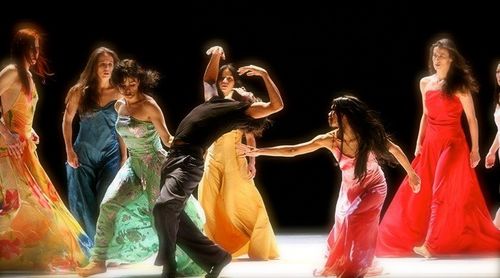
Eddie Martinez, center Photo: Ursula Kaufmann

 Life as a Modern Dancer
Leave a comment