By Todd Courage
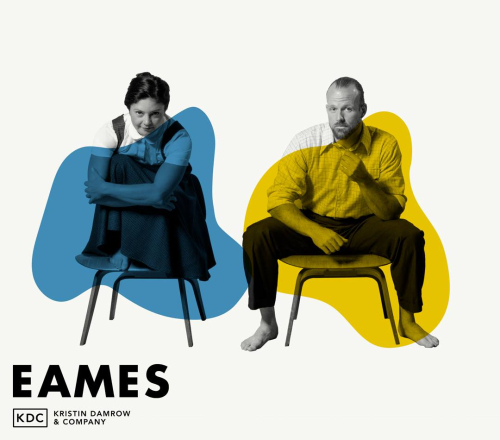
EAMES, an evening-length dance work choreographed by Kristin Damrow, premiered at ODC Theater in San Francisco on January 25th, 2018. Ms. Damrow’s current company of five dancers, represented as four women and one man, performed the piece with confidence and commitment.
The title and subject of the event, EAMES, addressed the iconic mid-20th century husband and wife design team, Charles Eames and Bernice “Ray” Kaiser Eames. The artistic visions of this heavyweight duo redefined the confluence of form and function in America, and their signature contributions in architecture and furniture fabrication continue to resonate to this day.
The press release prepared us for themes of “gender and artistic dynamics,” loosely funneled through the prism of both the intimate and professional relationships of this couple. Straight out of the gate, Damrow illustrated that she is serious about her endeavors. The week ahead of the actual unveiling, she prepared her prospective audience members with seven consecutive previews addressing several layers of the pre-production process, including: the “choreographic moment”; dancers’ words on the topic of risk and rigor in EAMES; the urgency of “live art”; and of particular interest, a short vlog (video blog posting) revealing the collaborative efforts between Damrow and music composer Aaron Gold.
Her unremitting commitment did not stop there. In the lobby of the theater was a large placard displaying a photo of a happy Ray and Charles and a short informative blurb reminding the viewer who the Eameses were and the resounding impact of their practice. Context is everything.
The theater space, too, was not an arbitrary environment. Scenic designer Rick Riemer had shrewdly arranged seven 50s-style “blobs” in primary colors floating against the upstage scrim, setting a tone relating to post-WWII American modern. The program, small and fastidiously considered, finalized the "mise en place," and served as one more nod to the streamline aesthetic of mid-century attitudes.
Dancer Patrick Barnes, portraying “Charles,” opened the piece with a riveting solo laced with curious stops and starts. Pensive stillness was set against quick and quirky variations that adroitly exploited curving, carving, spoking, and slicing through his expanse of space. Tableaux of contemplation enhanced sudden directional changes that exhibited strong modern technique and remarkable upper-body strength. That the evening got underway with a single man dancing was a compelling choice. His poise and conviction were impressively supported by his agility and physical strength – a strange and satisfying launch.
Next, Damrow introduces “Ray.” Powerhouse dancer Heather Arnett, overcoming an initial case of the jitters, soon enough relaxed into her artistry in an uncanny and deep way. Motifs reminiscent of Rodin’s The Thinker, soft feminine gestures suggesting the application of perfume, and coy facial expressions showed the spectator early on that this dancer can deliver on her promise.
Arnett’s “Ray” was most often accompanied by three women performing varying psychological components of her interior self: Independence (Anna Greenberg), Passion (Nell Suttles), and Compassion (Allegra Bautista). Reiterating the palette of blue, red, and yellow, these incarnations wore full-skirted couture cotton dresses, each color commensurate with its assigned representative. The collective energy of so many women was an interesting determination on the part of Damrow, and one had to wonder if this was more the result of the disproportionate number of women over men in the Bay Area dance community or if, indeed, her vision initially included four women and one man. This question aside, Ms. Damrow tackled this imbalance with keen intellect and grace.
These three "supporting" artists did a solid job serving up the choreographer’s intent: How do I convey the complex layers of an influential woman in 50s America while still adhering to the cross-pollinating elements of love and femininity? The answer lies in how these three women occupied space, whether posing demurely as if extracted from the pages of McCall’s or Vogue, or hoisting one another from point A to point B. A mid-century sensibility was cleverly illustrated.
The evening was predominantly comprised of quintets, a sort of “everybody on stage” technique that packs a punch by virtue of sheer number of bodies. Damrow adeptly used juxtaposition and counterpoint to provide visual and energetic tension for the viewer. In this way, she was once again vigilant and generous. There was no shortage of movement material. That said, for the sake of dynamic diversity and recuperation – for both the audience and the dancer – the piece may have benefited from more sections of sustained stillness and suspension, a lapse wide enough to allow the viewer to digest the intricacies of previous variations.
One such moment occurred flawlessly toward the end of the piece. An "adage" for four women began in a low and warm light, upstage left. One could feel the collective exhale of the environment and its inhabitants as the dancers fell into a vertical line, still and composed. Simple and sumptuous arm movements grew into larger and staggered combinations. This was Damrow’s strength at its clearest. Admittedly, she confesses that her choreographic practice, at least until now, had focused on abstract, non-narrative inventions. This brief and luxurious spill of solemn movement attested to her mastery of cryptic fluidity. It was at this point that the story began to support the movement, and not the reverse. Ms. Damrow may not have foreseen this turn of events, but it was not unwelcome.
Brilliant tiers of sound underpinned the evening’s action. Mr. Gold’s music was a seamless and cohesive collage of music samples of 50s jazz stacked and reimagined in a way that paradoxically spoke of that experimental time and of now. Together, his music and the dance were greater that the sum of their parts: the best kind of collaboration.
The lighting design by Jack Beuttler, was at times delineated and angular, and at other junctures soft and obscured. True to the dignity of the piece, the illumination also contributed successfully to bolster the action and define space in a way that imbued continued meaning to the metaphors unfolding in front of us.
EAMES was an ambitious project with multiple collaborators, a bounty of explicit ideas, and the materialization of attendant anecdotal concepts. Kristin Damrow’s courage to take personal risks and breach unchartered territory must be acknowledged; young artists have time and resiliency on their side. For the future, she might consider a slightly broader, less oblique topic of artistic inquiry to showcase her innate gifts in a less confining way. The pitfalls of a narrative can be inhibiting, particularly for a dance maker whose power lies in her unfettered flow.
All said, EAMES was a remarkably brave undertaking, replete with historical allusion, scrupulous detail, choreographic nuance, and a lot of good dancing. This kind of assiduous maintenance inspires dance enthusiasts and fills theaters. I can’t wait to pour a dry martini, pull up a molded plywood lounge chair, and watch Kristin Damrow & Company blossom.
——
Feel a 360 degree view of the project through reading:
Dancers' Perspectives: Dreaming/Preparing/Dancing: 3 Days Until the Premiere of EAMES by Kristin Damrow & Company
"Why live art, now?": Dreaming/Preparing/Dancing: 4 Days Until the Premiere of EAMES by Kristin Damrow & Company
A Video Blog with Composer Aaron Gold
The "Choreographic Moment": Dreaming/Preparing/Dancing: 7 Days Until the Premiere of EAMES by Kristin Damrow & Company
Audience responses: One Good Quote: EAMES by Kristin Damrow & Company
Artist Profile with Kristin Damrow
——
Todd Courage (MFA Dance: Creative Practice) is a dancer, choreographer, teacher, and dance scholar. Other influential interests include Art History, Literature, Food Culture, and Philosophy. He is currently artistic director of courage group and continues to build a diverse repertory of work in the San Francisco Bay Area.
—————————–

 Life as a Modern Dancer
Leave a comment