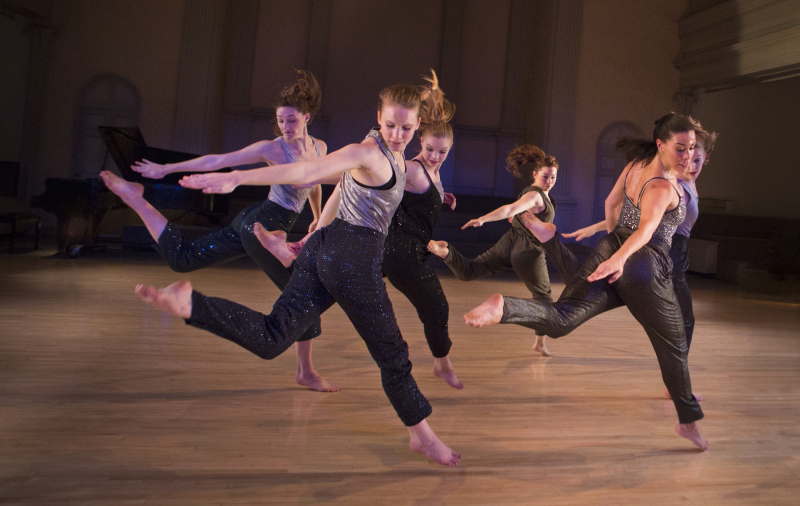
 Photo: Yi Chun Wu
How Can I Practice Dance Technique Without Being Frustrated by Learning Steps?
(OR: How Can I Teach Dance Technique Without Choreography?)
By Suzanne Beahrs
In order to practice dance technique effectively, it helps to alternate our attention between learning steps and biomechanics. Guided improvisation can help us focus more on how movements happen by taking a break from memorization. Here are some ideas about why and how to incorporate improvisation into technical training for any level of student.
Learning sequence can lead to an overly emphatic physicality that doesn’t serve the movement. When a teacher demonstrates gliding footwork that trips me up, I have noticed myself starting to stomp my feet on the floor as I mentally say, “Left right left.” The next time you’re in class, listen closely when a complex pattern is being taught: do you hear yourself or others stomping feet where it isn’t indicated?
Exaggerating shifts of weight in this manner might be an essential part of the learning process, but we can also use it as a cue to take a break from the choreography and practice our foot gliding as an isolated skill. Modern dance “groundedness” involves a substantial amount of skimming the feet along the floor, which deserves concentrated practice. Try imagining you are finger painting with your feet, tracing arcs, lines, and swirls on the floor.
It can be helpful to prioritize mechanics over memorization. In technique classes with set movement sequences, some students consistently prioritize memorization and procrastinate attending to biomechanics. They may assume they don’t have permission to do otherwise, or they may not want to get in the way. When concentrating on what step comes next, students can get frustrated trying to respond to advanced directions like bending their legs as they land every jump. They may figure they’ll work on bending their legs only after they can remember everything. Alternatively, maybe take a moment to play with the idea of a buoyant pelvis before returning to the jumping phrase.
We don’t have to know how to dance before we can improvise. The term improvisation can be intimidating to students who think that it is all about self expression or composing a dance. It can be those things, but it can also be a way to explore our technique. Also, it is helpful to let go of any assumption that you need to master a bunch of dance steps taught to you by somebody else before you can improvise as a practice; instead, it can as straight forward as creating a simple direction, such as changing levels, and then following it with curiosity and an open mind.
To this end, I give students task-based prompts with biomechanical objectives. Here’s an example:
Melting Twister Board Game
Objectives: a. Take bigger steps. b. Move more horizontally when changing levels (eg. when rolling to the floor from a lunge, place your hands further from your feet). c. Move big and three-dimensionally.
Task: Imagine you are on a melting, spreading Twister Board. When you aim to step “Right foot red,” the red dot moves away from you and you glide your toe further along the floor to catch it. Continue with other body parts, spreading yourself wider horizontally as you locomote from one side of the room to the other.
Progression of Games as Students Advance:
3-D Twister Board: Imagine the melting Twister Board is in three dimensions and you have to also reach your fingers, shoulders, etc. further out as you travel from one side of the room to the other.
A Race in Space But Not in Time: With a partner, follow the leader and try to pass them while doing the same steps to the same rhythm. The winner arrives at the far side of the room first with the exact same sequence.
—–
Principles at work: In order to move big and three-dimensionally, your entire body collaborates. For example, to arc your fingertips in a wide arc in front of you, it is helpful to soften your ankle joints, send your knees over your toes, bend forward at the hip joints and lie belly on thighs, and twist in your spine.
There are many other games to play for each aspect of strong technique. An added benefit to this approach is that you are offering students (or yourself) something accessible and valuable that can be practiced at home.
—–
Influences: Teachers, students, and movement systems and principles have informed my practice in this area. I included links wherever possible to offer some resources.
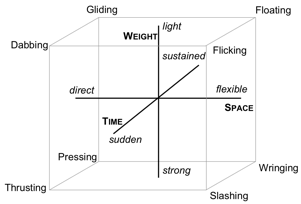
- The eight effort actions of Laban Movement Analysis
- Donna Farhi’s Seven Moving Principles as outlined in Yoga, Mind, Body and Spirit
- Anne Green Gilbert’s conceptual approach to dance training outlined in Creative Dance for All Ages
- Countertechnique
- Classes with Kathleen Hermesdorf and Jesse Zaritt
- My playful and collaborating students of all ages over the years, from 2 year olds to professionals
- Gaga and Forsythe are also worth mentioning; while my experience is tangential, this work has influenced some of my teachers and is a valuable resource.
**If you want to hear more or share your own ideas, come to a Playshop and we will dig in (Up Next: Tuesdays March 3-31, 2020 7:30-9 pm at Shawl-Anderson Dance Center, 2704 Alcatraz Ave, Berkeley, CA. 510-654-5921), or reach out via sbeahrs@gmail.com. suzannebeahrs.com
——————————

 Life as a Modern Dancer
Leave a comment