
From Blog Director Jill Randall:
Hello community! I know that it has been many months since I posted for this specific column (though the Artists' Gratitude Project is deeply related as well…check it out here).
Today I wanted to share about some books related to wellness.
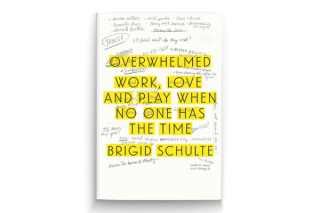 After many months of slowly moving through Overwhelmed: How to Work, Love, and Play When No One Has the Time, by Brigid Schulte, I finished the book this week. It fits perfectly on my shelf of readings related to wellness, work/life balance, and parenting, sitting alongside:
The Sweet Spot by Christine Carter
All Joy and No Fun: The Paradox of Modern Parenthood by Jennifer Senior
The Happiness Project by Gretchen Rubin
Lean In by Sheryl Sandberg
I wanted to share some powerful quotes from it:
- busyness became not just a way of life, but glamorous (page 45)
- A sidebar note I wrote: Is a busy lifestyle a personal choice or a necessity to stay in the field? (page 47)
- Without time to reflect, to live fully present in the moment and face what is transcendent about our lives, Hunnicutt says, we are doomed to live in purposeless and banal busyness. "Then we starve the capacity we have to love," he said. "It creates this 'unquiet heart,' as Saint Augustine said, that is ever desperate for fulfillment." (page 53)
- I began to realize that I, too, had spent me entire career caught in the cult of the ideal worker. (page 92)
- Google, 3M, and other innovative companies give their employees 20 percent of their work time to noodle around and work on whatever projects intrigues them. (page 134)
- American mothers, on average, have about thirty-six minutes a day to themselves. (page 216)
- But talk to any leisure researcher, and he or she will say the true test of leisure is not what the activity is that fills a certain block of time but how that time feels. (page 238)
- Play is a state of mind, an attitude of lightness, curiosity, wonder that can infuse any situation. (page 243)
- Referring to the work of Tony Schwartz, "Human beings, he said, are designed to pulse, to alternate between spending and recovering energy." (page 266)
Schulte interviewed and worked with time researchers around the globe – tracking how we spend our time and divide it between work, family, housework, and then actual leisure/fun/pleasure. One researcher, John Robinson at the University of Maryland, says that we should have 30 hours a week of leisure.
30?! Dancers – take a few minutes and sketch out your week. Where are these hours he speaks of? Reading this book resurfaced one of our unspoken puzzles of the field; we don't hold down one job, but really 1.5 jobs. I have felt this for years, and truthfully am exhausted by it. The first 40 hours counts for the full-time work (teaching, arts administration) that is paying the bills and is the bread+butter. The second job – as performer – includes all of the evenings and weekends over the years rehearsing and performing. But in the end, it was all valued as work. So, those 30 hours of leisure widdled away.
I feel that the dance field thrives on busyness. It is seen and felt as a sign of success. I have fed into this concept too. But like I said, 21 years into my career, I am exhausted by it all. I feel like I cannot keep up my membership.
For years, I have published a column on the blog called My Dance Week. The intention was to transparently share an artist's week and all that it entails – multiple jobs, commuting, training, downtime. It was meant to paint a clear and honest picture of working in the field right now in the U.S. (especially for younger dancers to get a sense of the field). But, in the end, I was starting to feel that I was perpetuating the busyness standard for the dance field. I was not meaning to praise working 7 days a week and the "everydayathon."
This year, I have published several dance weeks again, but have asked artists to work with a lens of wellness as they wrote. Where are their moments of wellness throughout the week? Check 3 of them out here:
—-
Back to the book Overwhelmed, some of my take-aways include:
- 30 hours of leisure; can I strive towards this?
- What truly brings me joy, fun, relaxation, togetherness, and centering?
- A hard question for the field, and for myself: Is taking class, or working out, fun or obligation?
- As a field, how can we talk about the value of our non-dance life and interests, especially with college students throughout their 4 years?
Personally, I am thinking about family and friends, and whatever form our connections take – dinners together, trips, a series of text messages, hanging out on the front porch. I am thinking about my love of reading. Outside time is also very important to me. Parks, beaches, running in parks and on beaches. Parks and beaches with my family. Plus, seeing visual art here in the Bay Area. (Super inspired seeing Kristin Farr's work this week at the Berkeley Art Center.) Also, whenever I can, volunteerism + mentoring fill my heart and soul. Some volunteerism is dance related, others related to my children, their schools, and the city of Berkeley.
My mind is a bit tripped up about dance classes – they feel like work, not like "leisure" to me. (Are they fun and challenging, lifelong learning? Of course.) Other movement practices can more easily fall into the leisure category for me – yoga classes, personal training, Feldenkrais group classes. Running – again – is a wee bit grey for me. I have run 2-3 times a week since age 15, to supplement my dance training and provide basic cardiovascular fitness. Some days, like today, running is fun, relaxing, and enjoyable. Other days it is a dancerly obligation to stay fit.
Lastly, I need to mention my writing practice. This blog, writing for Dance Teacher Magazine and DIY Dancer, and other freelance gigs all bring me much joy. I am grateful for this newer creative outlet in my life, dance writing. (And full disclosure, blogging is a super fun, quick, and easy leisure activity. You can do it anytime of day and turn things around so quickly. Many days I write at 9pm or 7am.)
—-
Well, that was my share and my debrief after reading Overwhelmed. I encourage you to check it out of the library soon as well, or one of the other titles mentioned above.
Next up on the wellness reading list: How to Not Always Be Working by Marlee Grace. Please leave a comment below with other books you would recommend as we all tackle, consider, and reflect on dancer wellness and well-being.
——————————

 Life as a Modern Dancer
Leave a comment