From Blog Director Jill Randall:
A conversation this week with a theater colleague inspired this series of questions and posts. Please join us!
Questions and wonderings include:
- What is your studio practice?
- Is your studio practice tied up/intertwined with an actual production on the books?
- When do you have time for noodling around, improvising, and playing without product? Is this with other dancers, or mainly yourself?
- The fine line – and intersections – between self-care and creative work, exertion and recuperation, training and art making
- Do you consider being in class part of your practice? Teaching as part of your practice? Basically….what falls under the category of “studio practice?”
- If your answer is NO at the moment to a studio practice, what do you aspire to create or make happen in your artistic life in the near future?
- And, does the topic of studio space play into this? Do you have regular access to a space (free or for a fee)?
Plus,
- What does my body need today?
- Where does my creative spirit + curiosity take me today?
I then think of some concepts from somatics and make a poem for today.
Somatic Words for a Studio Practice
Allow
Notice
Soften
Slow down to feel
Support
Yield
Whole.
I also pulled Using the Sky: A Dance (by Deborah Hay) off of the shelf today. Resonating and intersecting words include:
"What if where I am is what I need?" (page 121)
"When I notice my whole body there is a sense of weightlessness to my experience. I imagine the brevity of a single note to describe how I notice, a buoyancy that lands nowhere. In contrast, focusing on my body feels dense. It draws my attention inwards, making it cumbersome to focus elsewhere when the choice arises. It is as if focusing is bound by time and space and noticing is not." (page 29)
I want to thank Rebecca Stenn for diving in and sharing her thoughts on Studio Time and Studio Practice. Stay tuned for future posts in this series from other artists.
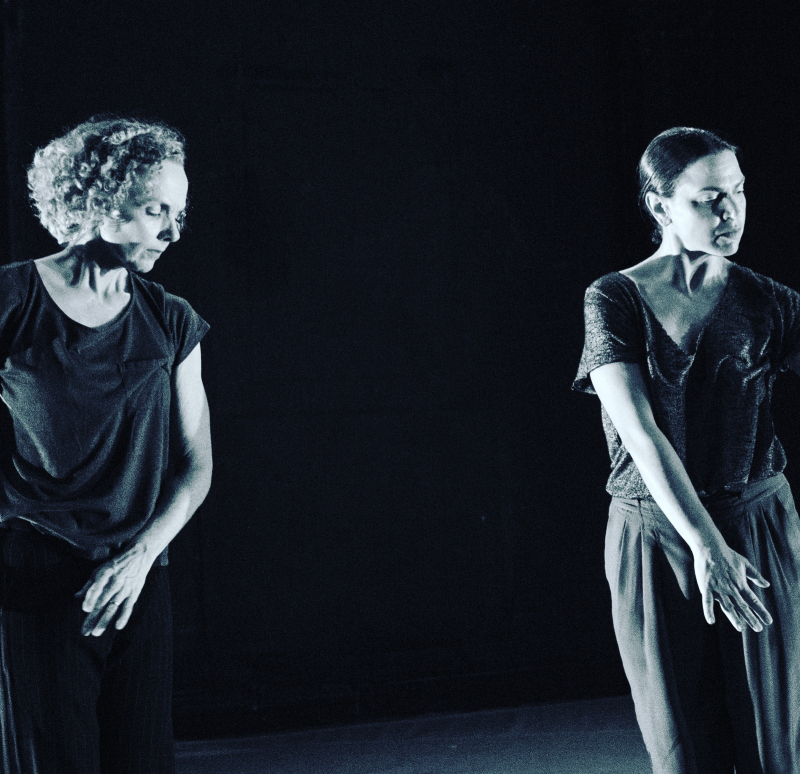 Megan Williams and Rebecca Stenn
I have always maintained some kind of a studio practice – for the last 30 years or so, I have found myself consistently drawn to the studio, to be alone, to experiment, research, play, listen and make. I almost always start my creative process alone, in the studio, by myself – the music, space and actually, sometimes the mirrors, my only companions. I think every project I’ve ever been involved with has, in some way, started this way.
My studio practice is almost always tied up or intertwined with an actual production on the books. I find it very difficult to make or work if I don’t have some kind of deadline in mind. It can be loose and it can be very far off in the future, but for me, this has proved to be important. I think the idea of time factors into making for me, and somehow fires me up. I also really like what happens to the process when there is a deadline and it approaches and the energy ramps up and studio time becomes exciting, scary, fraught, meaningful, completely frustrating and fulfilling at the same time.
Studio time and the practice of being alone in a studio becomes for me a form of self-care. I don’t make a distinction between self-care and creative work; they seem to be one and the same for me. I don’t consider being in class part of my creative practice. A different part of my mind is working as I take class. I do however think that teaching has become, over the years, a part of my practice, in that I bring to my students a choreographic question or moment I am wrestling with, as much as I bring to the studio a question or idea that came up with my students. What falls under the category of “studio practice?” Going into a studio on a regular basis (at first alone and then after a while with the dancers I am currently working with) and paying attention, committing to an idea, trying something over and over and over, and unraveling a thought process.
Interestingly I have also, more recently, developed a studio practice as a painter.
The topic of studio space played directly into this because as I began to become more serious about painting, I began to yearn for a studio space that I could dedicate solely to this practice. I wanted a more consistent practice! I finally saved enough money that I could purchase a very small garden shed, that I have turned into a painting studio (it is 8ft by 12ft – perfect for my canvasses, easel and paints). It has truly changed everything for me, to have a dedicated space to work in.
-Rebecca Stenn
————
Related posts:
Rebecca Stenn writes about her new book, A Life in Dance: A Practical Guide

 Life as a Modern Dancer
Leave a comment