From Blog Director Jill Randall:
During the past year, these five San Francisco Bay Area artists have shared Artist Profiles on Life as a Modern Dancer. Today, I pulled together their thoughts around the art of teaching. Click on each artist's name to read their full Artist Profile.
 Lauren Simpson teaching "Practice, Process, Research: Defining Terms and Playing Around" at Lion's Jaw Festival 2018. With collaborator Jenny Stulberg. Photo by The Fleet NYC.
From Lauren Simpson (San Francisco, CA)
What is the role of teaching in your career?
Teaching has been the most consistent part of my life and career. Recently I’ve been most excited about developing a theory around dance making and arts practices geared specifically to dancers and movers. I am interested in concrete ways to be creative in the studio/classroom, demystifying the creative process a bit. I hope to enable artists to explore artistic choices systematically through practice, process, and research – practice is about work, process is about framework, and research is about fieldwork. I draw on other artists' work and my own to make arguments about what’s required to make a dance successful, what’s required to make a dance enjoyable to create and what’s required to make a dance possible. I have been developing the curriculum through short-term residencies at Universities around the country.
In addition to my visiting teaching work, I have been an Adjunct Professor at University of San Francisco and Harvard College teaching contemporary modern technique, contact improvisation, dance history, and composition. One of my most formative teaching experiences was the three years I taught dance full time at the Cambridge Rindge & Latin School in Cambridge, Massachusetts. Since I was 14 I have been teaching dance in some capacity. Of the three typical dancer hats – choreographer, performer, teacher – it’s the thing I’ve practiced the longest and it’s likely my strongest suit of the three.
From Kathleen Hermesdorf (San Francisco, CA)
What does the phrase “teaching artist” mean to you? What is the interplay between art making and teaching?
I’ve always used class as practice and research. Even more since I began sharing it with my musical collaborator. We engage our creative process in class and share our creative research. I also try to bring in as much of my experience from rehearsals and performance into class and find ways to integrate that into the practice. The interplay allows for articulation and activation of intention, attention, sensation, inspiration, organizing principles, absurd situations, and more. This serves the teaching, the creating, and life in general.
From Charles Slender-White (San Francisco, CA)
Teaching. What do you love about teaching? What challenges you? Role models and inspiration for your teaching practice and pedagogy….
I most love teaching because it’s a direct way for me to share my enthusiasm for dance with other people. I start with a series of proposals, witness how the dancers in the room are taking in the information, observe what’s going on with my own dancing, and go from there. Every class is an amazing combination of physical effort, intellectual problem solving, community activation, and hopefully, joy.
I am currently working on two things: 1.) using more direct language and, 2.) becoming more sophisticated in my ability to sense when, in class, it’s time to say more and when it’s time to just shut up and let people dance.
I have been teaching Countertechnique since 2012, and it has an organized pedagogical framework. Within this framework, though, the teachers are encouraged to let their personalities, strengths, and interests inform the class. I continue to be profoundly inspired by my Countertechnique colleagues and my teaching mentor, Anouk van Dijk. James Graham is also an inspiring teacher. He and I started dancing together in 2003, and it has been amazing to grow into our respective practices alongside one another over the last 15 years.
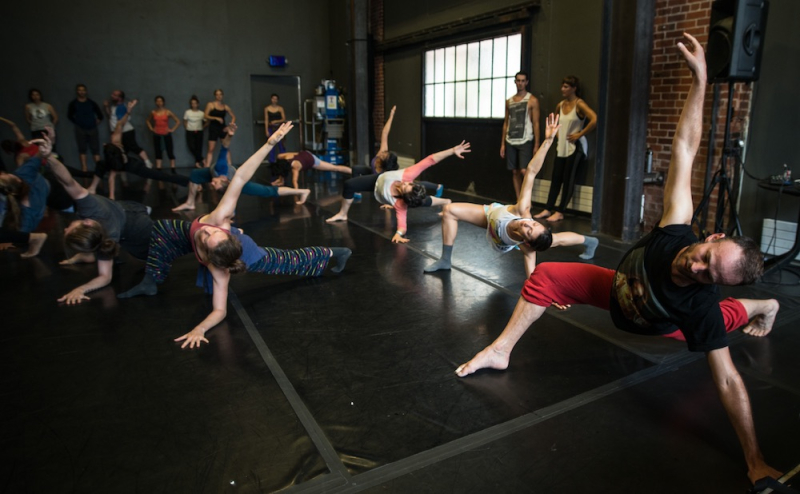 Charles Slender-White teaching (far right). Photo by Robbie Sweeny.
From Kristin Damrow (Oakland, CA)
What is the role of teaching within your dance life? What do you love about teaching? What does the phrase “teaching artist” mean to you?
Teaching for me is everything. I love the rigor and physicality. I enjoy the challenge that comes with teaching different ages/levels. I find excitement in finding new ways to explore familiar techniques/patterns. “Teaching artist” for me has a defined meaning as I was a teaching artist with LEAP when I first moved to the Bay Area. I would go into schools, usually k-12, and teach dance to students. As, I look back on it now, I think teaching artist can have many meanings or values. There is definitely an art to teaching.
Role models and inspiration for your teaching practice and pedagogy:
My pedagogy has morphed into what it is today by all of the influential teachers I learned from. At Columbia College: Margi Cole, Darrell Jones, Liz Burritt. Here in the Bay: Katie Faulkner, Christine Cali, Janice Garrett, Mo Miner. In NYC: Yin Yue and Shannon Gillen. To name a few.
From Tanya Chianese (Oakland, CA)
What is the role of teaching within your dance life? What do you love about teaching? What does the phrase “teaching artist” mean to you?
I could write a novel in response to these questions! Most of my income is from teaching dance, and I adore it. I used to teach upwards of 18 classes a week, but recently only 7-10 a week. Teaching helps me stay grounded and in reality. Because I have the pleasure of teaching a large age range (age 3-adults) I get to explore dance from all sides, ranging from focusing on the placement of our scapula bones to telling stories via creative movement. Each age, level, and context has taught me so much – both as an artist and a human.
But most importantly, teaching is not about me! It is about sharing this transformational practice in order to teach students a variety of lessons including how to take ownership of their body, how to express themselves, how discipline and respect will move them through life, how to be compassionate in the world, how to release stress and anxiety, how to work as a community, and so much more.
————

 Life as a Modern Dancer
Leave a comment