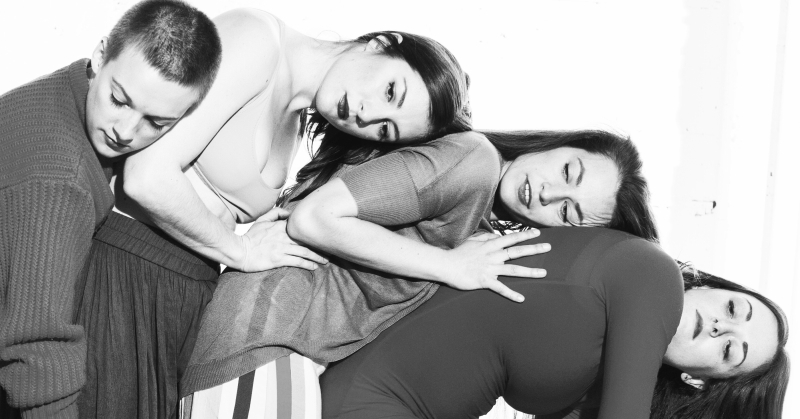
Emily Hansel, Mallory Markham, Katie Meyers, and Jessie Egbert. Photo by Summer Wilson.
Decisions, Decisions in BIG SALT
By Garth Grimball
“The doing is what seems hard. The having seems marvelous. But one doesn’t have a child, one does it.” So writes Sheila Heti in her autofiction novel Motherhood, dissecting the ambivalence and paralysis of choosing between motherhood and art; between giving oneself wholly to creation in two separate, unique forms. The Anata Project’s BIG SALT is doing — it is a verb — full action, full body. Premiering at Joe Goode Annex over two weekends, artistic director, Claudia Anata Hubiak, describes the work as “the clash between love and ambition in motherhood.” A mother herself, Hubiak drew inspiration from her own conflicts in valuing creative determination with birthing her second son.
A sense of division permeates the space before BIG SALT begins. The audience is split into two sections facing each other across the length of the theater. The dance floor is delineated by white lines into four quadrants. Choosing a side to sit feels less like finding a pleasing vantage point than staking a claim in an unknown conflict.
Five dancers — Kaitlyn Ebert, Jessica Egbert, Emily Hansel, Mallory Markham, and Katie Meyers — start the dance dressed in varying silhouettes of billowy white, standing in a line, swinging their arms back and forth. The arm swinging is a recurring visual motif, and collectively performed it feels like if a shrug could imagine itself to be more active: still listless and noncommittal but only just. The dancers lunge into competitive track and field starting positions and sprint across the space crossing one another and intersecting the imagined boundaries of the stage design. As they start and stop and change direction, the sprint devolves from a race against equal competitors to a rush of checkpoints in an endless to-do list.
The dancers slow and abandon the sprinter’s lunge for crouching into the floor. Four bodies are continually pulled down with lowered gazes by single down-stretched arms. Like tree trunks burrowing into soil to spread roots, the once swinging arms are now weighted and move with measured determination. Egbert contrasts the solemn ritual with a wild, frenetic solo. She is rootless and moves like the space is happening to her body. Every change in direction is outside of her control.
BIG SALT develops with detailed craft and smart editing. Visual metaphors and relationships morph and eclipse. Dancers lean, fall, grasp, and throw each other, exploring when support is a burden and when feeling someone else’s force is the remedy for being weightless. The arm-swinging returns around the halfway point. This time the dancers line up across center stage creating a barrier between the split audience. The unison swings break down and the bodies switch facings at uneven intervals. Newton’s Cradle comes to life, the motion begets motion, and the motion is the rhythm of waffling between two impulses. Not all thematic choreographic moments read so smartly. One dancer runs into a wall, another is pulled in different directions, and each feel like an easy pun. The literal undercuts the energetic build up in the movement.
The dancers perform with masterful technique and the awareness of a true ensemble. Hubiak harnesses the collective technical training of her dancers (Gaga, ballet, release) into a physical language punctuated by leg extensions, weighted centers, and crisp gestures. There is a frenzied section of dizzying and difficult partnering that breaks the spell of dancers’ focus. Every lift and lower is executed without hesitation, but there is the sense that when BIG SALT was constructed there was “the partnering section,” and the intention in the dancing feels different than the rest of the dance. The choreography is not lacking. Perhaps more time is required to build partnering trust that translates from the studio to the stage.
BIG SALT is true to its motive from beginning to end. And what an end Hubiak delivers. She avoids the explicit for the specific. There’s no dancer pantomime of infant care or hand-wringing at the struggle to create. The dancers fly and roll through the space in fast variations to glom en masse, repeatedly. Referencing the rooting from the beginning of the dance, four dancers are planted in space, arms floating above their heads, fingers twitching in search of stillness. Katie Meyers glides softly through this forest of decisions made. Doing is freedom from indecision but not from the repercussions of past choices. Ambition like parenthood is cumulative. Successes and failures build to form never-ending opportunities to succeed and fail. The Anata Project’s BIG SALT is a success.
Garth Grimball is a writer and dance artist based in Oakland, California. He is the co-director of Wax Poet(s), company member of Dana Lawton Dances, and performs regularly with Oakland Ballet.
———–

 Life as a Modern Dancer
Leave a comment