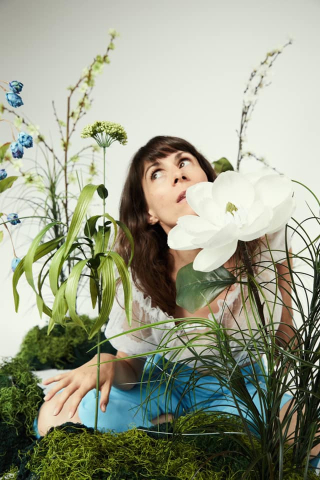
Molly Heller; photo by Marissa Mooney
Woodland Creatures, Summer Dance
By Garth Grimball
Remember when the “Song of Summer” wasn’t something to be predicted? The title wasn’t competed for, amalgamated from streaming metrics, to create a four-quadrant hit that could sustain the rapid-release-music-output era we now live in. Rather, as Summer faded into Fall, we collectively realized a certain earworm stuck with us for the preceding hottest months of the year, and we would now forever associate that song with that Summer. Think TLC’s “Waterfalls” and the summer of 1994. To my mind Carly Rae Jepsen’s “Call Me Maybe” of 2011 was our last semi-organic “Song of Summer.” (Though for me, Kelly Rowland’s “Motivation” will always be the soundtrack to hot nights in 2011.) All this is to query, could there be a dance/performance of Summer?
On Saturday, July 18, Shawl-Anderson Dance Center hosted “Heartland: Woodland Creatures,” a pop-up performance installation and dance party, created and facilitated by choreographer Molly Heller and musician Michael Wall. The duo first presented the event in their hometown, Salt Lake City, and brought the original cast–Marissa Mooney, Brian Gerke, and Nick Blaylock–with them, adding the Bay Area’s own Jenny Stulberg to this iteration.
Walking up to the venue it’s apparent the performance concerns physical space above all else. The edifice of Shawl-Anderson Dance Center is the subject with earth tone fabrics billowing out the second story windows; the top halves of dancers gesticulate and collapse within the window frames. Outside the building, on the steps, on the sidewalk, on the street, in the alley across the street, the dancers preen, prance, and prickle clad in Space Age-Victorian-Earth Goddess attire. The whole scenario is psychogeography meets Instagram filters. The choreography queers the physical space inviting viewers to reconsider how we interact with something as rudimentary as a building or a sidewalk. Prompting us to find play in the ordinary. When in reality, the moment becomes an occasion for folks to pull out their phones and capture a “moment.” The tension between affect and commenting on affect continues throughout the installation.
Once inside the building, we assemble in a downstairs studio as Stulberg dances a simple, gestural solo. With a blinkless gaze she moves closer and closer to the audience puncturing the performer-viewer divide. Proximity disabling participation via screen. Michael Wall welcomes us with an original song dedicated to Frank Shawl and Victor Anderson; a melancholy serenade composed of Wall’s baritone voice and accordion. We’re split into three groups, taking advantage of the physical space and its choreographic opportunities. My group witnesses a staircase solo by Mooney, followed by a reprise of the ode to Frank and Victor, before joining the rest of the audience upstairs.
Shuffling over and through each other to form a casual ring around the performance space we audience members mirror the set pieces in the center of the dance floor: islands of moss and flora. Stulberg, perched above us in open attic space, swathed in fabric, poses like one of Michelangelo’s Sibyls. Heller, Mooney, Gerke, and Blaylock huddle in the faux island and explode out in solos of angles and syncopation. Wall leaves the accordion for electronic beats. Pulsing rhythms expand the space. Heads and bodies bob along. The dancers strut back and forth and in circles, sometimes quickening to a trot or gallop, off-kilter enough to never be walking, jogging, or running. The movements are specific, grounded. Each body seems to quake in response to another in frivolity and frenzy. Jessi Barber’s lighting design bathes the space in varying temperatures of glow. Is there a connection to be found with the environment? Uncertain. The dancers, the lighting and the music conjures a vogue ball meets Barbarella meets Miyazaki animated plant-spirit. It is fun. Wall switches from electronic to piano. The dancers calm and meet under Stulberg’s perch to aid in her descent. Just as the melody of Wall’s playing becomes familiar, Stulberg joins in singing Cher’s “Believe.” A perfect song choice for the evening. A corny self-empowerment club banger now steeped in nostalgia, belted at karaoke bars, and so, so easy to dance to. After one verse and chorus from Wall and Stulberg, the Cher recording starts to play, the performers invite us into the space, and we are all dancers.
The installation experience is about 40 minutes in length before transitioning into full-on dance party. This brings me back to the “Song of Summer” comparison. The song of Summer is a pop song. It is a popular song. Rarely a song longer than 3 ½ minutes. It becomes embedded in your psyche. You sing along without realizing it. Does it have much depth or substance? Does it matter? “Heartland: Woodland Creatures” is fizzy and sweaty and relaxed. The performing is brief and feels like a preamble to the dance party. Like a pop song transporting you to summertime revelry, the performance is a conduit to revel. I got to sing loudly; shake, swoon, and sweat my body with dear friends; make fleeting acquaintances that exist only on the dance floor; lean out a crowded door to collectively will a breeze while drowning in the curry smell of the restaurant next door. I got a moment I’ll forever associate with Summer 2019. Molly Heller and Michael Wall have given us a Dance of Summer.
Garth Grimball is a writer and dance artist based in Oakland, California. He is the co-director of Wax Poet(s), company member of Dana Lawton Dances, and performs regularly with Oakland Ballet.
—————

 Life as a Modern Dancer
Leave a comment