From Blog Director Jill Randall:
Back in 2012 when I began Life as a Modern Dancer, I did not initially envision it being a site for dance reviews and dance criticism. But as the site grew and changed each year, the need arose for a new platform for dance criticism in the Bay Area. I am thrilled to be able to host this, and I am so grateful for my incredible roster of writers, including: Sima Belmar, Bhumi B. Patel, Todd Courage, Molly Rose-Williams, Garth Grimball, Sarah JG Chenoweth, and Michelle LaVigne.
Please note that we are toggling between various words here on the site: dance criticism, dance reviews, reflection, and response.
I thought it would be fun to review each of the 21 dance reflections published in 2019 and to pull one section from each. I hope that you will click on the links to read some of the pieces in their entirety. My heart is full reflecting on all of this beautiful work that was made and shared throughout the year in the Bay Area.
With these segments of writing, as with all dance reviews and criticism, the goals are many fold: some words offer a recap, some phrases paint a picture of the project for those who did not witness it, and other sentences pose larger questions about the field and artmaking.
And, if you are a college professor teaching a composition/choreography course, here's an idea to consider. What if you used these 21 reviews as reading material in a course? What can we learn about the choreographic process, and the audience experience, through reading these essays? How do we describe what we are making? Let me know if you give it a try.
Thanks for reading!
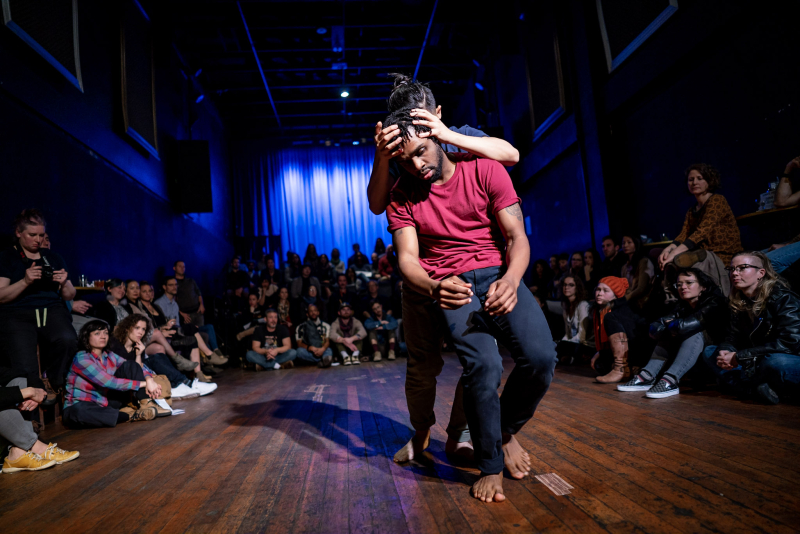 Dazaun Soleyn and Hien Huynh. Photo by Hans Holtan. Photo courtesy of Paufve Dance and its event 8x8x8.
Paufve Dance's 8x8x8 (Jan 24, 2019 at The Uptown, Oakland)
This is an unusual review, as it has 8 writers responding to the 8 dances. A section from Aviva Rose-Williams' writing:
I receive this performance as a gift. It is planned, ordered, well-thought out. Hours of studio time weave themselves through the performers’ physicality. Thoughts emerge as momentum. Sound. The environment and its audience are wrapped around these delights, coveting them, witnessing them, giving them reason to exist. Creating a space in which they can resonate. Finally.
Though the presentations hold their own valuable wonders, I experienced 8x8x8 this year like most 1 year olds experience birthdays. Nothing could snag my attention and get me more reeling in excitement than the colorful, crunchy wrapping. An audience practically humming with energy, I was taken with how powerful the simple presence of witnessing can be in terms of justifying a piece of art’s existence. How the mass of people ironically adds to the intimacy, how the exposure in-the-round can create such a feeling of shared experience.
I leave in deep question within my own practice about the strength and necessity of others to create a framework in which my work can resonate, in this top-secret collaboration.
 Anna Greenberg with ensemble in Kristin Damrow's Impact. Photo by Robbie Sweeny.
Reflection by Molly Rose-Williams
Where the chorus deepened and texturized as the piece progressed, the principal dancers coalesced into solid archetypes, each defined by specific, caricatured movement. Anna Greenberg, the dancer at the others’ feet in the opening image, began to stand for me as an evil queen. Where she went, the chorus in black seemed to follow. She held dominion over them, physically and energetically manipulating them to do her bidding, which more often than not included oppressing the other principal dancers through physical obstruction and domination.
Was the chorus an externalized manifestation of her power? Magical shadowy subjects? Human subjects oppressed by an unjust power structure? Or some other metaphor exposing the dark sides of power? The explicitly narrative interactions between dancers, the archetypal roles they played, and cohesive, albeit nonlinear, plot made me lean towards literality in my viewing.
Over time, I decided we were seeing a series of flashbacks to explain the dramatic opening image. My questions kept me fully engaged like a good story – primarily, how had the queen gone from all-powerful monarch to the defeated figure from the opening? Why and how had she come to hold dominion over the others? And how had that dominance been lost?
Katie Faulkner: Divining (February 14-16, 2019 at ODC Theater, San Francisco)
Reflection by Michelle LaVigne
…the last tableau with all four dancers leaning back on their forearms, staring up at the sky with expressions of wonder. This last scene offers hope. Hope that our bodies, for all of their faults and fits, know something about being in the world. Faulkner’s faith in the body’s resilience offers a way of seeing the future not as an object, but as a process of discovery.
The work on display in Divining – choreography, lights, music, dancing – raises important questions about how we we face the future and offers hope in the form of moving, breathing, and wondering bodies. We are definitely not alone – all we have to do is find a welcoming elbow, look up at the sky, or just breathe.
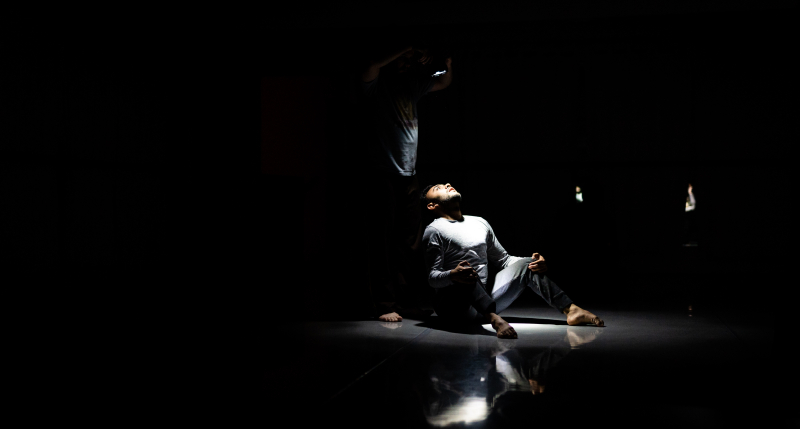
Rogelio Lopez & Dancers. Dancer: Kevin Gaytan. Photo: Ryan Kwok
Reflection by Molly Rose-Williams
If reckoning is a sensational act – a surrender to past, present, and future converging in a single, visceral moment – then Dicotomía del Silencio gives form to that sensation. The newest work from Rogelio Lopez & Dancers is based largely on Lopez’s exploration of past traumas, and what he calls in his Director’s Note “a need to organize and contextualize” his experiences growing up in Mexico with a “heavily Catholic faith influenced family.” In this deeply personal process of sense-making, Lopez has shepherded to expression not just the concepts that order his chaotic past, but the very sensations from which those concepts arise. The result is a haunting, awestruck, and searching prostration before a realm of visceral truths.
Reflection by Sarah JG Chenoweth
In the beginning of the piece the movement, as necessitated by the theme, felt more contained and writhing than some of Chianese’s past work. Various soloists seemed to dance inside of themselves, twisting and squeezing perpetrators’ badgering out of their bodies. As the piece progressed, the movement became more extended and explosive. Correspondingly, the dancers became equally more frayed and more powerful—the exhausted, “persisting” survivor.
Amy Foley: Let Slip the Witches (April 4-6, 2019 at ODC Theater, San Francisco)
By Sarah JG Chenoweth
What followed was irrefutably badass. For the next almost hour, these sister witches shook, twitched, lunged, and leapt their way into a different dimension. As technical as they were wild, the women showed the resolution of the most tenacious beast. Their goal? To create a tempest, or maybe a public outcry. It could have been an ancient fertility ritual, or a funeral rite. Repetition of simple movements and walking patterns gave it the tone of a folk dance. But it was also a knockout modern dance piece, packed with arduous contemporary movement and skill.

Vella & Merrell Dance
Reflection by Molly Rose-Williams
In describing my experience of the show to others, I have found that queer theory offers a useful framework for greater precision here; if “queerness” can be understood as a willingness to see taboos broken down, or a realm in which binaries are no longer relevant, then “Lipstick Lumberjacks, Losers and Leapfrogs” for me felt like a physical investigation of the act of “queering.” The works ran the gamut, from a manifesto on the radical potential of platonic intimacy urging us to “use emotionality as a radical tactic against a society which teaches you that emotions are a sign of weakness;” to an absurd and stunningly precise romance between a pair in striped shirts, berets, and glue-on mustaches; there was a joyful surrender to the physical release of punk rock, a depiction of modern queer love with dialogue so stereotypical and hilarious it was difficult to hear over the laughter, a tortured case of unfulfilled desire, and many more equally absurd, tender, and incise visions. Throughout, I saw a playful, but insistent line of questioning: What range of experience can we make room for? What forms of expression can we honor? How vast, inclusive, and beautiful can this shared life be?
Peiling Kao: One Body, Five Dances, Six Perspectives (May 24 and 25, 2019 at Dance Mission Theater, San Francisco)
Reflection by Sima Belmar
Peiling Kao lived in the SF Bay Area for many years and now resides in Honolulu, HI.
Over the phone after the show, Kao back in Honolulu, Kao told me that she has been thinking a lot about a question Gerald Casel has asked about whether a dancer’s body can be colonized by choreographic intention. “There are different ways to examine whether or not choreography is a colonizing force,” she said. “I don’t think of dance training and technique as colonizing forces necessarily—it’s a process of learning. We have to deal with power, as Gerald and I discussed post-show. If the commission comes from me, can we say I’ve been colonized? During the process, I felt like I was giving the power to those choreographers. I bow myself down, you tell me what I need to do and I will do my best, I’ll try again and again. In a collaborative process, a choreographer might see me as an equal power in the process—I’m giving you power and you’re also giving the power back to me.”
Reflection by Garth Grimball
In addition to “choreographic rock opera,” SiStars Strange & The Shatterer of Worlds describes itself as “punk” and “queer.” The most non-normative quality in this show has nothing to do with gender or boundaries or performance theories. This show is earnest. Earnest feels radical and unbound. Earnest melts away irony to reveal heart. Weckler is open and genuine in her art-making, and she invites her collaborators and the audience to be the same. The success of the art in reckoning with “environmental, political, and social unraveling” is questionable. But sounding the alarm with guileless energy and a rallying guitar riff is heartening. There’s nothing minimal to it.
Reflection by Garth Grimball
BIG SALT develops with detailed craft and smart editing. Visual metaphors and relationships morph and eclipse. Dancers lean, fall, grasp, and throw each other, exploring when support is a burden and when feeling someone else’s force is the remedy for being weightless.
Molly Heller: Heartland, Woodland Creatures (July 13, 2019 at Shawl-Anderson Dance Center, Berkeley)
Reflection by Garth Grimball
Molly Heller is a Salt Lake City-based artist and Visiting Artist at Shawl-Anderson Dance Center. This performance was her third at SADC in recent years.
Shuffling over and through each other to form a casual ring around the performance space, we audience members mirror the set pieces in the center of the dance floor: islands of moss and flora. Jenny Stulberg, perched above us in open attic space, swathed in fabric, poses like one of Michelangelo’s Sibyls. Molly Heller, Marissa Mooney, Brian Gerke, and Nick Blaylock huddle in the faux island and explode out in solos of angles and syncopation. Michael Wall leaves the accordion for electronic beats. Pulsing rhythms expand the space. Heads and bodies bob along. The dancers strut back and forth and in circles, sometimes quickening to a trot or gallop, off-kilter enough to never be walking, jogging, or running. The movements are specific, grounded. Each body seems to quake in response to another in frivolity and frenzy.
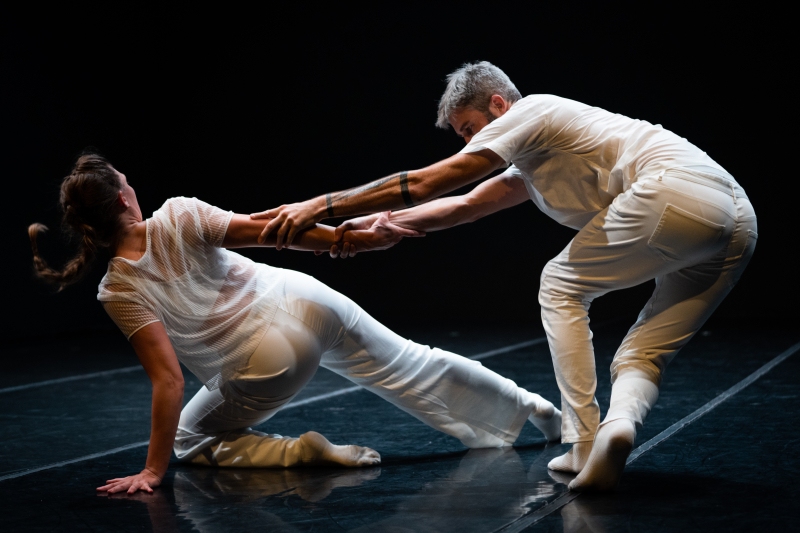
Joy Davis and Eric Mullis. Photo courtesy of FACT/SF. Photo by Robbie Sweeny.
For this festival, we asked two writers (Molly Rose-Williams and Todd Courage) to write about the festival. We segmented the writing into 4 posts:
On the choreography of Joy Davis and Eric Mullis
On the choreography of Dazaun Soleyn (dazaun.dance)
On the choreography of Maurya Kerr (tinypistol)
On the choreography of Charles Slender-White (FACT/SF)
An excerpt from post #3 about Kerr's work, written by Todd Courage:
The evening’s third offering was Maurya Kerr’s my beloved comet, an investigation into wonderment and what complex social forces might limit or prohibit that. The piece felt experimental; a courageous endeavor. Fourteen sections, short and shorter, for two dancers, showcased Ms. Kerr’s current concerns both socially and artistically. As a viewer, letting go of any prescribed narrative seemed key to the success of the work. To experience this episodic piece as independent movement studies, or many small duets, invited the audience into the unfolding of an artist’s process, sometimes clear and flowing, sometimes unresolved and less certain. To see Ms. Kerr’s intellectual exercises in this context was fascinating and, frankly, wonder-inducing. What initiated this choreographer’s growing concern for time and how might that be represented in the dancing body? What power might stillness hold in relationship to an expectant audience? Might the urgency of the choreographer’s message – slow down – be somehow related to the comet she alludes to? Or do we metaphorically grab its tail in a last ditch attempt to escape the world’s madness by yielding to the hypnotic nature of what we see? And, of course, how can one ever really not construct social meanings from two interacting bodies? A phenomenological quandary.
Reflection by Todd Courage
A solo by choreographer Audrey Johnson, titled "towards is no longer a direction.," was its own condensed gem. Refreshingly, a short jazz riff by Yves Tumor swelled in the darkness before Johnson’s solo body emerged bent over in an orangey-crimson wash. Silence. “The body marks its spiral in space,” she begins by saying as she turns toward us. This already feels like an investigation into a living body perceiving its own animated experience, the miracle and irony of contemplating oneself. Dressed casually and deliberately in an amber camisole and black sweats, she lingeringly feels her responsive body with her hands: the backs of her legs, then her feet and ankles, shins, pelvis, stomach and ribs, upward across her breasts, sternum, and neck, and purposefully across her radiant face and black hair. Her voice supplies the only sound, a spilling chain of statements all commenting on the potentials of a body in space. “It being the spiral,” the artist says, “It being myself,” all the while reaffirming the surfaces of her own body, both front and back, again and again, a kind of Merleau-Ponty-ish theme. Johnson’s text refers to the flesh as the pace of her diving and uncoiling quickens. Over and over, faster and faster, the dancer’s motion reiterates the urgency with which life is lived in these consciousness-carving vessels of experience called bodies as her narration rolls calmly forward. “But I digress,” she says after wandering into a random topic (but not really) about the dynamics of a relationship. Suddenly, as if she were channeling Trisha Brown, Johnson turns her head to the left, breaking from the established pattern while seamlessly introducing another. She undulates backwards. A counter-clockwise running theme unfolds joined with an improv flute jam that took me back to the tracks of French movies in the 70s. Johnson slashed and sewed huge circles with growing speed and intent. Women’s vocals came up as the dancer moved through her explorations unabashedly. As the music faded, she persevered, morphing, breathing; a pace of remembering, the site of return.
 Stephanie Hewett in the Queering Dance Festival, Program B. Photo by Lydia Daniller.
Reflection by Garth Grimball
The final work on the program shares a beautiful symmetry with the first, at least formally. In “Sam Cooke Wasn’t Gay” Stephanie Hewett uses ritual, voice over and lip sync to examine artistic process, intersectionality and cultural hijacking. As Hewett crawls into the space her recorded voice informs us that the work is unfinished. A narrative device that risks a blamelessness by way of apology but evolves into a meta commentary on process and ownership; on the definitions of queerness and the living of queerness. Hewett walks the perimeter of the space rolling and unrolling the legs of her pants. We learn of her injury fears, love of techno, and how “feeling inspired is the new falling in love.” She is falling inspired but subordination taints inspiration. Black techno co-opted by white space. A black man, one of the greatest vocalists of the 20th century, shot and killed by a white woman. Sam Cooke’s “A Change is Gonna Come” starts to play and Hewett erupts in sinew and stretch across the dance floor. In a deep second position plie, fists to her heart, she stares directly at us for the first time mouthing the lyrics. The confrontation is striking. Hewett exposes her body, her ideas, her process, but rarely her look. The ending is the most unfinished part. The music stops and we learn the original plan was to sing the song herself, but time and money got in the way. Instead, she invites us to sing-along with her. We do. It’s messy and awkward and queer.
Reflection by Bhumi B. Patel
Today, our attention turns to the ways in which our differences today define, strengthen, and afford us an unapologetic authenticity to challenge the racist hegemony of our contemporary cultural moment. And certainly, this work made me see each performer on stage, and made me continue to dream of the world where we aren’t valued by our ability to assimilate. Set in six sections, the work travels through an emotional landscape examining the breadth and depth of how each member of the company has come to know, understand, and love their brownness.
Reflection by Garth Grimball
Ten artists were selected to participate in a residency with Rashaun Mitchell and Silar Reiner, former Cunningham Company dancers, to create original works, and four dancers were cast to learn and perform Cunningham repertory. That’s 11 artists’ works plus collaborators sharing an evening to honor/complicate/respond to the legacy of one man.
What is a legacy? And what is it worth? It is easy to reduce Cunningham’s creative voice to systems. Chance operations – I Ching, Solitaire, flipping a coin – guide his choreographic craft. This democratic, formalist method is equal parts impenetrable and inviting. It is what it is. It refuses to submit to the tyranny of narrative. Cunningham technique is precise and exacting. This is why the work is so ripe for interpretation, so fecund for collaboration. All of it is there.
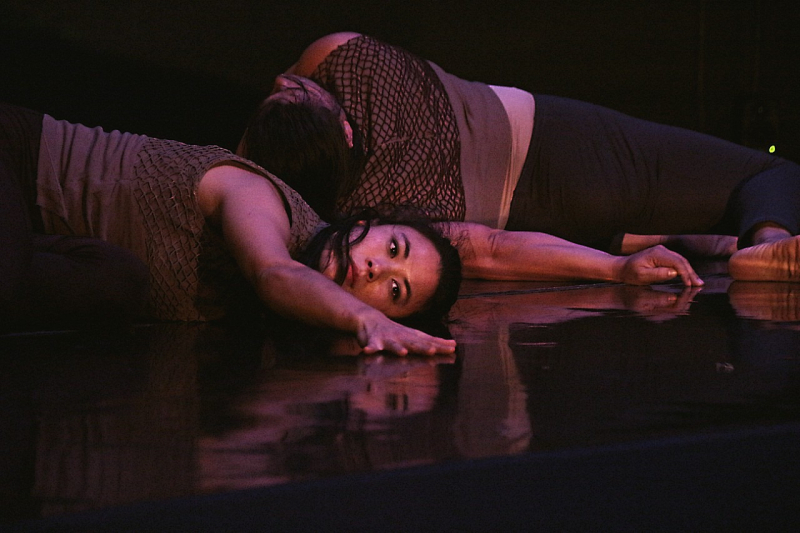
Nina Haft & Company. Dancers Rose Huey and Rogelio Lopez. Photo by Yvonne M. Portra.
Reflection by Garth Grimball
The program informs us there are fewer than 10 vaquitas remaining on Earth. We are killing them, drowning them. We the creators of precarity. Haft and dancer Mallory Markham create a sublime solo of isolation. The choreography is beautiful and tightly constructed. Bathed in a large down pool of light Markham wriggles on the floor, slowly makes her way to standing and articulates every movement and every body part with clarity. She radiates a bodily awareness born out of solitude.
patelworks: divisions the empire has sewn (November 16-17, 2019 at Finnish Hall, Berkeley)
Reflection by Molly Rose-Williams
Perhaps the most evocative element of the work for me is the fact that I never land. I am herded from place to place, never settling for long before being shepherded to the next nebulous experience. The work exists in pockets of bound displacement. The entire time, the large white screens circle the center of the hall, and just beyond, I see a beautiful table set with white linen, china, and white branches adorned with tiny sparkling lights. The scene evokes for me the compelling promise of something better but always out of reach.

 Life as a Modern Dancer
Leave a comment