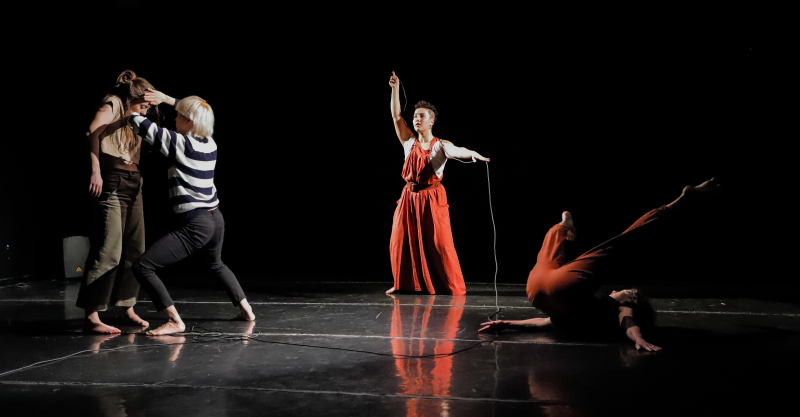
 The Leftovers. Pictured: Hannah Wendel, Mei Yamanaka, Sarah Chien, and Donnell Oakley. Photo credit: Yechiel Husarsky.
A Home for Improvisation at "Never Before Never Again"
By Sarah Chien
"Never Before Never Again," or “NBNA,” is an annual 3-week festival in January at Triskelion Arts in Brooklyn’s Greenpoint neighborhood. This year was guest curated by performing collective The Lovelies, who programmed mixed-bills of 10-20 minute performances, split bills, weekend workshops, and an open-mic style event called “Stage Dive.” I participated as part of The Leftovers, a collective created by the curators for this event consisting of Mei Yamanaka, Hannah Wendel, Donnell Oakley, and myself.
I’ve been struggling with how to succinctly capture the 3-week festival in this written form. Although I attended or performed in at least one show from each week, I’m still only one person amongst the many who bought tickets, taught workshops, performed work, hosted evenings, served drinks and played music at Triskelion Arts.
But as many improvisers know, sometimes you just need to start, propose something, and then follow the thread. I can hear my mentor David Zambrano saying, “If you feel like you’re waiting, then change something.”
So let’s begin with the festival’s closing night. My overwhelming feeling, walking into Triskelion’s main theater space, was one of “home.” They’d offered all artists in the festival a free ticket for that night, and the audience was full. As I walked up the tiered seating towards an open spot, there were people I knew in every row – my collaborators, friends, fellow improvisers from this festival and from other spaces, even some Triskelion regulars. For me, this sense of belonging is exceedingly rare in the dance world — with most institutions I feel like I’m on the fringes looking in, wondering how someone got curated or what the people in charge really care about. At Triskelion, I feel like a peer – my work has been curated in the space, and I in turn have invited Triskelion folks to perform in events I host. It feels less transactional, and more mutual – and a lot of that has to do with the space’s willingness to center my chosen craft, improvisation as a performance, throughout their programming.
Of course, I’m also acutely aware that what I feel at Triskelion, is what others feel when they walk into Movement Research at Judson, or Gibney’s theater, I’m sure. When I’m feeling embraced at Triskelion, someone else is wondering how I got there. There is a familiar cast of characters at Triskelion – and I am one of them. I want to recognize that privilege even as I revel in it.
On Saturday, before the show started, I talked to the people sitting beside me in the audience and found that indeed they both had different relationships to the space. On my left was a lighting director who had advised on the various iterations of Triskelion’s spaces, and on my right was a new student of improvisation who’d enjoyed the weekend workshops that the festival offered. “So do you do compositional improvisation?” he asked me. I laughed, because the assumption in that question (that this specific phrase was a common dance vernacular) made it obvious that his entry into improvisation was through this year’s festival curators, The Lovelies. Following their mentors, the Architects, The Lovelies have defined their work in this lineage, teaching and performing under that term.
I wish we had somewhere a catalogue of all of the different improvisation performer-teachers out there….David Zambrano, Katie Duck, Ruth Zaporah, Juleyn Hamilton, and Bebe Miller to name the few that are top of my mind from talking to other festival artists and my current frame of reference. There’s also a rich New York network of improvisers performing and teaching in ways that center African American experiences and lineages: the many members of the Skeleton Architecture Collective, mayfield brooks (whose recent show at JACK, I just missed!) just to name a few. I wish, for the sake of more cross-pollination within our communities, we NBNA performers had shared a list of mentors and schools of thought that inspired our own work. Most of the time when I see improvisation in the curriculum of dance studios or festivals here in the US, the class descriptions tend to center Contact Improvisation. And while I love this form, there is so much more improvising out there.
So what kind of improvisation happens at Never Before Never Again? Triskelion’s festival features improvisation as a performance practice, preferring long form, live-music collaborations, and (usually) performers who marry expansive contemporary dance movements with their own charisma. The festival’s success lies in the community of improvisers it nurtures throughout the year (not only for this festival); its incredible lighting designers Dave Glista and Andy Dickerson before him, who aren’t afraid to improvise lights alongside the performers; and its welcoming, casual environment created by friendly staff, who maintain the intimate but well-kept space. A strength this year was also The Lovelies’ curation of a multi-generational line-up of performers. As I’m dancing into my early-thirties, I find it a pleasure to share the bill with artists older than me — it reminds me that our art form, which always feels so ephemeral, is an endeavor that endures and transforms.
Here are some themes I enjoyed across the performances I saw, and participated in:
Luxurious watching – sifting through the noise.
NBNA is one of the few places I know that I can see multiple 20+ minute open scores presented on the same bill. Longform improvisation invites the audience to let the experience wash over them and then choose their own adventure. We aren’t told explicitly what we should be looking at, and at times we can feel there are multiple focuses. But the beauty of the relative chaos of improvisation, is that audience members are invited to find their own path, just as the improvisers are finding theirs. Agency all around! The Lovelies, as a collective, have performed in different configurations, but their trio Settling Dust, was their ideal form – we could see each performer’s individuality and contributions to the work, clearly delineated in space by boldy placing cellist Kirin McElwain at center stage.
Collaborators who are equal participants.
Improvisation gives choice-making back to the performers, which eliminates some of the hierarchy inherent in choreographer/dancer, or musician as accompanist structures. Those surely existed in some of the performers works (for example Troy Ogilve was billed with just one name, but there were many other bodies on stage), but many groups chose to place musicians squarely in the space, or perform as a collective, as I did with The Leftovers. For me, the most profound example of this trend was Andy Dickerson and Rachel Mckinstry’s collaboration, cotton candy machine. With no overhead lighting, Dickerson calmly walked the edges of the stage, employing a series of handheld battery-power lights whose changing focuses and colors would rest on the different gauze-covered tableaus that Mckinstry was exploring. Although Mckinstry was the visual focus, both she and Dickerson had equal presence onstage, with Dickerson even taking a “solo” when he turned on a disco-strobe light during one choice moment.
Humor as a reward for breaking expectations.
Performing improvisation is a practice of self-awareness. Performers must be both present and permeable with not only their own movements, but also the space, the audience and any expectations that already exist in the social contract between the two. I noticed frequently in the festival that audience members would laugh when a performer took a risk that surprised them, acknowledging the shared joy in playfully testing unspoken rules that we didn’t know we were obeying. In The Leftovers’ Saturday night performance, Donnell Oakley wryly placed a microphone continually out of the reach of Mei Yamanaka as the two reconfigured their intertwined bodies in a comedic yet elegant tumble. In This Time, the Architects established a game of searching out similar sounding words, eliciting a chuckle when they stumbled on a word that not only matched the sound, but also served as commentary on the action. Humor is evidence of the audience and the performer experiencing surprise at the same moment.
Trust between performers.
In set work, the choreographer carefully crafts a series of interactions, and each performer plays their part. But in improvisation, supportive confluences result not from carefully rehearsed steps, but from a carefully nurtured understanding between individuals. It’s a pleasure to watch longtime collaborators like Nicole Wolcott and Omar Zubair together, as their close creative relationship allows them to react seamlessly to each other’s proposals in real-time. We could watch these two play all day.
DIY aesthetic and diegetic stagecraft.
Improvisation empowers performers to take control of their own expression, and perhaps as an extension of this, many artists chose to manipulate their own sound, light and props in front of the audience. Jesse Zaritt walked on stage and opened a curtain blocking light from the lobby. Jennifer Nugent placed her laptop in a corner to trigger her sound from the stage. And both Zaritt and Nugent, in separate performances, read text from a sheet of paper they brought into the audience. The Leftovers, my group, placed a microphone, a cell phone and a clip light onstage, for performers to play with throughout the performance. Seeing multiple performers include these types of choices, I wondered if our own felt trite. But I know that when used well they highlight the magic of stagecraft and choice-making in the moment.
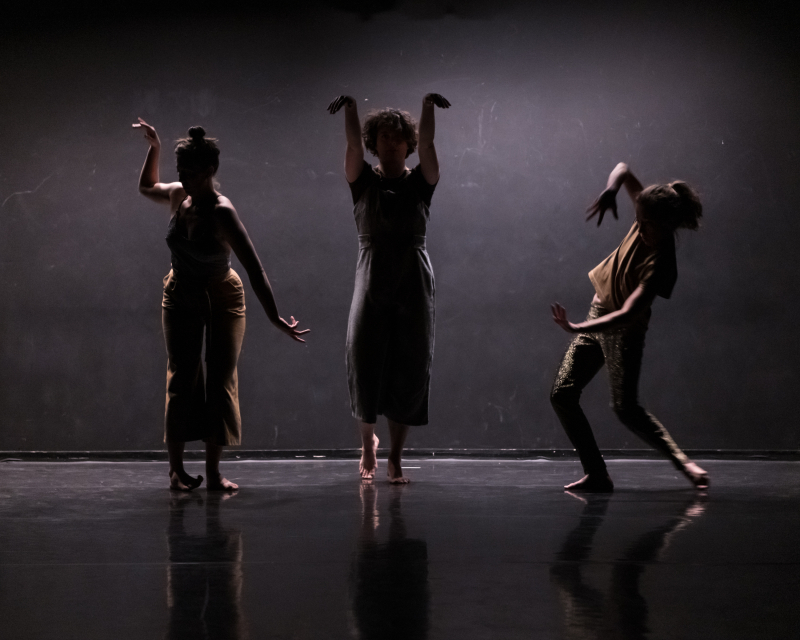 The Lovelies. Pictured: Lena Lauer, Joanna Futral, and Katie Vason. Photo: Anthony Collins.
I want to commend Triskelion for its commitment to elevating improvisation as a performance practice. I want both dancers and audiences alike to appreciate improvisation as something more than a dance you do in your living room, or a task you do to generate movement ideas for a choreographer, or as a jam in a dance festival. All of those ways are valid, but the community of improvising performers still needs nurturing. Some of the artists in NBNA are dedicated improvisers, and for some it's a chance to bring a different part of their practice center stage. As festival artist Ani Javian noted, “I'm always surprised at how it shifts in performance – there's more to listen to, to take in, and to make sense of…NBNA was a great opportunity to practice with an audience.”
Contemporary presenting institutions often espouse “artistic risk-taking” as one of their curatorial values. Watching the improvisers at Never Before Never Again, I realized that when you curate improvisation you create space for real-time risk-taking. There’s no need to ask performers, “How does your work embrace risk?” when it's a given that every performer is entering the stage ready to make choices live in front of an audience. “Improvisation is such a vulnerable practice, and performing can put that on the spot,” explained festival performer Wendell Gray II.That vulnerability, to reveal and react to what’s really happening, is a risk that I wish more institutions would acknowledge.
“This is so fun,” exclaimed my seat companion from Saturday night. “You get to see something that nobody else will!” In improvisation, performers trade repeatability for honesty. It's hard to sell this work as a “product.” Can you imagine where our art form could go if audiences and presenters approached performances like that?
—

 Life as a Modern Dancer
Leave a comment