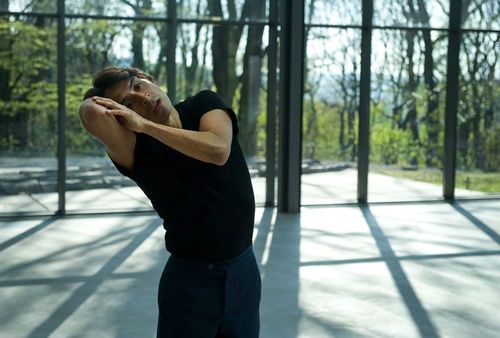
Eddie Martinez. Photo: Donata Wenders.
From Blog Director Jill Randall:
As we continue to evolve and shape the conversation about dance history and lineage, I would like to offer a few readings from the blog to support your course from a few different angles.
Over the past 8 years, the Artist Profile has been the core of Life as a Modern Dancer. These are self-interviews with artists about their career paths. I think that each and every one of the 172 Artist Profiles could be explored in a course, because each artist is sharing about their path, their history, and their location within the field. May I suggest that students browse and select 5 to read? Each one is only a 5 minute read. There is so much power in reading the words directly shared from the artists.
Yes, there are names of choreographers on the list who I recommend to read for their contributions to the field of choreography, such as:
—–
But may I also suggest the importance of performers and collaborators within the study of history?
For example, check out Eddie Martinez's profile, who is one of the longest performers with Pina Bausch. Or, Tina Fehlandt of Mark Morris Dance Group. Or Marc Brew, stepping into the role as the 2nd Artistic Director of AXIS Dance Company?
Check out Gesel Mason's profile on the blog, and then head to her website to find out more about her extensive project – No Boundaries – exploring African American modern choreographers. Likewise, read Netta Yerushalmy's profile, and then dive further into her work called Paramodernities.
I am also reminded of Janet Wong's piece. Janet is a longtime artistic partner of Bill T. Jones (currently with the title Associate Artistic Director).
—–
In addition to these profiles, please check out the Books section on the blog. Over the years I have kept hawk eyes to list new book titles. As you explore dance history, some of the titles in this section will be of interest for your assignments and research.
There is also a great book list on the IABD (International Association of Blacks in Dance) website, and the Dance Studies Association website.
—–
- How are we all a part of dance history – as choreographers, performers, teachers, students, audience members, artistic collaborators, and arts administrators?
- Who gets the spotlight in dance history books and who does not?
- As we talk and reflect deeply as a field about race and equity, how are you bringing a critical lens to the field's approach to dance history, and how right now can we reshape these conversations?
- If we look at children's books on dance and dance history, who has been featured thus far? Who needs to be spotlighted and celebrated now?
—————

 Life as a Modern Dancer
Leave a comment