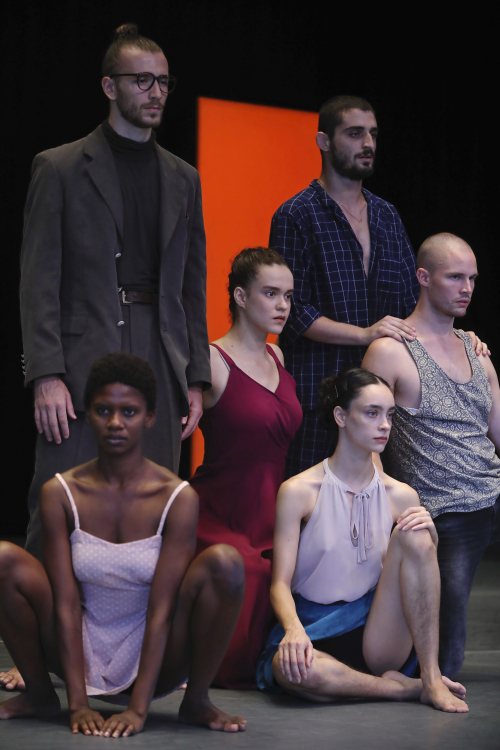
Igor Ptashenchuk, Yonatan Simon, Hani Sirois, Londiwe Khosa, Yael Ben Ezer, and Sean Howe in YAG.
In Batsheva’s YAG, It’s A Family Affair
By Garth Grimball
“Once my family loved, really loved, really really loved to dance.”
This is the thesis statement of YAG, spoken by each of the six cast members in an exploration of familial relations and heritage. Created for the stage by Ohad Naharin in 1996, this is Batsheva’s first production adapted especially for the screen; presented and streaming via the Joyce Theater. Yael Ben Ezer, Sean Howe, Londiwe Khoza, Igor Ptashenchuk, Yoni Simon, and Hani Sirkis dance with a commitment to those words. Playing family is easy. Moving as an ensemble is tough. The world building in this dance succeeds by the coherence and chemistry of the cast.
The cinematography by Roee Shalti is superb. The entire production is filmed on a proscenium stage. The lighting design is one look. The images move from the screen into the mind without the barrier of showy effects or angles. Each close up is earned. I never felt I was missing part of the choreography beyond the frame even when unseen actions are evident. After a year of reviewing, watching, interacting with online dance, a personal barometer for quality is how often I feel the urge to lift my hand over to the trackpad and drag the mouse to the bottom of the window to see how much time is left. During YAG the urge was absent. For 45 minutes my attention was rapt in the translation of this concert dance to the screen.
On the topic of urges, the sexual politics present in much of Naharin’s work leaves me with a sense of horniness unsatisfied. The choreographic tension builds on hormonal bounty. The dancers’ bodies feint and parry like gladiators commanded to abstain before a match. Simon and Ptashenchuk graze the inner thighs of Khoza with their ears before being pulled into the groin. Simon jumps atop a rectangular orange plank held from underneath by a naked Ptashenchuk. While the work has an arc, there’s an avoidance of climax.
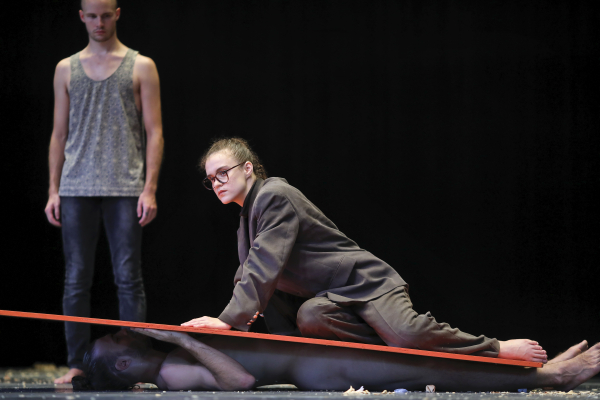
Sean Howe, Igor Ptashenchuk, and Yael Ben Ezer in YAG.
This is not to say YAG is without nuance. Other than the plank/door/barrier, there is a prop use striking in its simplicity and symbolic effect. Sirkis walks backwards placing fortune cookies like ducks in a row on a diagonal across the stage. Several feet behind, Ezer walks forward crushing the cookies with every step. Fortunes are made and lost passed down through generations. The remains of the sugary prophecies cover the floor adhering to the dancers like inheritances material and immaterial.
The choreography moves within confrontation, slight to extreme. Naharin’s direction confronts the implicit agreement of a fourth wall. The dancers look directly into the camera often, usually when speaking. Are they telling us? Or inside the direct gaze is the internal monologue revealed? Together, Naharin and Shalti, keep the kinesthetic alive on the screen. The edits feature the effort of dancing even if the cast make it look effortless. Wide (almost cruel in their width) deep fourth positions, accumulating gestures, spasms with the intensity of electrical shocks, and caresses that become shoves, expose the relational currents in this family.
Once I loved, really loved, really really loved to watch live dance; to be part of an audience. I am in awe of how concert dance shifted to the virtual stage over this past year. YAG is an exemplary product of the shift. I can’t wait to live in that love again, live. Until then, I know the heritage of dance is alive, on and off the screen.
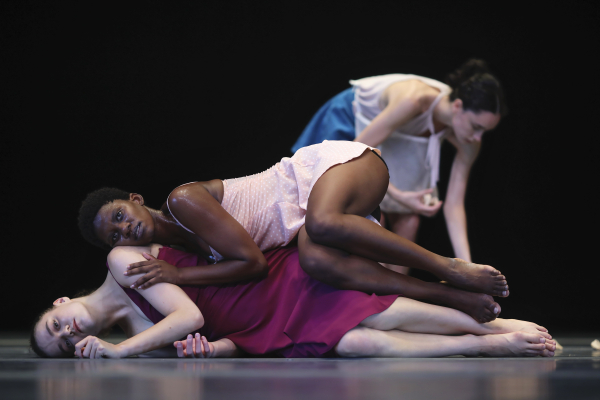
Hani Sirois, Londiwe Khosa, and Yael Ben Ezer in YAG.
YAG is streaming via joyce.org May 27 – June 2, 2021.
Garth Grimball is a writer and dance artist based in Oakland, California. He is co-director of Wax Poet(s) and hosts the podcast Reference Desk.

 Life as a Modern Dancer
Leave a comment