FACT/SF’s Summer Dance Festival Dances Through Genre
By Garth Grimball
Editor’s Note:
For some dance events, securing a dance writer/reviewer can be a difficult task due to timing and availability. But the questions still can linger: How can artists receive feedback and impressions? How are works of art documented in writing for audiences, artists, and funders? Writer Garth Grimball attended Weekend 2 of the FACT/SF Summer Festival in-person, and offered to view the video of Weekend 1. Given Grimball’s writing throughout the pandemic about many performance formats, including recorded and streamed events, this seemed like a great opportunity to ask Garth to engage in a recording of Weekend 1 as well.
– Jill Randall
—–—–
FACT/SF’s Summer Dance Festival featured six artists over the weekend of July 29-30 at the Joe Goode Annex. Unfortunately no writers from Life As A Modern Dancer were able to attend the festival live, so here I am, six weeks later, writing about recordings of the performances. Which is to say, my responses are to a 2D rendering of a 3D form, and I watched on my laptop from the solitude of my bedroom, not engulfed in the energy of an excited audience. This is an experience of which I am now quite familiar.

slowdanger, based in Pittsburgh, PA, opened the festival with “Resonant Body.” Co-artistic directors Taylor Knight and Anna Thompson, clad in white windowpane-patterned jumpsuits, move behind two microphones stationed on the diagonal from upstage right and downstage left. Their bodies blend and separate like their amplified voices. “Resonant Body” is evocative of Steve Reich’s “Pendulum Music” (1968); Knight and Thompson explore sound and the body with a specificity that expands.

Megan and Shannon Kurashige, co-directors of Sharp & Fine, premiered “This Time Tomorrow,” a duet for Eric Garcia and Moscelyne Parkeharrison. The dance opens with the duo speaking back and forth through a tube of packing paper discussing the end of the world. Garcia is dressed in a pink tutu and brandishes the paper tube and a pair of scissors like a fairy wand. “This Time Tomorrow” uses a blend of the mundane and fantastical metaphorically to explore how humans deal with the enormity of things like a pandemic or climate change.

“Boys, Boys, Boys!” from the Seattle-based duo DRAMATOPS makes an effort of effort. Elby Brosch and Shane Donahue enter wearing replicas of Elton John’s famous Dodgers sequined baseball ensemble. After hyping up the crowd they perform lap dances to Ginuwine’s “Pony” that evolve into gymnastic partnering in wrestling singlets. Camp becomes force. Brosch and Donahue lift, drop, cantilever their bodies in endless configurations until they sit facing each other, pounding their torsos together, over and over. Phil Collins’s “In The Air Tonight” plays and the pounding continues until the drum beat hits. Delayed gratification.
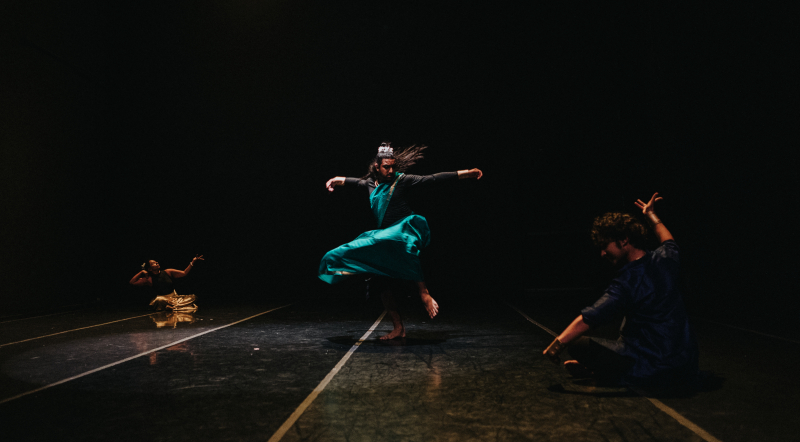
“They,” choreographed and performed by Amit Patel & Ishika Seth with Akhil Joondeph, “is inspired by the concept of Ardhanarishvara, the Hindu God represented as half woman-half man.” The trio makes the greatest use of the stage space, creating narrative out of spatial relationships. Blending classical Indian dance gestures with modern dance partnering, “They” moves between harmony and disharmony as Patel, Seth, and Joondeph merge in and out of sculptural tableau.

Chinchin Hsu collaborated with Brianna Elyse Torres on the duet “time eater.” The dance succeeds in sticking to its central contrasts. Torres dances all over the stage. Hsu remains stationary. Torres’s movements shift and vary. Hsu is dedicated to one task. Torres undresses as she moves leaving clothes scattered. Hsu slowly empties a burlap bag of grain hoisted across her shoulders. “time eater” shows how the experience of time depends on context as much as measurement.

FACT/SF closed the evening with “Number 6.” Choreographed by Charles Slender-White and performed by Slender-White, Katherine Neumann, and LizAnne Roman, the trio feels like a precursor to the following weekend’s premiere, “For a.” The dancers prance in wearing shiny amber rompers and black socks. The trio is mostly unison choreography of body halves with gesture accumulation to music by Joel Corry & Jax Jones Feat. Charli XCX. “Number 6” is a brisk 3 minutes 15 seconds. Its breezy quality is undercut by an adherence to Modern Dance Face. A little more face would take this dance a long way.
Attending a dance festival can encourage one to proclaim trends or locate a throughline that may be non-existent. What does seeing these six works tell me about dance, about dance makers? Nothing, writ large. But in these six dances I see a grappling with the question of, How to be? What are the connections a body can make in this time and place? Good questions to ask and keep asking.
Garth Grimball is a dance writer and artist based in Oakland, CA. He is a contributor to SF Examiner and Dance Media. He is the editor of ODC’s Dance Stories.
—–
Related post:

 Life as a Modern Dancer
Leave a comment