
Lasos – REYES Dance
By Melissa Hudson Bell
10/10/22
Two dancers, dressed in garishly loud primary-colored childlike dresses with over-large pockets stand facing each other downstage. Beads of sweat are visible on each, from almost forty minutes of vigorous jumping, running, gesturing, full-bodied movement. It is a face-off, tense and charged, that the audience has encountered twice already in “Lasos,” the latest choreographic work by REYES Dance presented at Joe Goode Annex this past week.
This moment of relative stillness is anything but chill. In fact it is an apex of sorts, a notable slowing of time in what is otherwise relentless athletic dance and a cacophonous score of music and sound effects including babies crying, dogs barking, clownish horns honking, alarms ringing and more. This time out of time slowing of action renders the moment an obvious focal point of the choreography. Well, that and the fact that it also happens downstage and center. Well, that and the fact that now, as the audience encounters it a third time, our bodies can physically anticipate the gesture that follows the stillness…
What we anticipate (and/or, perhaps, hope not to encounter a third time) is the gesture where the dancer on stage left rears back their arm, and with a great swooping action, gestures a slap that slices through the air on a downward diagonal with such force that it sends the other dancer tumbling to the ground in a heap. No actual physical contact is made, but the cause and effect are clear. The fallen dancer then stands, and the gestured slap is repeated. Again. And again. And again. And again. It is repeated enough that my focus goes from the slapping gesture itself to the reverberations of the slap. I notice how the dancers’ body hits the floor, which limb crumples first, how heavily the hips thud, how the arm folds in a little differently each time (perhaps to blunt the inevitable physical impact of such a move?).
It’s unpleasant to watch, on some level. And yet, in a theatrical setting, it is also familiar. We the audience can both feel the threat of violence, and recognize the threat as staged, as volitional. So, as we-the-audience encounter this stand-off a third time, I find myself pondering the power of choreographic choice. There are a few obvious paths – will Reyes choose to enact this cycle of generational trauma for a third time? There is a Biblical sort of power in offending thrice, we are told… (I should probably mention that theatrical trappings like wigs and costume have denoted it is an elder injuring a presumably younger and more vulnerable human in these encounters.)
Instead, will Reyes choose to black out the lights and leave audience members with a choose-your-own-adventure ambiguity as to what happens next? This has proven a popular tactic in our American postmodern and post-postmodern dance landscape and would seem a fitting match for the patchwork quilt of a danced narrative she has thus far concocted…
Maybe she will enlist another dancer to stop the action, staging a necessary intervention? In this choice she might be indicating a sort of “it takes a village” mindset for interrupting generational trauma. This seems valuable in a social moment where folks are often finding themselves adjacent to harm of all kind – finding themselves wanting to take action but not knowing how…
Or, in this moment of relative stillness, will we watch the offending figure – who, by the way, has been played by a different dancer each time this motif re-occurs – interrupt their own action? Having spent enough investigative energy in forty-some minutes of churning, roiling, leaping dancing, will they have the wherewithal to make a different choice? To make room for some hope? To indicate the possibility of not only a change of action but also a change of heart?
I don’t think I will give it away.
Instead, I will say that "Lasos," the Spanish word for “ties,” is a performance piece that, as the press materials suggest, concretely explores “the links between childhood trauma and chronic pain in the context of Latin American culture and traditions.” The four dancers – Brooke Terry, Caitlin Hicks, Maya Mohsin, and Jess Bozzo – play various characters in several short films created by Reyes, and then cleverly transition from film to stage as the final film ends with the four dancers cavorting into the Joe Goode Annex moments before they actually appear in front of the audience. In defiance of the gravity of the chosen subject matter, the mood of “Lasos” is not somber. Instead, the piece creates a carnivalesque world where pedestrian-style gestures are writ large with a puppet show sort of quality to them. The gestures are combined with presentational feats of highly structured and organized movement that draws from ballet (someone actually turns fouettes), old school hip-hop, salsa and cumbia, and more. The overall effect is a frenetic kind of story ballet that transports viewers into a world down-the-rabbit-hole (for lack of a better metaphor) in search of not home, but relief. Or understanding. Or connection. Or all of the above.
Reyes is forthcoming about the fact that the pain and the trauma she is grappling with in “Lasos” are not merely metaphorical. They are based on her own lived experience. She was, at one point, subjected to corporal punishment. She was, at one later point, so crippled with pain that she couldn’t walk. She knows/believes/senses that the two are linked, and she decided to work her way through these particular ties using the types of dance and the choreographic strategies that had, in her youth, made her feel strong and powerful, despite circumstances that sometimes made her feel powerless.
Because Reyes’ chronic pain prevents her from dancing fully, she had to collaborate with the dancers in unique ways, sometimes drawing stick figures depicting action to communicate a plan. She shared journal entries, and had them participate in exercises she had learned in her pain management classes. She also leaned on their training and technique in asking them to execute certain ideas that she could only communicate verbally (each dancer is a beautifully unique and grounded mover, by the way). The end result creates a compelling dance vocabulary that is both familiar, and slightly off-kilter from the familiar.
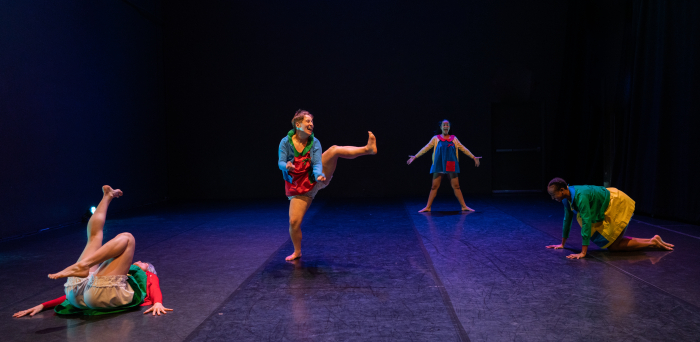
One main source of movement inspiration for “Lasos” was the wildly popular 1970s Latin sitcom “El Chavo del 8,” where slapstick humor is a central plot device. Here small acts of violence amongst neighbors or family members are passed off as humorous. They are absorbed as a regular part of problem solving in this television snapshot of a Latinx neighborhood. Interestingly, in “El Chavo del 8,” children are played by adults, which enables these foibles to play out more fully than they would if actual children were involved. Reyes found herself rewatching episodes a few years back, while bedridden with chronic pain following her grandmother’s death. She had watched El Chavo and enjoyed the antics in her childhood home, but as a young adult working through complex familial relationships, she questioned the juxtaposition of violence and pleasure, and love and pain, that were so vividly on display there. In response, she and the dancers that she enlisted for the project began to explore this juxtaposition through dance tropes, finding creative and sometimes absurd ways to indicate that any given moment can hold all the things: the pain and the pleasure and the sensations and the stories we tell ourselves about the sensations – all the past and the present and the now – all at once.
It is this general feel that permeates “Lasos.” The ties, it screams, are complicated. They are also generative. They are also quite literally painful, or at least they can be. And through it all, the choreographic choices of “Lasos” seem to intimate that deep investigation of one’s ties – to the past, to familial others, to one’s physical self and one’s deeply buried pain – is a necessary and nourishing feat. Reyes spoke to this in no uncertain terms. “With the show, I was able to finally say some things that I haven’t been able to say so clearly in language,” she told me in a phone interview. “I feel like I have been trying to make this dance over and over again for years and years and I feel like I could finally put it out there… ”
“I feel,” she said, “like I came out of hiding.”
Sounds like a move that requires both a loosening and a strengthening of ties, and an unwillingness to let the entanglements of the past weigh her down. I’m glad I was there to see it.
Don’t miss whatever comes next from REYES Dance.
Melissa Hudson Bell (she/her) is a dancer, choreographer, teacher, writer, and VP of WKB Industries. She has an MFA in Experimental Choreography and a PhD in Critical Dance Studies from UC Riverside. She recently taught at UC Berkeley, Santa Clara University, and USF. She spends a fair amount of time dancing in her living room, but she is thinking about getting back out there. Melissa is interested in dance as an art form, field of critical inquiry and agent for social change. Dance events that are experimental, accessible, and collaborative. Choreography that is born of and that stimulates curiosity. Movement as a means of shaping and reshaping our world. More at: melissahudsonbell.com

 Life as a Modern Dancer
Leave a comment