
Dimensions Dance Theater
Celebrating 50 Years
Lisser Hall, Mills College
October 22-23, 2022
By Sima Belmar
Oakland-based Dimensions Dance Theater is celebrating its golden anniversary this year, fifty years of making, performing, and teaching dances of the African Diaspora under the artistic direction of co-founder Deborah Vaughan. Naming and blurring the line between the traditional and the contemporary, historical experience and the lived realities of the present moment, the company’s 50th anniversary performance at Mills College did not merely present the audience with finely crafted, beautifully danced choreographies but also wrapped us in a community embrace.
The evening opened with In Dis House (2015) featuring the Dimensions Extensions Performance Ensemble (DEPE) – Laëticia Jacques, Naimah Mba, Jayde Rose, Zuri Scott, Kamiley Shakir, and Marie Soumah. DEPE dancers, who range in age from 12-19 years old, must audition for the ensemble, and train in jazz, modern, hip hop, Haitian, ballet, and traditional African movement (DDT website). Choreographed by Latanya d. Tigner and Abdoulaye Sylla, with video and restaging by Marianna Hester (Tigner and Hester are DEPE’s co-artistic directors), the work was pure jubilation. Barefoot in red pants and white t-shirts adorned with rainbow hearts, the dancers demonstrated the depth and breadth of their African diasporic dance knowledge. When laura elaine ellis came out to introduce the next dance, she said of DEPE, “That’s our future.” I hope she’s right because, if it is, our future is bright.
Before we were treated to the Bay Area proscenium premiere of ruminations. [re]visited., choreographed by ellis in collaboration with the dancers (Denice Simpson Braga, Katrina Deans, Shawn Hawkins, Marianna Hester, Erik K. Raymond Lee, Valrie Sanders, Dorcas Sims, Justin Sharlman, Phylicia Stroud, and Latanya d. Tigner), ellis invited the audience to learn a gestural phrase to “prepare the space for what’s to come.” After a few practice rounds, the audience, on its feet, performed the phrase, that included gestures that point to the belly, the sternum, the heart, to a poem written and performed by Atiya Ziyad. I’ve heard choreographers say that the audience is part of the dance or that without the audience there is no dance, but by getting us up on our feet to learn a gestural phrase from a work we were about to witness, ellis involved us bodily. And when I recognized the gestures during the performance, I understood that the invitation to share movement language between audience and performer bound us to each other in loving community.
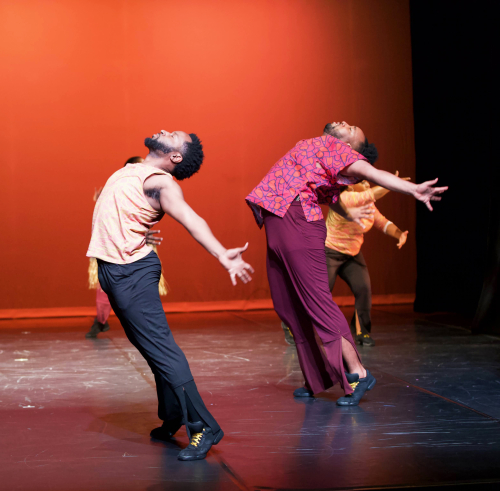
ruminations features textile-art costumes designed by Tiersa Nureyev and richly textured spoken word performances of original poems by Jordon E. Dabney and Ziyad. The work opens with Dabney and Ziyad sitting on opposite ends of the stage as the dancers in shades of orange, brown, and pink enter through the audience. A voiceover references “Hands Up. Don’t Shoot” as dancers sprint across the stage, the poem inviting us to see the running as “recess, tag your it, ready set go” and as traumatic flight at the same time. Gestures of protest and submission appear in counterpoint with soaring leaps. The dancers embody themes of incessant motion and the desire to slow down, of invisibility and hypervisibility—an invisible weight pushes a dancer down while others stagger, shake, and twitch.
ruminations reflects on the challenges of living as a Black person in an antiblack society; it also pushes back against the neoliberal glorification of the individual as uniquely responsible for their success or failure. There is a lot of individual movement expression juxtaposed against the group, a vision of an ensemble, of a community that holds its members tightly or loosely depending on need. The work ends with the gestural phrase we learned and a joyful step-touch phrase.
After intermission and a video homage to Black dancers lost in recent years, edited by Hester, the company brought down the house with another Bay Area premiere, Dai Zoe Bush–The Breaking of the Poro & Sande Bush, choreographed by Liberian dance and music artist Nimely Napla. Poro and Sande refer respectively to the male and female members of the Vai and Gola communities of West Africa. The work brought the company together with the Rites of Passage youth program dancers in traditional regalia designed and constructed by Napla. (Rites of Passage is an educational outreach program that serves youth ages 8-18.)
A trio of drummers (Eric Bli Bi Gore, Mohamed Kouyate, and Napla) ignite the “ceremonial dance rhythms of Vai and Gola people from Liberia's remote Grand Cape Mount County” (program note). The dance tells the story of a ceremony performed by a female “Jennet” who initiates girls into womanhood in the forest. One day, Jennet is killed by a leopard. The performance enacts communal grieving and the way memory lives in the body. We see embodied connection as the dancers across generations share vocabularies and rhythms.
During a pedagogical scene between Jennet and the youth group, the dancers form a circle, a cypher, and the audience is enlivened and emboldened to shout. This isn’t a cheeky aside that breaks the fourth wall but rather a form of call and response that lies at the center of Black dance, what scholar Thomas DeFrantz calls “corporeal orature”: “Dances offer greeting and debate; a mode of cultural identification and recognition which links African Americans in corporeal orature. […] The call and response mode of performance embraces an inclusionary aesthetic of creativity and invention, in that ‘call-and-response implies that every part of the community is important to its continuity and richness, that everyone has a voice and, through it, the power to act, enact, react’ (Gottschild, 1996: 144)” (DeFrantz in Lepecki 2004).
Dimensions dancers demonstrate the ways bodies are inhabited by lineages. The evening invited the audience to recognize and revel in the complex root system that constitutes African diasporic dance. Equal parts technique and heart–especially those kids in white, smiling broadly while losing their hats and leg bands without missing a beat—Dai Zoe Bush was the perfect way to celebrate 50 years of art, community, and love. I hope folks and funders keep investing in this extraordinary company so they can reach their centennial and beyond.
Sima Belmar, Ph.D., is a Lecturer in the Department of Theater, Dance, & Performance Studies at the University of California, Berkeley, and creator/producer/host of the ODC podcast Dance Cast.

 Life as a Modern Dancer
Leave a comment